

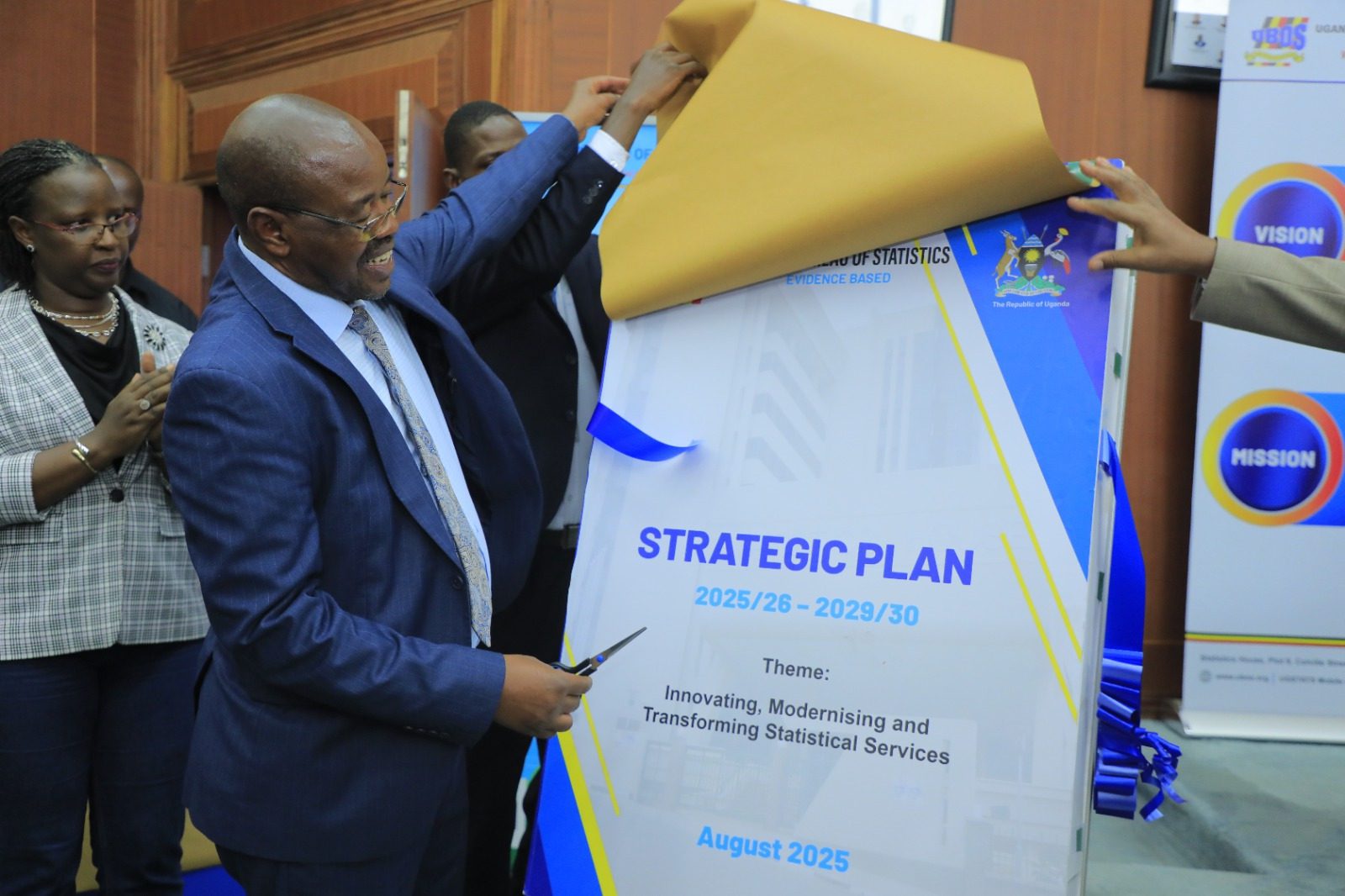
Uganda is making a decisive push to replace guesswork with hard evidence. As the country chases an ambitious tenfold economic expansion, the Uganda Bureau of Statistics (UBOS) has launched three major strategic frameworks designed to close data gaps, tighten public accountability, and ensure government money goes where it is actually needed.
Unveiled during Africa Statistics Week 2026 (running November 12–20), the newly released documents—the Fourth Plan for National Statistical Development (PNSD IV), UBOS Strategic Plan IV, and the UBOS Service Delivery Standards—signal a new era in how Uganda collects, protects, and uses national data.
For years, Uganda has improved its ability to gather numbers, yet turning those figures into smart policy has remained a stubborn hurdle. Reflecting on the country’s early planning days, State Minister for Finance and Planning Amos Lugoloobi noted that planners once had to rely heavily on rough estimates and foreign data to draft the first National Development Plan.
Today, the challenge is ensuring leaders actually use accurate numbers rather than manipulating them for personal or political gain.
“At times people use figures to obtain their own interests deceptively. For example, someone says, ‘we are going to serve 5,000 people,’ yet the area has only a few people. We need to have the right figures for what we are going to do.” Amos Lugoloobi, State Minister for Finance and Planning
To stop inflated figures from distorting national budgets, Lugoloobi urged ministries and government agencies to integrate verified data into every stage of planning—and to adopt artificial intelligence (AI) and big data analytics to sharpen how information is applied.
The urgency of reliable statistics goes far beyond economic spreadsheets; it directly affects daily survival. Tied to this year’s African Statistics Day dialogue on November 18, UBOS is spotlighting how accurate data can fix water and sanitation gaps and shield communities from climate shocks.
According to UBOS Deputy Executive Director Dr Vincent Fred Ssenono, raw access numbers can hide dangerous realities:
While over 80% of Ugandan households get their water from improved sources, access does not equal safety.Findings from the 2022 Uganda Demographic and Health Survey show that 89% of Ugandan households remain at risk of waterborne diseases due to contamination and In rural communities, that risk jumps to a staggering 93%.
To help local leaders target investments accurately, UBOS has partnered with district governments to roll out a new digital mapping application that pinpoints water sources across jurisdictions, ensuring clean water projects reach the communities left behind.
UBOS Executive Director Dr Chris Mukiza emphasized that statistics must be treated as a “strategic national asset” rather than a routine bureaucratic checkbox. Aligned with the Fourth National Development Plan (NDPIV), the UN Sustainable Development Goals, and the African Union’s Agenda 2063, the three new documents overhaul how the bureau operates:
“The service delivery standards and guidelines will help us deliver the outputs we have highlighted in the strategic plan,” said Thomas Rutaro, UBOS Director for Methodology and Statistical Coordination Services. “They will enable you to hold us accountable on what we promise to deliver.”
Alongside policy reforms, UBOS is tearing down barriers to public access. Principal Officer Ivan Kanyeheyo noted that strict response timelines will keep the bureau agile as technology evolves, while Head of Digital Solutions Ivan Atwiine highlighted that citizens, investors, and researchers can now pull official figures directly from the data dissemination portal on the UBOS website.
Beyond the boardroom, UBOS is marking Africa Statistics Week with a broader push to engage the public—hosting a professionals’ seminar, a students’ symposium, a sports gala, blood donation drives, and tree-planting campaigns. Together, these efforts aim to cement a simple truth: if Uganda wants to multiply its economy tenfold, every shilling and every policy must start with the facts.
