

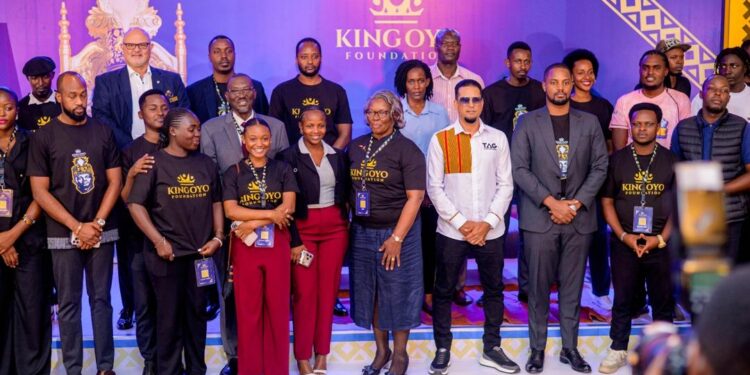
The family of the late Tooro King Oyo Nyimba Kabamba Iguru Rukidi IV will officially launch the King Oyo Foundation on December 15 at Speke Resort Munyonyo, with President Yoweri Museveni expected as the guest of honour.
Announcing the launch on Monday, November 16, at a press conference at the Sheraton Kampala Hotel under the theme “Preserving the Legacy,” the foundation’s Chief Executive Officer and former Tooro Prime Minister, Steven Nyabongo Rwakijuma, said the initiative is designed to carry forward the late monarch’s lifelong commitment to community progress.
Born on April 16, 1992, King Oyo made history on September 12, 1995, when he ascended the Tooro throne at just three years old. Over a nearly 31-year reign spanning from 1995 to 2026, he transformed his early responsibility into decades of active service, earning international recognition for championing youth empowerment, modern agriculture, environmental conservation, and public health.
“It is born out of the conviction that although a life may end, the good that a person stood for need not end with it,” Rwakijuma said.
To sustain the late king’s vision, Rwakijuma explained that the foundation will operate across four core pillars: youth empowerment, tourism and conservation, health initiatives, and the establishment of the King Oyo Tooro Museum.
Throughout his life, King Oyo leveraged his platform to drive tangible change across Eastern and Southern Africa. In 2016, he took on a prominent role with UNAIDS to advocate for ending HIV among young people—an effort for which UNAIDS formally recognised him in 2026.
On the home front, he spearheaded community health drives, including free eye-care camps in Tooro that restored sight to residents, and championed agribusiness through initiatives like King Oyo’s Model Farm to demonstrate commercial farming as a pathway to household prosperity. Environmentally, he was a vocal advocate for protecting natural ecosystems, notably rallying communities in 2019 for the Save River Mpanga Now clean-up and conservation campaign.
Former Tooro Kingdom minister Joan Kantu Adyeri noted that tourism and environmental stewardship were among the late king’s greatest passions, recalling the royal tours he organised to promote the region’s natural wonders.
“We visited the hot springs, Kibale, Bwindi and the Rwenzori Mountains, among other places,” Adyeri said, adding that the monarch frequently spoke of creating an institution that would endure for future generations. “He always talked about the future. He always talked about the children and his grandchildren. That is why the King Oyo Foundation is important to us.”

Rwakijuma emphasised that the foundation is strictly a developmental and cultural body—not a political institution or an alternative kingdom—and will steer clear of matters regarding Tooro’s leadership and succession. Instead, it will collaborate closely with the Tooro Kingdom leadership, the Ugandan government, and development partners.
“Our role is different, but equally important: to ensure that King Oyo’s life, values, achievements and aspirations are preserved and carried forward for generations,” Rwakijuma stated.
Prince Patrick Mpuuga Akiiki, speaking on behalf of the royal family, echoed this sentiment, noting that the family fully supports the foundation as a constructive way to channel their grief into lasting societal benefit. “This is not in any way intended to cause division. We intend to work with very many stakeholders, including the kingdom and the government,” Mpuuga said.
A flagship project of the foundation will be the King Oyo Tooro Museum, which will feature two branches: one at the late king’s former residence in Buziga, Kampala, and another in Tooro.
According to Rwakijuma, the museum will house King Oyo’s personal collections, speeches, historical documents, photographs, and royal artefacts. It will utilise interactive exhibitions and digital storytelling to engage both physical visitors and global online audiences.
“We want younger people who never had the opportunity to meet King Oyo to feel inspired by his story. We want them to understand that leadership is not merely about titles and privileges, but about responsibility, compassion, courage and service,” he said.
Ali Alibhai, the board member overseeing partnerships, events, and marketing—who previously collaborated with King Oyo through Talent Africa Group on the annual Mpango coronation anniversary celebrations—invited broad collaboration to scale the foundation’s reach.
“We welcome corporate partners who can bring resources and expertise, media partners who can help tell these stories, and government and international partners who can help us reach more communities,” Alibhai said.
Members of the public can register to attend the December 15 launch, sign up to volunteer, or pledge financial support via the foundation’s official website at www.kingoyofoundation.org. Details regarding a separate regional launch in Tooro will be announced at a later date.
“King Oyo may no longer walk among us, but his legacy can continue to walk with us,” Rwakijuma concluded.
