

The government has challenged the Uganda Bureau of Statistics (UBOS) to embrace Artificial Intelligence (AI) and Big Data analytics to transform Uganda’s vast data surplus into practical economic growth.
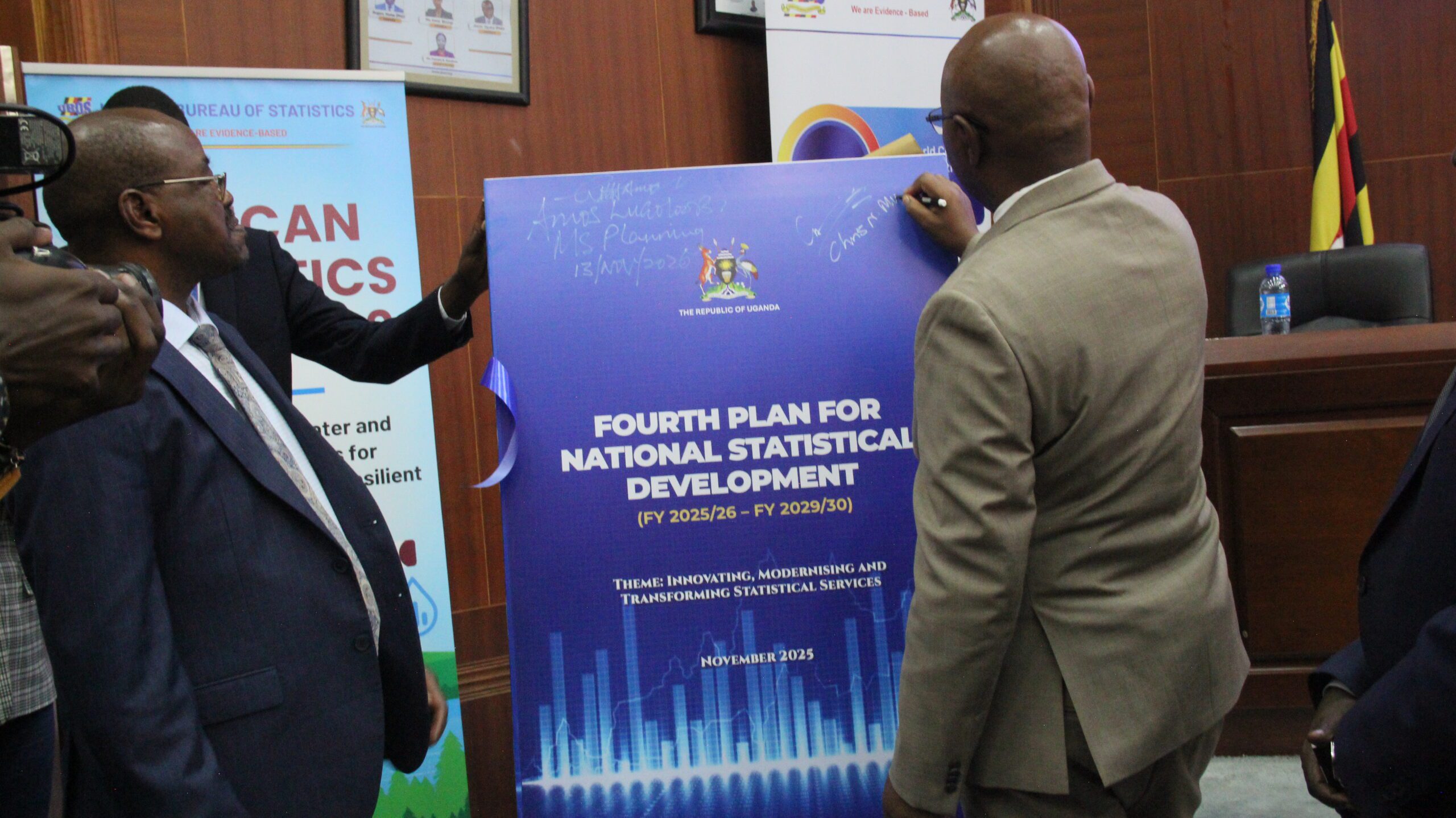
Speaking at the launch of the Bureau’s new five-year strategic blueprint (2025/26–2029/30) during Africa Statistics Week 2026, the Minister of State for Planning, Hon. Amos Lugoloobi, urged public institutions to stop merely archiving statistics and start using them to drive President Yoweri Museveni’s tenfold economic growth strategy.
Minister Lugoloobi noted a dramatic shift in Uganda’s planning landscape. While early National Development Plans suffered from severe data gaps, the government now faces the exact opposite challenge.
“Today, we are instead choking on an oversupply of data from UBOS,” Lugoloobi observed. “The stakes have shifted to an extent that some data is instead being underutilised. This is a good problem.”
To turn this statistical abundance into measurable development outcomes under the Fourth National Development Plan (NDP IV), the Minister outlined urgent priorities:Investing in AI, Big Data analytics, and automated systems to modernize data processing,asked all Ministries, Departments, Agencies (MDAs), and Local Governments to establish functional statistics units to eliminate duplication and finally to translate raw census numbers into smarter resource allocation and sharper economic policies.
The newly launched framework includes the Plan for National Statistical Development (PNSD) IV, the UBOS Strategic Plan IV, and updated Service Delivery Standards.
Representing Board Chairman Dr. Albert Byamugisha, UBOS Executive Director Dr. Chris Ndatira Mukiza described the new Service Delivery Standards as a “social contract with citizens.” The charter guarantees predictable service timelines, user-friendly digital platforms, and transparent access to data for researchers, businesses, academia, and the media.
The digital overhaul comes as UBOS aggressively expands its national data repository. Recent and upcoming milestones driving this data boom include:the 2024 National Population and Housing Census, the 2021 Livestock Census, the May 2025 Aquaculture Census, and the 2025 Baseline Education Census and the Uganda Census of Agriculture Crop Report (2027/2028) and the Census of Business Establishments.
Africa Statistics Week 2026 runs from November 12 to 19, rallying public and private stakeholders to leverage credible statistics for better governance and public service delivery.
UBOS Executive Director Dr. Chris Ndatira Mukiza said the newly launched strategic documents provide a framework for strengthening the production, coordination and dissemination of official statistics in line with Uganda’s national development priorities.
Mukiza described reliable statistics as a strategic national asset that enables government and development partners to make informed decisions and improve citizens’ livelihoods.
He said the UBOS Strategic Plan IV places emphasis on credible, timely and disaggregated statistics as the foundation for sound policymaking, effective resource allocation and sustainable national development.
The PNSD IV, on the other hand, seeks to modernise Uganda’s statistical system through digital technologies, Big Data, geospatial analytics and automated systems to improve the speed, accuracy and efficiency of data collection and dissemination.
The plan also prioritises stronger coordination among Ministries, Departments, Agencies and Local Governments to eliminate duplication, harmonise statistical methodologies and build institutional capacity across the National Statistical System.
Mukiza said the Board is committed to ensuring that official statistics directly support national development plans, regional integration agendas and the localisation of Sustainable Development Goals (SDGs).
He urged UBOS management and staff to take ownership of the strategic documents, uphold professionalism and treat every data user with transparency, responsiveness and respect.
Beyond strengthening data production, the new Service Delivery Standards seek to improve accountability and make official statistics more accessible to the public.
Mukiza described the standards as a social contract with citizens, pledging transparency, responsiveness and professionalism in the Bureau’s execution of its mandate.
The standards provide for predictable service timelines, user-friendly platforms and accessible official statistics for researchers, businesses, academia, the media and the general public.
