

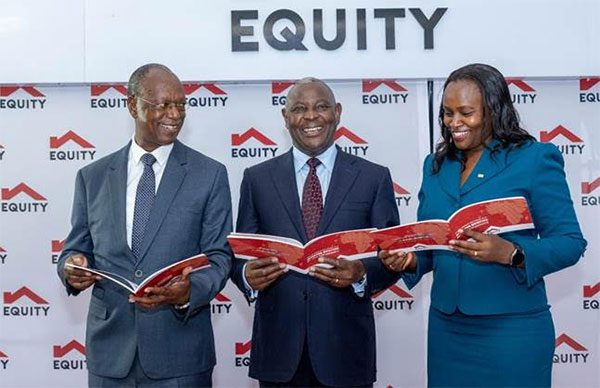
Equity Group Holdings reported a 32% increase in first-half 2026 profit after tax, reaching KSh 45.5 billion ($352 million) up from KSh 34.6 billion during the same period in 2025. This growth was anchored by strong regional subsidiary performance, a 25% rise in total income to KSh 124.9 billion, and higher non-funded income
For the six months to June rose to KSh45.5bn ($352m) from KSh34.6bn a year earlier, while pre-tax profit climbed 39 percent to KSh57.8bn. The results exceeded the group’s own guidance on nearly all measures, it said.

Total income grew 25 percent to KSh124.9bn, driven largely by a 36 percent jump in non-funded income — earnings from fees, transactions, foreign exchange and other services rather than lending — to KSh55.6bn. That stream now accounts for 44.5 percent of the group’s income, up from 40.8 percent a year earlier, a shift Equity said reflects its spread across multiple business lines and markets.
The balance sheet expanded 20 percent to KSh2.16 trillion, supported by a 21 percent rise in customer deposits to KSh1.59 trillion and a 19 percent increase in net loans to KSh981bn. Shareholders’ funds rose 27 percent to KSh350bn.
Dr James Mwangi, Equity’s group Managing Director and chief executive, said the performance was the product of a multi-year effort to reposition the bank around regional expansion and technology.

“Our H1 2026 performance reflects the success of our deliberate transformation into a diversified, regional, technology-enabled financial services group,” Mwangi said. He described the strategy as moving “beyond traditional banking” toward an institution that “mobilises capital, connects ecosystems, and accelerates inclusive, sustainable prosperity across Africa.”
Equity, which operates in Kenya, Uganda, Tanzania, Rwanda, South Sudan and the Democratic Republic of Congo, said its subsidiaries outside Kenya now generate 42 percent of the group’s banking profit and 52 percent of its revenue.
Equity Bank Tanzania led the growth, with profit after tax up 82 percent to KSh2.0bn, while Equity BCDC in DR Congo posted a 30 percent rise to KSh11.8bn — the largest single subsidiary contribution after the Kenyan business. Equity Rwanda grew profit 12 percent to KSh2.9bn.
In Kenya, still the group’s biggest market, the flagship bank reported a 32 percent increase in profit to KSh25.7bn. Equity said the unit recorded double-digit quarterly loan growth for the first time since 2021, a signal that credit demand in the country is recovering after a prolonged squeeze.
 Mwangi said the results were unfolding against a backdrop of relatively strong regional economic expansion, citing projected 2026 growth of between 4.5 and 5 percent in Kenya, 6.4 percent in Uganda and 5.9 percent in Tanzania. Those figures are government and multilateral projections rather than outcomes.
The group’s insurance arm continued to grow, with gross written premiums up 24 percent to KSh6.4bn and pre-tax profit up 34 percent. Equity said insurance was becoming “a meaningful third pillar of growth” alongside banking and payments, with 79 percent of policies sold through digital channels.
Equity said 98.3 percent of all transactions now take place outside branches, with 89.7 percent processed through digital platforms serving 23.3 million customers. The bank has also invested heavily in artificial intelligence training for staff: it said 82 percent of employees had completed a generative AI course, together logging almost 120,000 hours of instruction, while 406 staff had been admitted to master’s programmes in financial engineering and applied AI through WorldQuant University.
Asset quality improved over the period. Non-performing loans fell to 9.5 percent of the book from 13.7 percent a year earlier, which Equity attributed to tighter underwriting and a more diversified portfolio. The cost-to-income ratio improved to 48.6 percent from 51.7 percent, while return on equity reached 26.5 percent.

Through the Equity Group Foundation, the bank said it had trained more than one million entrepreneurs and facilitated over KSh436bn in credit to small and medium-sized businesses, and that it supports more than 11,600 secondary-school scholars under its Wings to Fly and Elimu programmes.
Equity said the Foundation had planted more than 48.7 million trees and had secured accreditation to the Green Climate Fund as a direct access entity, which it said would allow it to channel international climate finance into projects across the region. The bank framed the work as advancing its mission of “transforming lives and livelihoods” — language that reflects Equity’s own positioning of its social and environmental programmes.
Mwangi said the group was targeting operations in 15 countries and 100 million customers by 2030 under its Africa Recovery and Resilience Plan, backed by further investment in digital and AI systems.
