

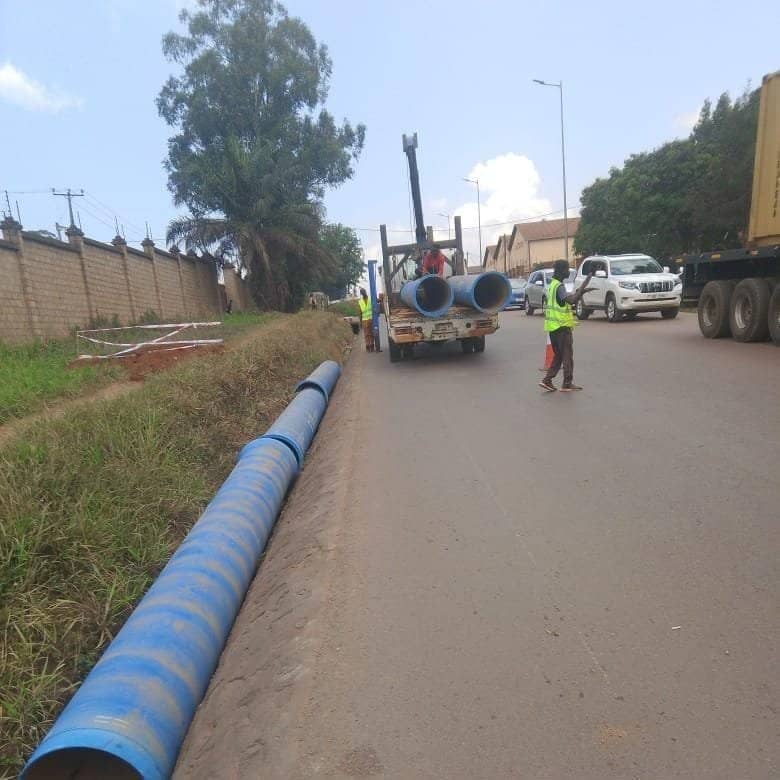
The Government of Uganda and the National Water and Sewerage Corporation (NWSC) are on track to complete the Katosi–Mutungo Water Supply Improvement Project by November 2026. This strategic infrastructure upgrade will transfer Mutungo’s water demand from the heavily strained Muyenga network over to the high-capacity Katosi system.
By shifting this load, the project will instantly free up capacity within the Muyenga system. This ensure a more stable, reliable, and consistent water supply for households, businesses, and institutions across the Greater Kampala Metropolitan Area
Currently, the Mutungo service areas are served by the Muyenga system. The project is designed to facilitate the transfer of these service areas to the Katosi water supply system, thereby reducing the load on the Muyenga system and improving overall supply reliability within its service areas.
According to the projects details,the works involves the laying of approximately 3.8 km of DN600 DI pipeline from Seeta to Namanve. Upon completion, approximately 708 m³/hr of demand will be transferred from the Muyenga system to the Katosi system, thereby creating additional capacity within the Muyenga system.
The improved capacity and operating levels within the Muyenga system are expected to enhance water supply reliability in the following areas:
Rubaga, Lungujja, parts of Wakaliga Road, Busega, Natete, Ndebba, Mutundwe, Nalukolongo, Makindye, Salaama Road, Busabala, Mutesa I Road, Sentema Road, Rusaze, Mackay Road, Mbubi Road, Kamanya, Kitinzi, Kibumbiro, Albert Cook, Sekabakintu Road, Gumotoka and Kabuusu.
Bulenga, Buloba, Bulaga, Wotansimbi, Bukasa, Buyala, Kyebando, Gganda-Nasere, Kamu-Kamu, Bujjuko, Kawoko, Gombe-Kitasa, Naluvule, parts of Ssenge, Kabulengwa, Kireka-Biira, Nakabugo, Kigoma and Kayunga.
Overall, the project will contribute to improved water supply reliability, increased system capacity and greater supply flexibility between the Katosi and Ggaba systems, particularly benefiting customers in the above-mentioned areas.
The Government is working around the clock to complete the project by November 2026 and Upon completion, the project is expected to increase system capacity and provide greater supply flexibility, helping NWSC improve service reliability for customers in the targeted areas.
Greater Kampala’s rapid urban expansion and an outdated distribution network are the primary causes behind the city’s ongoing water pressure and scarcity woes. While the National Water and Sewerage Corporation (NWSC) has expanded raw water treatment capacity—most notably through the Katosi Water Treatment Plant the underlying issue is a severe bottleneck in network distribution and pipe capacity, rather than an overall lack of water.
The primary factors driving Kampala’s persistent water pressure and supply issues include the undersized and aging colonial-era pipes that cannot handle or adequately distribute the full daily volume of treated water to rapidly growing suburbs,Grid fluctuations and national blackouts where a 1-hour power outage requires up to 6 hours to stabilize system pressure.
