

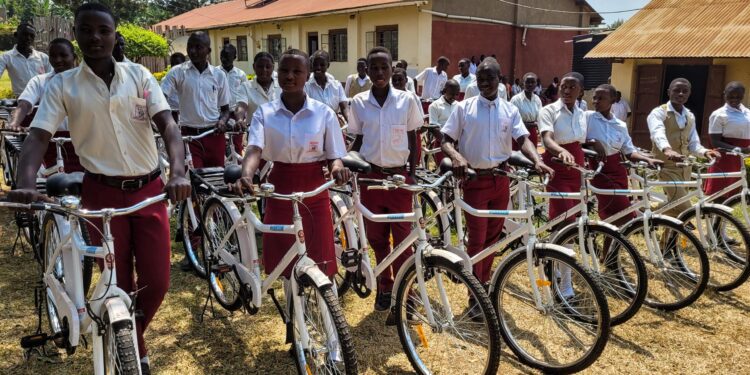
Hundreds of learners in Kamuli and Kyegegwa districts are enjoying studies following the rollout of a bicycle programme aimed at reducing the burden of long journeys to school.
CooP Uganda, Enabel, the Ministry of Education and Sports, the European Union and the Government of Belgium offered a total of 458 bicycles to nine secondary schools under the WeLearn WeTeach Bicycle Empowerment Programme 2026–2027 under the WeLearn WeTeach Bicycle Empowerment Programme 2026–2027,
According to officials the programme has provided 208 bicycles to four secondary schools in Kyegegwa District and 250 bicycles to five secondary schools in Kamuli District.

Speaking during the handover ceremonies, CooP Uganda General Manager Kabaale Edgar said the programme is designed to keep more children in school and improve their chances of completing their education.
“A bicycle may look simple, but for many learners it means arriving at school on time, attending classes consistently and staying in school longer. This programme is about dignity, opportunity and keeping education within reach,” he said.
He further The bicycle initiative seeks to address these challenges by introducing a structured Bicycle Management System, enabling schools to manage the bicycles fairly and sustainably while ensuring they benefit the learners who need them most.
The bicycles were distributed to Rwentuha Seed Secondary School, Mpara Secondary School, Kakabara Secondary School and Kibuye Secondary School in Kyegegwa District, while learners in Kamuli District will access them through Namasagali College, St John Bosco Secondary School, St Paul Secondary School Mbulamuti, Bulopa Secondary School and Luzinga Secondary School.

Kabaale said beyond providing transport, the programme is equipping schools and communities with the knowledge and skills needed to maintain the bicycles and ensure their long-term use.
Enabel Project Manager Joeri Leysen said the programme’s success depends on community involvement and changing attitudes towards girls riding bicycles.
“We engaged communities directly on cultural attitudes around girls cycling because lasting impact only comes when communities support the solution. Better transport for girls means better attendance, improved safety and stronger chances of completing school,” he said.
Under the programme, schools are encouraged to ensure that at least 40 percent of the bicycles are allocated to girls, while communities are being encouraged to embrace cycling as a practical solution to improving access to education.
The initiative also includes ongoing research to assess its impact on learner attendance, punctuality, retention, safety and academic performance. The findings are expected to inform future efforts to expand sustainable transport solutions within Uganda’s education sector.
The programme now moves to Adjumani District, where the next phase will run from June 29 to July 3, 2026. During the exercise, 260 bicycles will be distributed to learners at Pagirinya Secondary School, Adjumani Secondary School, Dzaipi Secondary School, Lewa Secondary School and Ofua Seed Secondary School, benefiting both refugee and host communities.
In addition to bicycle distribution, school bicycle management committees will receive training on fleet management, learners will participate in practical cycling and maintenance sessions, and five local mechanics will be trained to provide long-term bicycle repair services within the district. Learner-led cycling clubs will also be established, while action research will begin to monitor improvements in attendance, punctuality, learner safety and retention.
Upon completion of the Adjumani phase, the programme will have distributed 728 bicycles across 14 secondary schools in three districts, marking a major milestone in expanding access to education through sustainable mobility. Beyond improving transportation, the initiative is expected to transform the daily school journey for hundreds of learners, replacing long, exhausting walks with a safer and more reliable means of reaching the classroom.
Enabel the Belgian development agency has partnered with the Ministry of Education to improve secondary education and vocational training across Uganda. Their programs focus on elevating teacher training, equipping youth with life and employability skills, and integrating digital innovations like Virtual Reality IN training Institution
