

In the shadow of Uganda’s premier large-scale gold mine, a different kind of wealth is being unearthed.
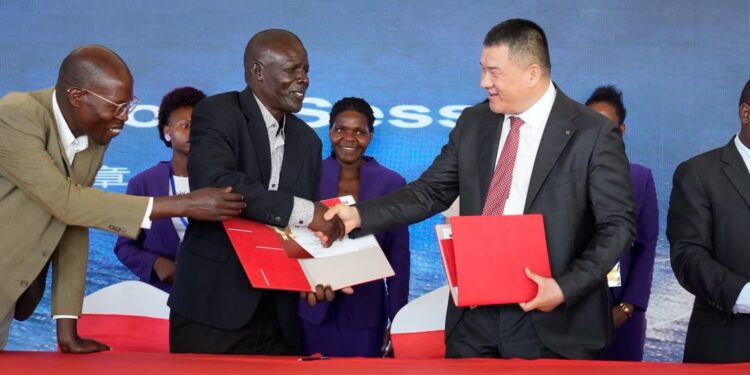
On Friday, Wagagai Mining (U) Limited officially handed over the keys to the brand-new, Shs3.8 billion Alupe Primary School and the newly reconstructed St. James Church of Uganda to the Busia District community. The state-of-the-art facility transforms what educators once described as an academic “desert” into a vibrant learning hub for 600 young learners.
“For us, success is not measured only by how much gold we produce, but also by what we leave behind,” says Tan Jiuchang, Wagagai’s general manager.

The handover marks a monumental chapter in the Wagagai Corporate Social Responsibility (CSR) Program, an initiative increasingly focused on education, community security, and sustainable infrastructure to balance the rapid industrialization of Mawero Parish.
For two and a half years, the Alupe community felt the literal and figurative tremors of the massive mine. Operational noise and structural cracks had forced the original school to close, displacing hundreds of pupils.
The reopening sparked an emotional outpouring from those who lived through the transition:
Philipine Adengero, Head Teacher: “Alupe was a desert—a place with no teachers, no learners, and no finances. But today, we celebrate its transformation.”
The Rt. Rev. Samuel George Bogere Egesa (Chief Guest & Bishop): Speaking at the handover, Bishop Egesa urged the mining leaders to remember that host communities must remain the primary beneficiaries of resource wealth, commending the project for restoring a place of worship alongside the classrooms.

Benard Opoloti, Busia Deputy Chief Administrative Officer (CAO): “Many government schools continue to struggle with land disputes caused by encroachers. Wagagai’s timely intervention—including their broader plans to safeguard school lands—helps curb conflicts and protect public assets.”
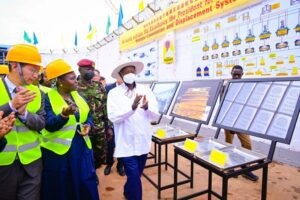
Alupe Primary School sits next to a massive Shs940 billion ($150 million) gold mining and refining operation. Commissioned by President Yoweri Museveni on August 16, 2025, the facility is operated by Wagagai, a subsidiary of China’s Liaoning Hongda Enterprise Group.
While the mine taps into an estimated 30 million tonnes of gold ore, local leaders emphasize that the school represents an investment designed to outlast the resource itself.
The new Alupe Primary School campus features eight modern classrooms, a fully equipped library, staff quarters, its own perimeter wall, and a dedicated safe water source. This model builds on Wagagai’s evolving CSR portfolio across Busia, which includes:educatiuonal safety,vulnerable student support and clean water grid.
 A phased initiative to fence vulnerable government schools like Mawero Primary School, protecting learners from tresspassers.
Financial backing and scholarship funding for orphans and low-income students within the district to cover school requirements.
Extending safe, clean water pipelines to four neighboring villages adjacent to the mining perimeter.
The economic footprint of the project remains undeniable. Wagagai has injected massive utility into the region, employing over 2,000 Ugandans and aligning its integrated refinery with the Bank of Uganda’s national gold purchase program under the Uganda Vision 2040 framework.
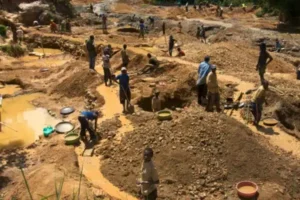
Yet, the rapid transition from a quiet border district to a mining powerhouse has come with distinct growing pains. Wagagai continues to navigate local friction, including lingering compensation grievances with local families, the displacement of traditional artisanal miners, and calls from the Iteso Cultural Union for a fairer distribution of mining royalties.
The mine’s lifespan is finite, estimated at 20 to 30 years. But by trading gold from the earth for the long-term education of Busia’s children, the community and corporation alike hope to build a legacy that will never run dry.


The celebration surrounding the newly built Shs3.8 billion campus is deeply rooted in the painful memory of its near-extinction. The journey of Alupe Primary School from a top-tier educational beacon to an abandoned ghost school, and finally to a state-of-the-art facility, serves as a poignant blueprint for industrial displacement and corporate responsibility in Uganda
Founded in 1997 as a community school under the Anglican Church Foundation, Alupe became government-aided in 2003. For years, it was the crowning jewel of Buteba Sub-county. With an enrollment that grew to nearly 800 pupils, Alupe was an academic powerhouse, routinely registering double-digit First Grades in the Primary Leaving Examinations (PLE) and outcompeting prestigious local rivals.

The school’s fortunes changed drastically when Wagagai Mining (U) Limited established its sprawling gold mining infrastructure right at Alupe’s doorstep. Soon, the heavy machinery began tearing into the earth, producing unbearable decibel levels that shattered the classroom environment.
The structural impacts were immediate,massive, dangerous cracks split open the classroom walls due to drilling vibrations.
The mine expanded its perimeter, fencing off entire sections of the premises and physically cutting off students’ safe access to their school.
Terrified of the structural risks and unable to teach over the roar of mining equipment, parents pulled their children out. Enrollment Plummeted. In a shocking decline, a school built for hundreds dwindled down to just two pupils, forcing the government to officially shut its doors. Scores of children dropped out entirely, while families who could afford it crossed the border to enroll their children in Busia, Kenya.
Wagagai initially agreed to fund a total rebuild, but the project ground to a halt over a bureaucratic roadblock. Busia District struggled to raise roughly Shs500 million from its internal revenue streams to secure the necessary 3.5 acres of land away from the mine, as stringent conditional grant laws restricted the reallocation of public funds. For nearly two years, displaced pupils were left stranded in makeshift shelters, drawing sharp criticism from civil society groups like OXFAM over the human cost of mineral concessions
The gridlock broke when district authorities finally secured the new plot in Alupe Village. Wagagai stepped in aggressively, investing over Shs4 billion into the school infrastructure and adding another Shs700 million to reconstruct the historic St. James Church.
Today, the perimeter walls of the new Alupe protect students not just from structural hazards, but from the encroachers that threaten many public schools in the region. The pupils who scattered to Kenya are returning home, finding an oasis built upon the very soil that once drove them away
