

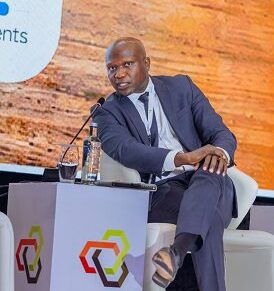
dfcu Bank as called for the urgent establishment of a dedicated mining risk-sharing mechanism to drive capital into Uganda’s rapidly growing minerals sector. Financial leaders argue that robust, collective risk mitigation frameworks are essential to attract major investors and secure long-term, sustainable growth for the industry.
The proposal was championed by Moses Malinga, dfcu’s Sector Head of Infrastructure and Energy, during a panel titled “De-risking the Mine” at the 15th Annual Mineral Wealth Conference and Expo held at Speke Resort Munyonyo.

Malinga proposed a structured mining risk pool that would allow insurers, commercial banks, and development stakeholders to collectively absorb and navigate sector-specific challenges. By spreading exposure, financial institutions can confidently back mining ventures through every phase of development—from high-risk initial exploration to active production.
Drawing a direct parallel to the collaborative consortium frameworks utilized in Uganda’s oil and gas industry, Malinga emphasized that the mining value chain must adapt similarly to expand access to credit.
“Mining projects carry different risks at every stage of development. Financial institutions must understand and appropriately mitigate these risks before deploying capital,” Malinga stated.

He added that insurance should transition from a basic lender-protection tool into a comprehensive, shared safeguard that builds deep confidence across the entire investment ecosystem. To support this, Malinga called for targeted investments into Uganda’s reinsurance capacity, enabling local insurers to retain more risk on their balance sheets and minimize reliance on expensive foreign markets.
The push for flexible capital comes at a critical juncture for Uganda’s economic planning. Also addressing the 1,112 delegates from 30 countries at the expo, the state minister for Minerals, Phiona Nyamutoro, highlighted the steep climb ahead for the industry current Mining Contribution to GDP: 2.2% and national Development Plan IV Target: 7.9% by 2029.
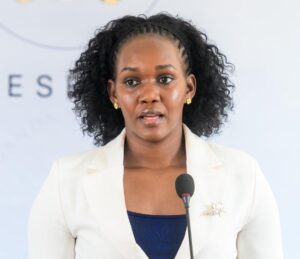
Minister Nyamutoro noted that closing this gap requires aggressive cooperation to implement actionable strategies across mining licensing, artisanal operations, geological data compilation, and skills development.
Maria Kiwanuka, Chairperson of the Uganda National Mining Company, stressed that clear governing rules are non-negotiable for foreign and local capital injection. She underscored the need for absolute clarity regarding State participation, specifically surrounding capital commitments, shareholder rights, and regulatory approvals.
“Predictable frameworks give investors certainty when assessing long-term project viability,” Kiwanuka remarked, while reinforcing that Uganda must pivot toward local processing, refining, and downstream industrial development rather than exporting raw, unprocessed minerals.
To bridge these gaps immediately, dfcu Bank continues to deploy a comprehensive value-chain banking model tailored to mining enterprises, incorporating asset financing, performance guarantees, and specialized foreign-exchange risk tools.
