


Hon. Joyce Nabbosa Ssebugwawo, the Minister of State for ICT and National Guidance has officially launched the U-Learn Platform along with the Uganda Human Rights Commission (UHRC) Case Management System to enhance teacher training and broaden access to justice, marking a practical step in digital transformation.
Both digital platforms were developed by the National Information Technology Authority-Uganda (NITA-U) as part of the Uganda Digital Acceleration Project (UDAP-GovNet), with support from the World Bank.

Speaking at the launch, Minister Ssebugwawo emphasized that digital transformation is not just talk but a practical effort to make government services faster and more accessible.
“I commend NITA-U, World Bank, Ministry of Education and Sports, Uganda Human Rights Commission and other partners who contributed to this initiative. Digital transformation is about using technology to make government services faster, responsive and accessible,” Minister Ssebugwawo said.
“I commend UHRC and the Ministry of Education and Sports for embracing ICT solutions. This shows Uganda is not just talking about digital transformation but putting it into practice. These are practical examples of how technology can improve the lives of Ugandans,” she added.

For many years, accessing basic government services required long trips, paying for transportation, filling out extensive paperwork, or waiting endlessly in line. These new platforms directly address those challenges for ordinary Ugandans. For teachers and instructors at Teacher Training Institutions, upgrading skills no longer requires traveling to distant towns or attending costly in-person workshops.
“Through the U-Learn Platform, educators can study online at their own pace on a smartphone or computer, gaining valuable training in pedagogy, digital skills, and financial literacy. Similarly, citizens seeking justice no longer need to travel to a UHRC office to submit paper complaints.,”she stated.
“Through the new digital system, anyone can lodge a complaint online, track case progress on a phone or computer, and receive updates directly from home,”she added.
The minister noted that U-Learn closes the long-standing gap between teachers in urban centres and those serving remotely but cautined that professional development should never depend on where a teacher is posted.

“ The UHRC Case Management System strengthens human rights protection by tracking every complaint from registration to resolution; a transparent digital trail replacing paper that could be lost, delayed or misplaced,”she explained.
She pledged her ministry commitment to provide the policy direction, digital infrastructure and strategic partnerships required for platforms such as these to succeed and scale.
“ Digital transformation must ultimately be measured by improved service delivery, greater inclusion and stronger institutions that remains our focus,”she stated.
The minister called upon all institutions, implementers and users to fully embrace these systems, ensure their effective use, and keep improving them for lasting impact.
“ Our teachers, human rights institutions and the wider public must take ownership of these platforms, so the benefits of digital government reach every part of the country,”she stressed.

Dr. Mugisha Annet Kajura, Commissioner for Teacher Education Training and Development at the Ministry of Education and Sports, explained the necessity of the new learning platform, noting that traditional in-person training is no longer practical for all teachers nationwide.
“Teachers, by policy, must be continuously taught, and sitting in a classroom somewhere is no longer efficient. That is why, through U-Learn, we added digital and financial literacy modules useful to teachers,” Dr. Kajura said.
“We thank NITA-U and other partners for supporting us to ensure that we attain the current Continuous Professional Development curriculum for teachers and trainers and making it accessible to all those with phones and computers,” she added.
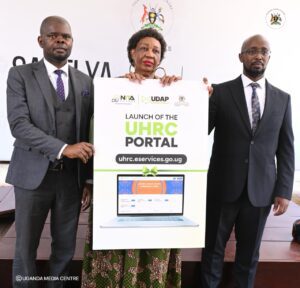
The Chairperson of the Uganda Human Rights Commission, Hon. Mariam Wangadya, praised the initiative, noting that replacing paper-based complaints with a centralized digital system will make human rights protection faster and more transparent.
“By receiving this platform, we are reaffirming our commitment to safeguard the rights and freedoms of all Ugandans. Ugandans can lodge their complaints and track their cases from wherever they are on their phones or computers,” Hon. Wangadya said.
The Executive Director of NITA-U, Dr. Hatwib Mugasa, revealed that the platforms prove local capacity and lower the cost of government operations.

“U-Learn was built in-house by Ugandans, so we reduced the cost. The system is scalable should there be a need to integrate with other systems in the future. This goes to show that Uganda has digital capacity,” Dr. Mugasa noted.
“The Uganda Human Rights Commission Case Management System addresses all the challenges they were facing, and the system is now flexible and has made information easy to access and the system easy to use for all.”
Dr. Mugasa added that both platforms demonstrate what is possible when government institutions embrace technology to serve citizens better, bringing public services directly to the people who need them most.
