

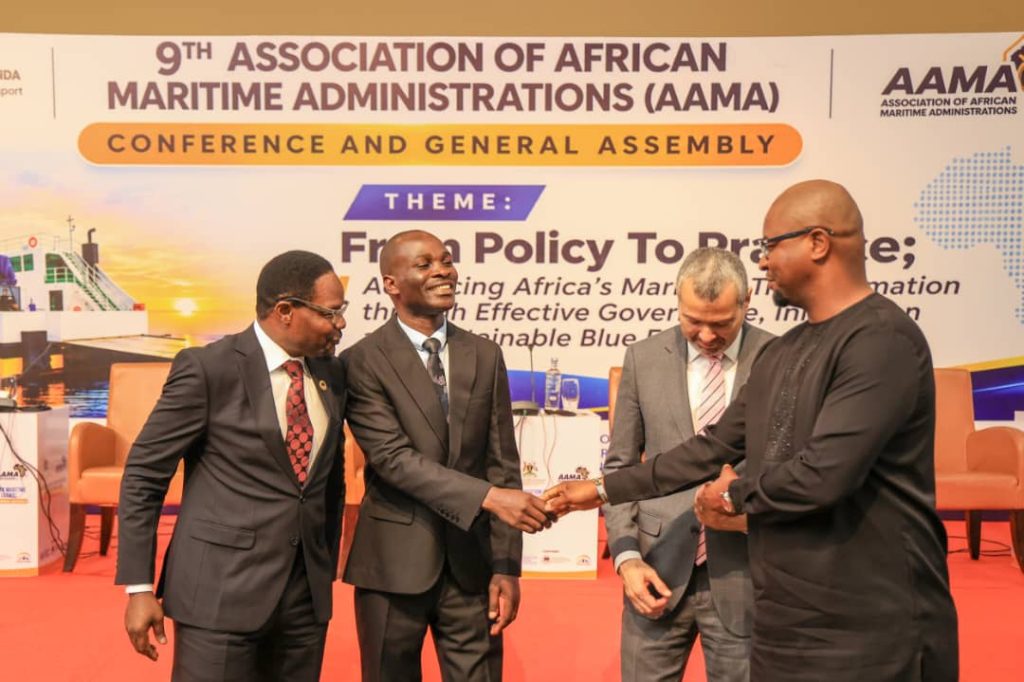
African nations have been challenged to move beyond drafting maritime policies and focus on strict implementation to boost regional trade, improve water transport safety, and create thousands of jobs for the continent’s youth.
The urgent call came on Tuesday, November 17, 2026, during the opening of the 9th Annual Conference and General Assembly of the Association of African Maritime Administrations (AAMA) at Speke Resort Munyonyo in Kampala.
Speaking at the event, Uganda’s Minister of State for Works and Transport, Hon. Fred Byamukama, noted that while Africa excels at creating regulatory frameworks, weak enforcement and underfunded institutions continue to stall real progress.
“For far too long, our continent has demonstrated considerable strength in developing policies, strategies and regulatory frameworks, yet we continue to face significant challenges in translating these commitments into tangible results,” Byamukama told delegates.
Held under the theme “From Policy to Practice: Advancing Africa’s Maritime Transformation through Effective Governance, Innovation and Sustainable Blue Economy,” the three-day summit has drawn maritime regulators, government officials, and private sector leaders from across the continent.
To give maritime affairs greater political weight, Byamukama urged the African Union (AU) to formally recognise AAMA as the official continental body coordinating maritime transport. He argued that AU recognition would help channel vital financing and high-level political backing into Africa’s blue economy.
Despite being land-linked, Uganda has positioned itself as a key player in regional maritime governance. Byamukama highlighted that Uganda recently became the 15th member state to ratify the Revised African Maritime Transport Charter—meeting the exact legal threshold required for the historic charter, originally adopted in Kampala in 2010, to finally enter into force.
Because Uganda relies heavily on the Kenyan port of Mombasa and Tanzania’s port of Dar es Salaam for international trade, the government is aggressively upgrading its domestic water and rail links.
Byamukama also warned that global geopolitical tensions—such as shipping disruptions in the Strait of Hormuz—demand stronger African solidarity to protect regional supply chains, energy security, and seafarer welfare.
Echoing the minister’s call for action, the Secretary-General of the International Maritime Organization (IMO), Arsenio Dominguez, challenged delegates to turn past conference resolutions into measurable results on the water.
Dominguez singled out domestic ferry safety as an immediate priority, urging governments to enforce regular vessel inspections, strict loading limits, crew training, and emergency preparedness to prevent recurring tragedies on African waterways.
To modernize the sector and cut the cost of doing business, the IMO chief urged African nations to embrace digital transformation, including Maritime Single Windows, electronic certification, and stronger cybersecurity. He also called for a fair transition to greener shipping and concrete action to bring more women into maritime leadership.

In remarks delivered on behalf of Ministry of Works and Transport Permanent Secretary Waiswa Bageya, Chief Mechanical Engineer Eng. Tibesigwa Timothy emphasized that Africa’s youthful population is a massive, untapped asset for the global shipping industry.
“Every African seafarer who secures employment aboard a vessel represents more than an individual career achievement. It represents a livelihood created, a family supported, valuable foreign exchange earned and professional experience that can ultimately strengthen our own maritime industry,” the statement read.
Tibesigwa called for increased investment in maritime training academies and international certification so young Africans can compete for high-paying jobs aboard global vessels while strengthening local operations on vital inland waterways like Lake Victoria.
The Kampala summit concludes on Thursday, November 19, and is expected to adopt a binding implementation framework complete with clear timelines, assigned institutions, and monitoring mechanisms to hold African maritime administrations accountable.
