


The National Animal Genetic Resources Centre and Data Bank (NAGRC&DB) has officially rolled out five ambitious roadmap documents designed to completely revolutionize livestock breeding, overhaul public service delivery, and put high-quality, affordable breeding stock directly into the hands of Ugandan farmers.
The high-profile launch, held at the NAGRC&DB headquarters in Entebbe, was presided over by the Minister of State for Animal Industry, Bright Kanyontore Rwamirama. He made it clear that the ultimate test of these new frameworks will be what happens on the ground, not the glamour of the launch day.
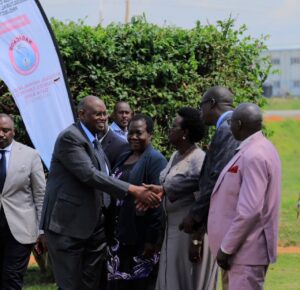
“The value of these documents will not be measured by the launch today,” Minister Rwamirama emphasized, challenging the institution to deliver clear, measurable benefits to local households. “Success depends entirely on how effectively these commitments are implemented.”
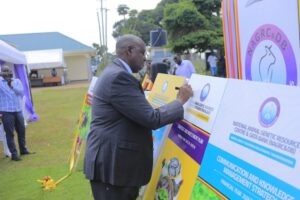
The Big Five: Uganda’s New Livestock Blueprints
The five newly launched documents establish a rigorous framework for the country’s agricultural future:
- The Strategic and Investment Plan (2025/26–2029/30): The primary roadmap driving the commercialization and scaling of livestock genetics.
- Uganda National Animal Breeding Strategy and Action Plan (NABSAP): A comprehensive framework to transform animal breeding into a climate-resilient, highly productive, and inclusive sector.
- The Client Charter (FY2025/26–2029/30): A firm commitment to consumer rights, accountability, and seamless complaint resolution.
- Service Delivery Standards (FY2025/26–2029/30): Strict, time-bound benchmarks designed to maximize efficiency for visiting farmers.
- Communication & Knowledge Management Strategy (2026/27–2030/31): A blueprint to bridge the information gap, ensuring data-driven farming practices reach the grassroots.
Supercharging the Parish Development Model (PDM)
At the heart of the five-year investment plan is a massive push to upgrade the livelihoods of ordinary Ugandans. NAGRC&DB farms and ranches are transitioning into high-tech multiplication and technology-transfer hubs. Working hand-in-hand with local governments, the agency will fast-track the breeding of dairy cattle, beef cattle, goats, pigs, poultry, and fish.
For farmers participating in the Parish Development Model (PDM), this means direct access to high-performance, climate-resilient genetics at highly subsidized prices. By anchoring PDM financing with premier breeding stock and expert technical support—covering everything from precision feeding to enterprise management—the initiative aims to rapidly increase household productivity and support Uganda’s broader agro-industrialization goals.

No More Waiting: Tough New Service Standards
To ensure farmers are treated with the respect and speed they deserve, the newly launched Service Delivery Standards and Client Charter introduce zero-tolerance rules for bureaucratic delays:
- 5-Minute Rule: Staff must attend to clients within five minutes of their arrival at any service point.
- 48-Hour Acknowledgment: All filed complaints must be formally acknowledged within 48 hours.
- 14-Day Resolution: Complex investigations into complaints must be fully wrapped up within 14 days.
- 5-Day Turnaround: Official written correspondence must receive a response within five working days.

A Vision of “Possibilities”
Speaking on behalf of the Board Chairperson, Eng. Robert Ssenozi, Board Member representing Central Region farmers, noted that this launch signals a shift from paperwork to real-world impact. “The launch is not just about unveiling documents. It is about launching possibilities,” Ssenozi stated.
Supporting this vision, Dr. Israel Mugezi from the National Planning Authority (NPA) highlighted that building a sustainable, high-yielding animal industry is foundational to Uganda’s aspirations under the Fourth National Development Plan (NDPIV)—including scaling up value-added exports like premium milk powder to the global market.
