

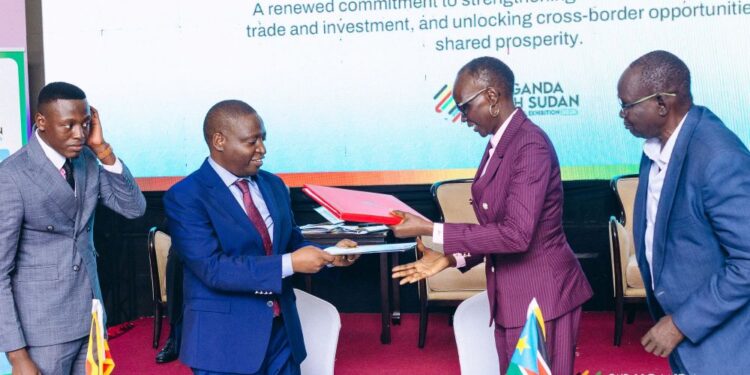
Uganda and South Sudan have signed a landmark Memorandum of Understanding (MoU) to boost bilateral trade and eliminate the costly bottlenecks choking the Kampala-Juba trade corridor. Signed at the second Uganda-South Sudan Business Forum and Exhibition at the Mestil Hotel in Kampala, the agreement arrives at a critical time. Officials are fiercely pressing for the removal of unofficial checkpoints, clearing delays, and duplicate charges that heavily inflate the cost of doing business.
The economic relationship between the two neighbors remains starkly one-sided. Uganda currently exports $524 million (£390 million) worth of goods to South Sudan, while South Sudan exports just $22 million back to Uganda. Uganda’s State Minister for Trade and Industry, David Bahati, noted that while the gap is partially due to population differences (Uganda’s 46 million versus South Sudan’s 12.4 million), deep institutional roadblocks must be cleared to foster mutual growth.

Ugandan Traders report severe bottlenecks along the Kampala-Gulu-Nimule-Juba corridor. Issues include duplicate assessments from South Sudan’s electronic permit (e-permit) system, continuous cargo verification, inconsistent clearance, and lack of matching infrastructure at the Nimule border to complement Uganda’s one-stop border post at Elegu.
South Sudanese Ambassador Paul Malong Akaro highlighted that South Sudanese traders lack direct access to Ugandan manufacturers, leaving them vulnerable to regional transportation monopolies. Furthermore, South Sudanese exporters face severe transit hurdles when moving dried fish through Uganda toward the Democratic Republic of Congo.
Ambassador Akaro defended the controversial e-permit system, noting it has successfully curbed tax evasion and boosted revenue collection since its joint rollout with the Uganda Revenue Authority.

Meanwhile, South Sudan’s Minister of Trade and Industry, Dr. Labanya Margaret Mathya, confirmed that a high-level committee appointed by President Salva Kiir is aggressively tackling non-tariff barriers. The country has already scrapped alien registration and simplified visa payments, though foreign workers will still require valid work permits.
Beyond immediate logistical fixes, the forum emphasized long-term economic integration:
Uganda spends $1 billion annually on steel imports (including $490 million on raw materials). Both nations possess vast iron ore deposits that could be jointly commercialized and Uganda aims to generate 40,000 to 50,000 megawatts of electricity over the next decade, prompting officials to encourage South Sudan to expand its grid network.
Minister Bahati warned that the success of the MoU must be judged “not by the signing ceremony alone” but by tangible job creation and barrier removal.
This diplomatic push follows a directive from Presidents Yoweri Museveni and Salva Kiir to harmonize customs, coordinate intelligence against border crime, and align operations under East African Community rules.
