

In a major bid to accelerate its economic transformation, the Government of Uganda has unveiled an aggressive suite of fiscal incentives for Thai investors, including 10-year tax holidays, full foreign business ownership, and unrestricted profit repatriation.
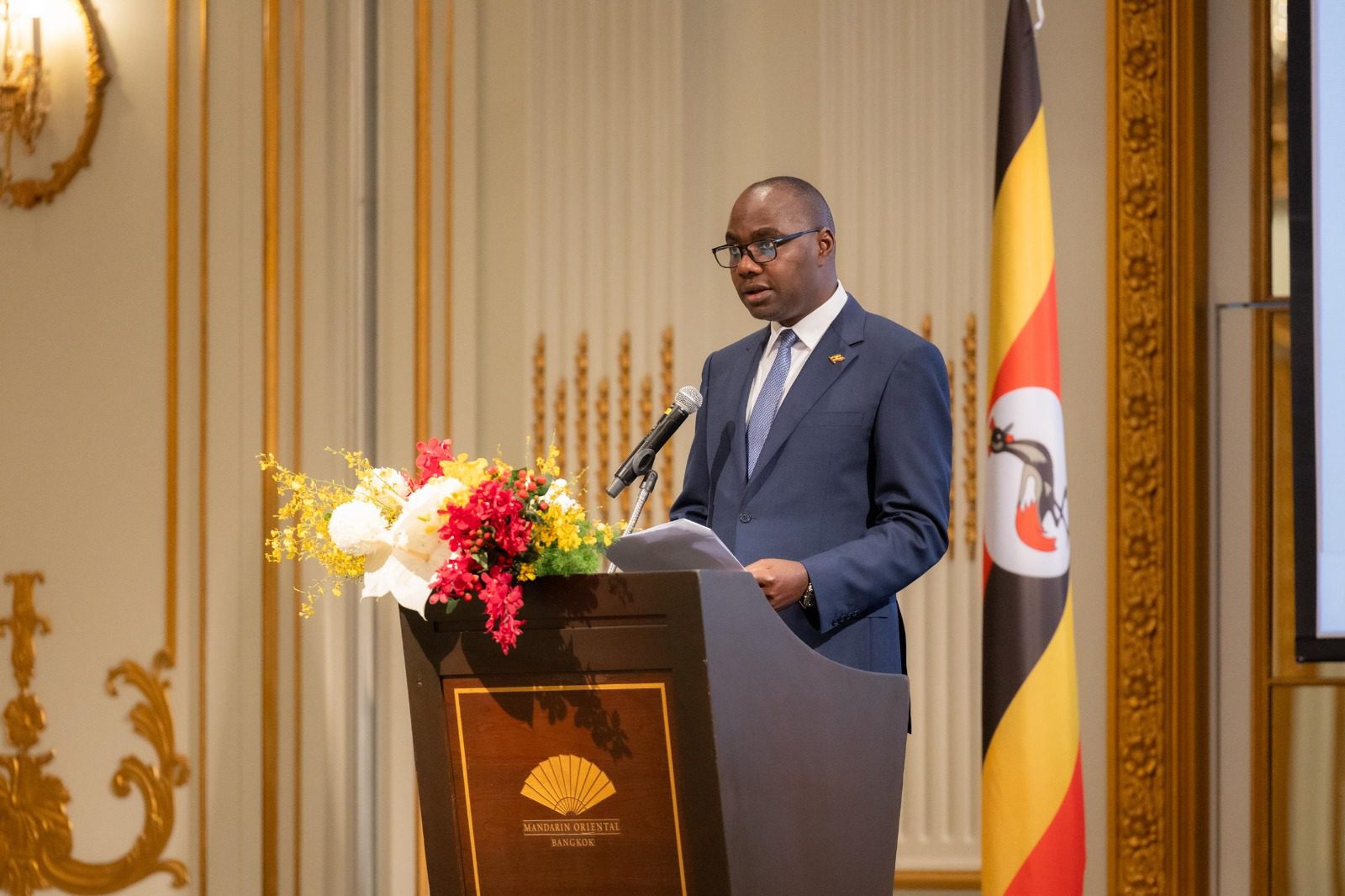
The incentives were presented to top Thai corporate leaders and government officials at the Uganda-Thailand Economic Networking Dinner, held at the Mandarin Oriental Hotel in Bangkok on Monday, 12 October 2026. The high-level forum took place on the sidelines of the Annual Meetings of the World Bank Group and the International Monetary Fund (IMF), running in the Thai capital from October 12 to 18.
Addressing the gathering, Dr. Ramathan Ggoobi, Uganda’s Permanent Secretary and Secretary to the Treasury, announced that under the country’s modern legal framework, qualifying manufacturers and agro-processors will pay 0% income tax for a full decade.

Furthermore, capital equipment, spare parts, and industrial inputs are 100% exempt from import duties. Under the 2019 Investment Code, foreign entities retain the unrestricted right to transfer dividends and capital out of the country.
“In Uganda, we are committed to doing whatever is necessary to facilitate your investment,” Dr. Ggoobi told the delegation. He added that the state is providing serviced industrial parks and free zones that offer subsidized land, reliable power, direct road access, and streamlined one-stop licensing.
Uganda’s Minister of Finance, Planning and Economic Development, Henry Musasizi, emphasized the ease of doing business in Uganda, noting that official investment registration takes just 24 hours.
“Uganda’s macroeconomic fundamentals are strong. Investing in Uganda is secure. You can have 100% foreign business ownership, although joint partners are encouraged,” Musasizi stated. He highlighted that through joint ventures, Thai investors can easily establish successful businesses within a short timeframe, earning predictable profits ranging from 15% to 25% annually—with even higher yields projected in high-tech ICT infrastructure, data centers, fintech, and electronics.
The investment drive aligns directly with Uganda’s ambitious Tenfold Growth Strategy, which seeks to expand the national economy from approximately $70 billion to $500 billion by 2040. The strategy prioritizes four anchor sectors where Thailand holds proven global leadership: Agro-industrialization, Tourism, Mineral Development, and Science, Technology & Innovation.
Key opportunities highlighted for Thai partnership include:Agro-Processing & Coffee, Mineral Value-Addition: Transitioning from raw material export to high-value manufacturing, including lithium-ion electric batteries, automotive steel from iron ore, organic fertilizers from phosphates, and electrical components from Kilembe copper and cobalt and Eco-Tourism & Hospitality: Leveraging Thai luxury hospitality brands to invest in Uganda’s rapidly growing tourism sector, which generated $1.62 billion in revenue in 2025.

The Ugandan delegation, which also included Bank of Uganda Governor Dr. Michael Atingi-Ego and Uganda’s High Commissioner to Thailand, Dr. Betty Bigombe, presented a highly resilient macroeconomic profile.
Uganda’s economy grew by 6.4% in the 2025/26 financial year and is projected to surge by 10.2% in 2026/27, bolstered by the upcoming launch of commercial oil production at the Tilenga and Kingfisher fields. Core inflation remains stable at 3.3%, while national exports recently jumped 34% to reach $18.4 billion.
Citing data from the Growth Lab at Harvard University Dr. Ggoobi revealed that Uganda has successfully added 31 new export products to its portfolio over the last 15 years—outperforming regional peers including Kenya, Tanzania, and Rwanda. Harvard’s Growth Lab projects that Uganda will grow faster over the decade to 2035 than any of the other 145 countries it tracks.
Furthermore, investors setting up manufacturing hubs in Uganda gain seamless, duty-free access to continental markets through Uganda’s active membership in the East African Community (EAC) Customs Union and the African Continental Free Trade Area (AfCFTA).

The networking dinner was organized by the Uganda High Commission in Kuala Lumpur (accredited to Thailand) alongside the Ministry of Finance, under Uganda’s Economic and Commercial Diplomacy Programme.
Thailand was represented at the event by Urasa Mongkolnavin, Director General of the Department of South Asian, Middle East and African Affairs at the Thai Ministry of Foreign Affairs, who affirmed that geographical distance should not deter expanding bilateral trade, investment, and tourism.
Minister Musasizi extended an official invitation to the Thai private sector to conduct exploratory trade missions to Uganda, where the Uganda Investment Authority stands ready to fast-track their entry. “Together, let us turn the friendship between our two countries into factories, export growth, jobs, and shared prosperity,” Musasizi concluded.
