


Speaker of Parliamanet Jacob Marksons Oboth has sought guidance from UK House of Commons as he implements reforms at Uganda’s Parliament institution.
The House of Commons is the democratically elected house of the UK Parliament, responsible for making laws and checking the work of Government
The House of Commons formally scrutinises the Government through its Committees and Prime Minister’s Questions, when members ask questions of the prime minister; the house gives other opportunities to question other cabinet ministers. Prime Minister’s Questions occur weekly, normally for half an hour each Wednesday.
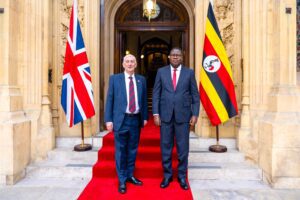
Oboth met UK House of Commons Speaker Sir Lindsay Hoyle in London on September 17, 2026 and both leaders focused on improving parliamentary management and strengthening ties between the two legislatures.
Uganda’s parliamentary systems and administrative practices drew much of their structure from the House of Commons. Oboth now wants Parliament to revisit that foundation as part of his reform programme.
He said the UK Parliament’s long history offers lessons that could support changes in Uganda.
“This is about consolidating our efforts to reset, revive and rejuvenate the management and affairs of the Parliament of Uganda,” Oboth said.
The two leaders also discussed staff and legislator exchanges, attachments and benchmarking programmes. These initiatives would allow officials from both institutions to share knowledge and experience.
Oboth proposed an inter-parliamentary network to promote cooperation beyond legislative affairs. He identified education, trade and mining as areas where Uganda and the UK could pursue common interests.
“Such parliamentary relations should be strengthened to a level that brings the two parliaments and the two nations closer in jointly pursuing shared interests,” he said.
Hoyle congratulated Oboth on becoming Speaker and welcomed his reform agenda. He pledged the UK Parliament’s support for closer parliamentary relations with Uganda.
The British Speaker also placed the talks within the wider Commonwealth relationship. He said parliamentary diplomacy could strengthen the organisation and help African countries pursue a common agenda within it.
Officials from both legislatures expect the meeting to pave the way for a formal cooperation framework covering governance, education and trade.
Oboth Oboth Plans for Parliament
The Speaker, Jacob Marksons Oboth has pledged Parliament’s commitment to supporting government programmes aimed at accelerating Uganda’s economic transformation.
Oboth said that this is aimed at achieving the desired increase in Gross Domestic Product (GDP) from US$50 billion to US$ 500 billion by 2040.
“On behalf of the 12th Parliament and on my own behalf, we affirm our commitment to the realisation of government’s ten-fold growth strategy, designed to expand the country’s GDP,” Oboth said.
He pledged to steer Parliament under seven key pillars, including zero tolerance to corruption, strengthened accountability, evidence-based debate, a people-centred legislature, results-based budgeting, an open Parliament, and proactive oversight.
“Accountability begins with us. We cannot demand it from others if we do not practice it ourselves,” he said.
He emphasised that Parliament under his leadership would prioritise transparency and a professional relationship with the media, describing journalists as “the public’s eyes and ears”.
Oboth also pledged structural reforms to strengthen parliamentary oversight and ensure real-time monitoring of public resources.
“I will remain the same Oboth Oboth, not changed by the grandeur or majesty of this office,” he concluded.
