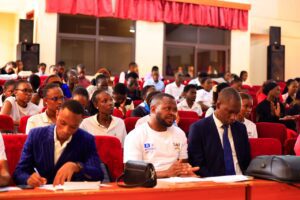
The Chairperson of the Uganda Human Rights Commission (UHRC), Hon. Mariam Wangadya, has urged that Uganda’s ambitious tenfold economic growth strategy must explicitly prioritize citizens’ welfare, dignity, and equal opportunities. True economic progress, she emphasized, cannot be measured solely by national output, but by its tangible impact on the lives of ordinary Ugandans.
Hon. Wangadya delivered these remarks during her keynote address today at the Makerere University Human Rights Expo 2026, held at the College of Engineering, Design, Art and Technology (CEDAT).
Speaking on the theme “Human Rights in Uganda’s Tenfold Growth Strategy: The Gen Z Perspective,” Wangadya acknowledged the country’s commendable strides in infrastructure development, education, healthcare expansion, and grid electricity access. However, she cautioned that development remains fundamentally incomplete if citizens continue to battle high unemployment, social exclusion, and systemic barriers to justice.
“Economic growth tells us how much a country produces. Human rights tell us how its people live. We must pursue both,” Wangadya noted, highlighting the necessary harmony between economic planning and human rights.
A significant portion of her address focused on the aspirations of Uganda’s youth. She noted that Gen Z expects dependable access to jobs, affordable quality education, meaningful seats at decision-making tables, and responsive public institutions. While calling for the aggressive inclusion of young people in shaping national policies, she also reminded them to exercise their civic freedoms with responsibility.
Reaffirming the Commission’s mandate to investigate abuses and protect constitutional rights, Wangadya reminded state actors of their obligations. “A right written in the Constitution but denied in everyday life is a promise awaiting fulfillment,” she said, urging government institutions to welcome public scrutiny and cultivate strict accountability.
Echoing these sentiments, the Chief Guest, H.E. Dr. Katja Kerschbaumer, Head of the Austrian Embassy and Development Cooperation, emphasized that sustainable economic growth is inherently tied to democratic freedoms, noting that societies thriving the most are those that actively respect and protect human rights.
Dr. Katja Kerschbaumer, Head of the Austrian Embassy/Development Cooperation, noted that societies that respect human rights create an environment conducive to investment. She added that development without respect for human rights is unstable, while observing that economic, social, and cultural rights often present more complex implementation challenges than civil and political rights.
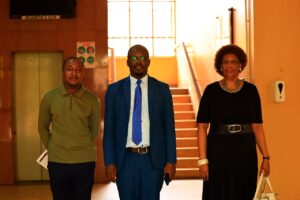
Dr. Robert Kakuru, a lecturer in Makerere University’s Department of Philosophy, said the Expo allows students to reflect on human rights and enables partners to showcase their efforts in promoting and protecting them.
The Head of Department, Dr. Dickson Kanakulya, noted that the Expo, which began in 2015, seeks to deepen students’ understanding of human rights, encourage young people to engage in human rights work, and expose them to experiences from other countries.
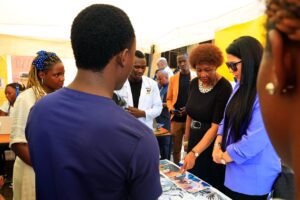
During the event, the Chairperson, the Chief Guest, and the Executive Director of the Cross-Cultural Foundation of Uganda, Ms. Barbra Babweteera, together with the leadership of the Philosophy Department visited exhibition stalls where students showcased innovations aimed at promoting and protecting human rights.
Other guests included university lecturers, civil society organisations, development partners, secondary school students, and students pursuing Ethics and Human Rights at Makerere University.
The Expo highlighted the importance of placing human dignity and people’s welfare at the centre of Uganda’s economic transformation, with young people playing an active role in shaping the country’s future.