

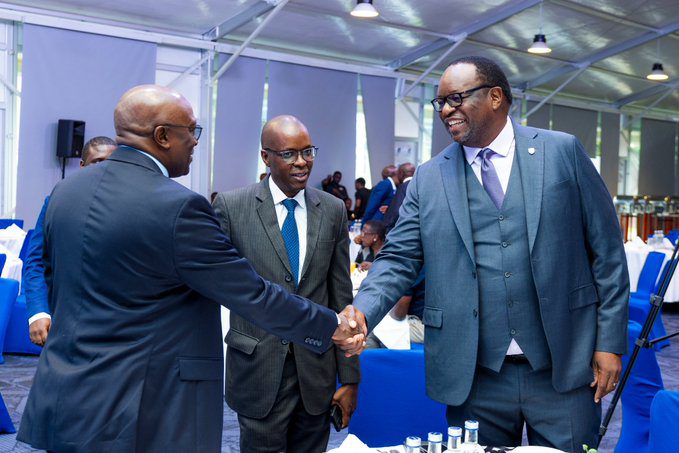
Inside the Serena Hotel Kampala, the atmosphere carried the distinct, heavy hum of high-stakes mathematics and national destiny. Gathered under the banners of the inaugural Stanbic Uganda Pensions Conference, the country’s financial vanguard—regulators, policymakers, fund managers, and commercial bankers—locked eyes with a staggering objective. Uganda wants to supercharge its current economy from about US$50 billion to a historic US$500 billion by 2040.
The road map to a half-trillion-dollar GDP, however, is no longer being drawn around the tables of foreign aid donors or international concessionary lenders. Instead, the country’s economic survival is increasingly pinned on a much more intimate, internal resource: the monthly savings of its own working citizens.
“Retirement savings are first a promise of dignity and security to those who have worked and contributed,” noted Mark Ocitti Ongom, Chief Executive Officer of Stanbic Uganda Holdings, grounding the high-level policy debate in human terms. “When professionally managed, invested, and governed, they are also sources of long-term domestic capital to an economy.”
For Stanbic, this is no longer just an academic exercise or a macroeconomic theory. The banking giant used the conference to anchor its own major strategic pivot into pension fund management through SBG Securities Uganda, throwing its institutional weight behind a wider campaign to build a robust local investment culture.
The argument places retirement funds at the absolute center of a virtuous macroeconomic wheel: when households save, financial institutions mobilize those resources into productive enterprises, supporting business expansion, employment, production, and ultimately tax revenues. Yet, translating abstract, small-scale savings into physical economic engines like tarmac, power grids, and local factories requires scaling an immense structural wall.
Right now, Uganda’s formal retirement safety net is a privilege enjoyed by a relatively small, predictable circle of regular salary earners. The real economic heartbeat of the country, however, lives entirely outside corporate office buildings. It is found in the open-air markets, the millions of small farming holdings, the bustling traders, and the hyper-local Savings and Credit Cooperative Organizations (SACCOs). These informal workers operate on volatile, irregular incomes. A traditional, rigid pension model simply does not fit their lives.
“More demanding is to expand enrollment for account holders,” observed Simon Mulongo, Minister of State for Labour, Employment, and Industrial Relations. Mulongo argued passionately that pensions must shed their corporate exclusivity. “Pensions should become more accessible to Ugandans across different income groups and employment categories rather than remaining largely associated with people earning regular salaries.”

For a country where a significant proportion of economic activity takes place outside formal employment, expanding coverage represents both a social and economic crisis. Farmers, traders, small business owners, members of SACCOs, and village savings groups need pension products that reflect irregular incomes and different capacities to contribute. They cannot be bound by rigid monthly deductions that do not account for a bad harvest or a slow trading month.
The minister pointed directly to a structural solution: banks, pension institutions, and other financial players need to actively collaborate with SACCOs, Village Savings and Loan Associations (VSLAs), and market associations to widen access. By nesting retirement products within the financial structures that informal workers already trust, the formal system can begin to bridge the gap.
This is where digital technology and the ubiquitous power of mobile money platforms transform from a convenience into an absolute economic necessity. In Uganda, where the vast majority of the population lacks a traditional bank account but carries a mobile phone, digital rails are the only infrastructure capable of gathering the country’s fragmented cash.
“The use of bank accounts and mobile money platforms,” Minister Mulongo added, “would be critical in building a stronger retirement savings culture.”
The math behind this digital shift is compelling. Traditional pension funds are built to handle large, predictable, lump-sum transfers from corporate bank accounts. Processing a Shs5,000 contribution from a market vendor in downtown Kampala using legacy systems is an administrative nightmare that eats up any potential return. However, when integrated with mobile money APIs, technology allows for micro-contributions—enabling a farmer to save a tiny percentage of every crop sale, or a trader to sweep their spare change into a retirement account at the end of the day.
This digital approach directly addresses one of Uganda’s greatest structural bottlenecks: getting more people into the formal financial system and converting small, fragmented savings into longer-term pools of capital. By deploying mobile wallets linked to pension sub-accounts, financial institutions can create a frictionless experience where saving is as simple as buying airtime. It democratizes wealth accumulation, ensuring that a micro-merchant in a rural district has access to the exact same investment engines as a corporate executive in Kampala.
Paradoxically, while the sector struggles to onboard the masses, it is already sitting on a historic fortune. Daisy Nabakooza, the Director of Supervision and Market Conduct at the Uganda Retirement Benefits Regulatory Authority (URBRA), revealed that pension sector assets under management had reached about Shs36 trillion as of June.
While that pool represents a substantial and historic source of domestic capital, it has triggered a parallel, deeply frustrating crisis: Uganda is running out of high-quality, secure local projects to absorb it. The money is there, but the “bankable” investment pipelines are dry.
Nabakooza noted that the immediate challenge is ensuring that this vast wealth is invested in projects capable of delivering acceptable returns while protecting members’ savings from loss. The regulator’s stance remains unyielding, prioritizing the worker over speculative national ambitions.
“We cannot deploy funds in areas we cannot trust 100%,” Nabakooza warned flatly. She explained that while regulators and industry stakeholders are actively assessing investment opportunities in areas such as real estate and infrastructure, they are simultaneously tightening the forensic processes used to evaluate these projects. For pension funds, the question is not simply where money can be parked, but whether the investment has appropriate governance, accountability, security, and a crystal-clear mechanism for measuring returns.
“Investors want to know how to invest my money and exit when things do not work out,” Nabakooza emphasized, pointing out that capital will refuse to flow into long-term infrastructure if it feels trapped inside a poorly managed vehicle.
This investability deficit is felt most acutely at the National Social Security Fund (NSSF), which controls a near-monopoly of Shs35 trillion of the industry’s total pool. Kenneth Owera, the Chief Investment Officer at NSSF, articulated the unique weight of managing a fund of this magnitude in a developing market.
“That capital has to contribute to national development but also ensure we issue a good return on investment to our members,” Owera said, balancing the dual mandate of national progress and fiduciary duty.

NSSF already invests heavily across multiple asset classes, including government securities, real estate, and prominent equities. Its equity holdings include major listed companies such as MTN Uganda, Airtel Africa, and Quality Chemical Industries, alongside various investments across wider regional markets. But the sheer velocity of the fund’s growth is threatening to overwhelm the local capital market.
“The challenge is there is growth in assets at NSSF but investment opportunities are not growing as much as we expect,” Owera admitted candidly.
Owera insisted that while every investment carries inherent risk, the answer lies in structural collaboration rather than retreat. “There is a place for different players to come together to achieve outcomes like roads and other infrastructure,” he noted, urging a coordinated effort to fundamentally upgrade Uganda’s investment environment.
Solving this puzzle creates a perfect opportunity for the government and the private sector to co-develop more structured, institutional-grade investment projects. Large-scale infrastructure projects—such as toll roads, energy grids, and affordable housing schemes—are structurally ideal for pension funds. They provide long-term, inflation-protected assets that perfectly match the multi-decade duration of a pension fund’s liabilities, while granting the government direct access to domestic capital without relying on volatile foreign currency borrowing.
However, such arrangements cannot be built on good intentions alone. They require strong project preparation, transparent procurement, credible revenue models, and appropriate risk allocation.

Paul Muganwa, Executive Director at Stanbic Bank Uganda, explained that pension funds are highly motivated to enter these spaces, but they require sophisticated financial instruments that offer both yield and flexibility.
“Pension funds have appetite for investment in long-term investments and they want options,” Muganwa explained. To bridge this gap, Muganwa highlighted how banking institutions can structure specialized products—such as listed infrastructure bonds, securitized debt instruments, and project finance facilities—designed to package massive national developments into liquid, tradable assets. These vehicles allow institutional investors to smoothly exit when market conditions or risk profiles change, solving the secondary market liquidity riddle that historically kept pension cash sitting safely in short-term government paper.
For commercial banks, the balance sheet looks entirely different, creating a natural point of symbiosis with pension funds. “Banks carry short-term financing risks of up to seven years,” Muganwa pointed out.
Because banks are legally and structurally bound to manage risk within these shorter timelines, they cannot easily fund a 25-year railway project on their own balance sheet. This creates a massive scope for collaboration: commercial banks can step in during the high-risk, early construction phases of a project using short-to-medium-term lending, and once the asset is stable and generating steady revenue, Stanbic can help package that project into an infrastructure bond. At that milestone, pension funds step in with their longer-duration, “patient” capital to buy out the bank’s position. This ecosystem approach links banks, pension funds, capital markets, and the state into a single, unified financing machine.
The broader macroeconomic reality is that Uganda cannot achieve its Tenfold Growth Strategy through public spending and foreign capital injections alone. The looming expansion of Uganda’s oil and gas economy will undoubtedly provide vital public revenues and foreign exchange, but pension leaders argue that sustainable, long-term national transformation must be anchored by deep domestic savings.
However, increasing the raw volume of cash within the financial system is only half the battle. Minister Mulongo issued a vital caution to the conference, reminding delegates that an increase in financial assets alone does not automatically translate into a thriving economy.
“An increase in financial assets does not mean the economy will produce,” Mulongo stated sharply. He reminded the room that inflation, exchange rate volatility, household income levels, general industrial productivity, and the actual availability of well-run, productive businesses all dictate whether financial resources translate into real-world economic expansion.

A growing pension sector is highly necessary, but on its own, it is simply not sufficient. The country must simultaneously create investable businesses, bankable infrastructure projects, and deeper, more liquid capital markets capable of safely absorbing long-term savings.
The government must focus entirely on building a stable legal and infrastructure environment that reduces investment risks across the board.
While impending petroleum revenues will inject a massive wave of capital into the economy, pension savings represent a far more sustainable, resilient source of domestic financing because they are accumulated gradually, systematically, and directly from the sweat of workers and employers.
Ultimately, Uganda stands at the edge of a profound psychological and economic shift. The country must transition away from a conservative culture where pensions are viewed purely as a passive safety net for life after work, and move toward an aggressive system where retirement savings are recognized as the primary bedrock of national capital formation. This does not mean sacrificing the hard-earned interests of workers for political vanity projects. Rather, the grand challenge of the next decade is to design an investment ecosystem sophisticated enough to simultaneously protect the dignity of the Ugandan worker while funding the industrial transformation of their nation.
If Uganda can successfully align the financial instruments of tomorrow with the micro-savings of today, it may just find that the keys to its $500 billion future were never hidden in foreign bank vaults—they were waiting right in the pockets of its own people, ready to turn everyday savings into the literal concrete and steel of a transformed nation.
