

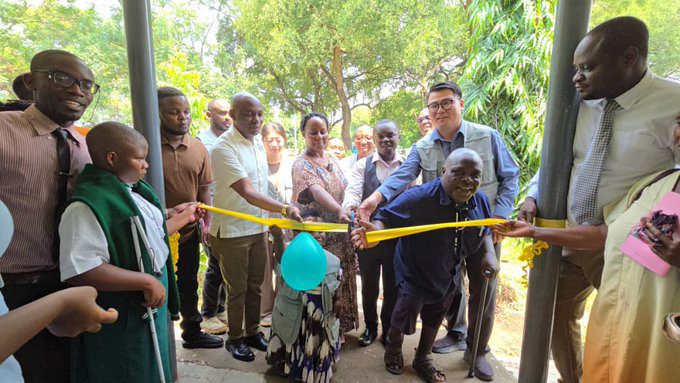
Persons with disabilities in Kasese District are set to benefit from improved access to digital skills Courtesy of National Council for Persons with Disabilities (NCPD) and the International Development Institute (IDI) Uganda, under a project funded by the Korea International Cooperation Agency (KOICA).
Over 5 million people live with disabilities in Uganda, with over 60% of this population lacking basic ICT skills. Digital inclusion remains low, as only 42.4% of persons with disabilities aged 10 and older own a mobile phone, 16% use the internet generally, 8% use computers, and regular daily internet usage sits at just 5.9%.

The facility will provide computer literacy training, vocational skills development and digital empowerment programmes designed to equip persons with disabilities with the skills needed to participate in the modern digital economy.
For years, persons with disabilities have remained among the most marginalized groups in society, facing barriers to accessing education, employment, vocational training and digital technologies.
Dr. Sinmyung Park, the Project Manager at IDI Uganda, said the ICT Hub is part of broader efforts to ensure persons with disabilities are not left behind as technology continues to transform education, business and communication.

“This ICT Hub is intended to provide persons with disabilities with practical digital skills that will improve their access to education, employment and economic opportunities while strengthening their participation in society,” Park said.
He further oted that the new centre seeks to bridge this gap by providing an inclusive learning environment equipped with accessible ICT facilities.
Lilian Namukasa, the Programmes Manager at the National Council for Persons with Disabilities, said the project goes beyond providing computers by creating opportunities for empowerment and social inclusion.
“Digital literacy is now a basic necessity. Through this facility, persons with disabilities will be able to acquire the knowledge and confidence required to compete in today’s digital world,” Namukasa noted.

Peter Baluku, the Executive Director of KADUPEDI, welcomed the establishment of the centre, describing it as a significant milestone in promoting equal opportunities for persons with disabilities in Kasese District.
“This facility will help us acquire skills that have previously been inaccessible, opening doors to employment, self-reliance and social inclusion,” Baluku said.
Officials appealed to Kasese Municipal Council to safeguard the ICT equipment to ensure the facility continues serving its intended purpose for years to come.
Namukasa emphasized the importance of proper management and maintenance of the centre.
“We request the municipal council to ensure that all this equipment remains here. It should not be removed from the ICT Hub because it is meant to benefit the entire disability community,” she said.
Kasese Deputy Town Clerk Zedekiah Kambasu assured stakeholders that the municipality would protect the facility and ensure it remains operational.

“The Municipal Council is committed to protecting this investment and ensuring that the ICT Hub serves persons with disabilities and other members of the community in promoting inclusive digital learning,” Kambasu said.
Officials noted that although persons with disabilities are the primary beneficiaries, the ICT Hub will also be accessible to the wider community to encourage shared learning and strengthen social inclusion.
Before the commissioning of the facility, district leaders, disability rights advocates and policymakers held a stakeholder workshop to discuss the implementation and enforcement of the Persons with Disabilities Act, 2020, with participants calling for stronger enforcement of disability rights.
Dr. Park said combining digital inclusion with effective implementation of disability policies would help reduce stigma and improve the quality of life of persons with disabilities.
“Technology alone is not enough. We must also strengthen policies that guarantee equal rights and opportunities so that persons with disabilities can fully participate in national development,” Park added.
Stakeholders expressed optimism that the ICT Hub will become a centre of innovation and empowerment, enabling more persons with disabilities in the Rwenzori region to access education, employment and digital opportunities while promoting a more inclusive society.
According to the Uganda Bureau of Statistics (UBOS) 2024 National Population and Housing Census, the population of persons with disabilities (PWDs) in Uganda aged 2 years and above is approximately 5.5 million people, representing 13.2% of the total population
