

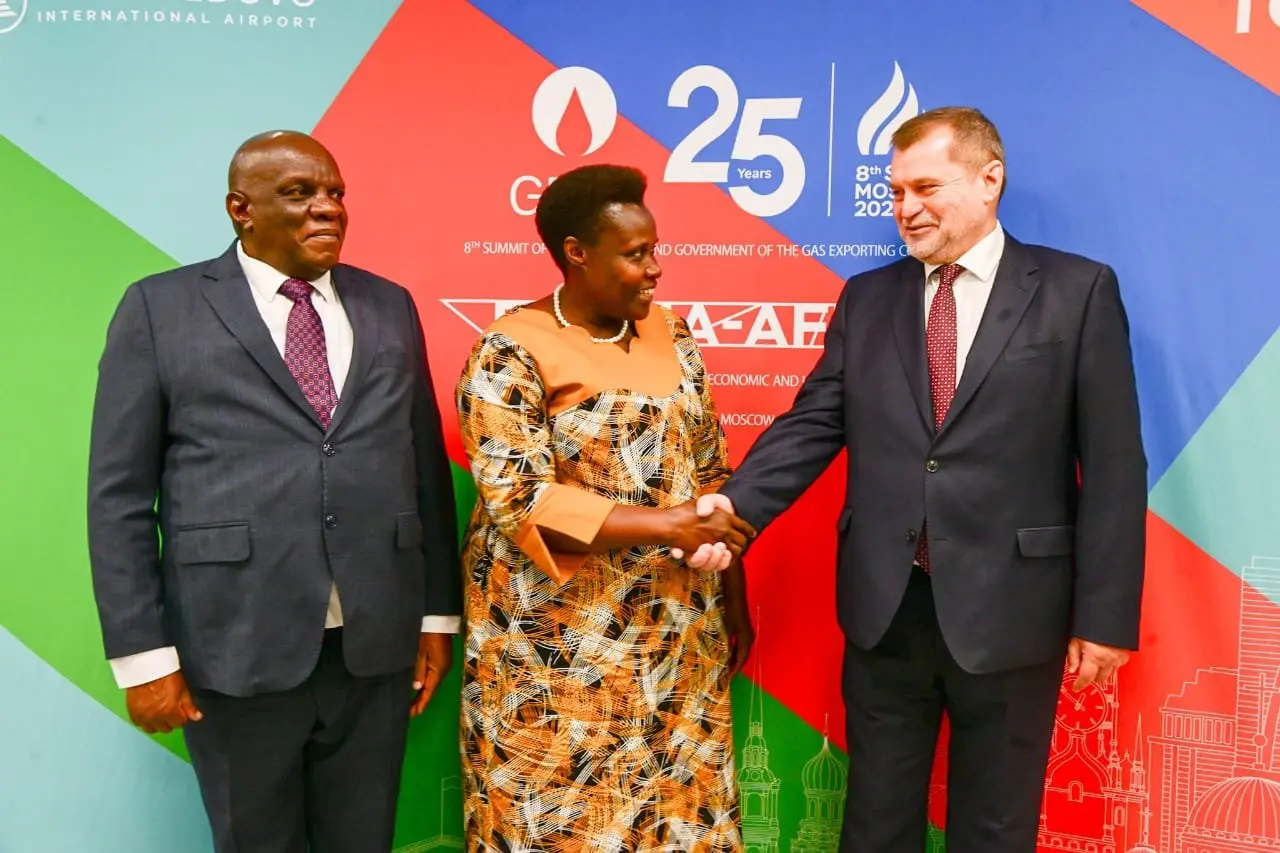
President Yoweri Kaguta Museveni has called on the Russian Federation to open its doors to finished African goods and fund key infrastructure across the East African Community (EAC).
Delivering the address on the President’s behalf at the Third Russia–Africa Summit in Moscow, Vice President Jessica Alupo urged Moscow to drop the import of raw materials and back local agro-industrialization.
Museveni asked Russian President Vladimir Putin to eliminate barriers for processed exports—including coffee, fish, fruits, textiles, leather, cereals, nuts, and vegetable oils—to help Africa capture higher profit margins.
Pointing to the EAC’s 331 million consumers and a $356 billion intra-regional market (sitting inside the broader 1.5-billion-person African Continental Free Trade Area), Museveni noted that local demand is already shielding regional manufacturing.
The President invited Russian firms to back major transport and utility projects, spanning railways, inland waterways, solar, hydro, natural gas, and nuclear power.
Museveni invoked decades of bilateral solidarity dating back to Soviet-era backing of African liberation movements, citing projects like Egypt’s Aswan High Dam and Uganda’s Busitema University.
Uganda and Russia are historically strong, built on decades of military cooperation, educational exchanges, and growing economic diplomacy. In recent years, Kampala has taken a pragmatic approach to foreign policy, deepening ties with Moscow—particularly through Uganda’s admission as a BRICS partner country in January 2025
Military cooperation serves as the backbone of Uganda–Russia relations. Uganda relies heavily on Russian hardware for the Uganda People’s Defence Forces (UPDF), including Sukhoi fighter jets and Mi-28 attack helicopters
In October 2026, Russia finalized a $53 million (UGX 184 billion) military infrastructure and equipment package for Uganda. This included specialized naval defense assets and maintenance centers in Entebbe, Maga Maga, and Kalangala.
In October 2026, President Yoweri Museveni met with Russian military officials to advance a new five-year agreement that will bring Russian military instructors to Uganda to provide personnel training and language courses
While historically centered on defense, current diplomatic efforts focus on expanding economic transformation and commercial markets.
Uganda imported goods valued at $138.2 million from Russia in 2025, while exporting roughly $59.7 million—primarily driven by agricultural products.
Coffee acts as the anchor of Ugandan exports to Russia, accounting for roughly $58.6 million of trade value. Uganda is actively lobbying to ease restrictions and increase the visibility of finished, value-added agricultural exports like processed coffee, fruits, and fish
