

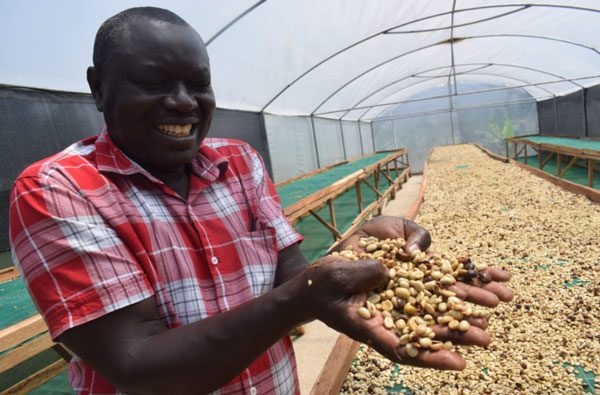
Uganda’s premium Bugisu Arabica coffee is undergoing a massive transformation, moving from the rural volcanic slopes of Mount Elgon directly into the cups of Chinese consumers.
A strategic cooperation agreement signed between Mbale City and Guiyang City establishes a direct-sourcing partnership that completely bypasses third-party international intermediaries. This diplomatic breakthrough allows Uganda’s flagship agricultural export to protect its single-origin identity and claim its rightful place on the rapidly expanding Asian specialty coffee stage
Historically destined to lose its identity inside European and North American espresso blends, Mbale’s celebrated Arabica coffee is executing a pivotal, highly lucrative shift toward Asian markets.
The economic footprint of this diplomatic push is already yielding massive dividends. Driven by a surge in demand, overall Ugandan coffee exports to China skyrocketed by 224% in the 2025/26 financial year alone, according to data from the Uganda Consulate General in Guangzhou.
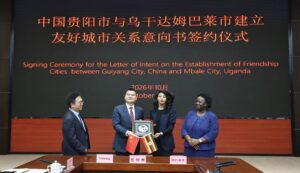
The newly signed Letter of Intent between Mbale City Mayor Joyce Matuka Kidulu and Guiyang Mayor Wang Hong lays the groundwork for an official sister-city partnership. Signed in Guiyang, Guizhou Province, the bilateral framework establishes a direct-trade pipeline aimed at eliminating foreign middlemen who have long diluted the origin of Ugandan beans.
To translate this agreement into immediate action, both municipal governments have committed to forming a joint working group within the next two months. A technical delegation from China will soon visit Mbale to evaluate investments across the agricultural value chain, tourism hotspots, and the gazetted Sino-Uganda Mbale Industrial Park.
Beyond agriculture, the broad cooperation framework outlines four other priority development fields: Smart Cities & Digital Governance: Upgrading city systems through big data, Industrial Investment: Scaling up local manufacturing capacity, Tourism & Culture: Fostering reciprocal travel and heritage exchanges and environmental Sustainability: Mitigating urban waste pressures.
In Guiyang—recognized as a national big data pilot zone and ecological demonstration hub—industry leaders are actively pushing for strict product traceability. Lu Yuan, president of the Guiyang Coffee Industry Association, revealed that local companies have already imported more than 150 tonnes of Ugandan coffee and are actively preparing to scale up volumes across Guizhou province.
“Chinese roasters are moving away from anonymous regional blends,” the association noted. By securing single-origin Bugisu Arabica, they are buying a premium, traceable profile shaped by the distinct environment of Mount Elgon. The plan involves cementing long-term supply contracts, joint marketing campaigns, and direct pipelines linking Mbale’s exporters straight to Chinese roasters and retailers.
Grown on the fertile volcanic slopes of Mount Elgon in Eastern Uganda, Mbale Arabica—commercially celebrated as Bugisu Arabica—is globally recognized as one of Africa’s finest specialty coffees.
This legendary flavor profile relies on three structural pillars:
Rich Volcanic Terroir: Mount Elgon is an extinct volcano boasting some of the deepest, most nutrient-rich volcanic soils on the continent.
Extreme Altitude: Cultivated between 1,500 and 2,300 meters above sea level, the high altitude slows cherry maturation, allowing the beans to develop concentrated sugars and complex organic acids.
Unlike the dry-processed (natural) Robusta grown in lowland Uganda, Bugisu Arabica is strictly wet-processed. Farmers hand-pick cherries, pulp them using mountain spring water, ferment them carefully, and sun-dry them on raised African beds to highlight clean, bright fruit notes.
The strategic agreement has received enthusiastic, unanimous backing from Mbale’s political, cultural, and administrative leaders, who view it as a gateway to structural modernization:
Mayor Joyce Matuka Kidulu (Political Head, Mbale City): “Mbale is the commercial heartbeat of eastern Uganda and the epicenter of Arabica production. We are pushing for Chinese technology to upgrade local grading, roasting, packaging, and cold-chain infrastructure, while seeking Guiyang’s expertise in waste sorting and composting to fix our overstretched solid waste management system.”
Jolly Hasoho (Deputy Town Clerk, Mbale City): “We will strategically utilize open space and municipal land to co-create jobs for young people, replicating the immense industrial success seen at the Sino-Uganda Mbale Industrial Park.”
Ambassador Judyth Nsababera (Uganda’s Consul General in Guangzhou): “Uganda’s unique dual-harvest climate allows it to supply distinct, traceable Robusta and Arabica profiles year-round. Direct traceability is a powerful tool to protect our smallholder farmers from predatory international middlemen.”
The Inzu ya Bamasaaba (Cultural Institution): Providing a critical stamp of cultural authenticity, the cultural institution emphasizes that linking single-origin coffee purchases directly to the protection of smallholder farming families creates an ethical, traceable narrative that commands premium prices in booming Asian specialty markets.
By trading directly with China’s top tech and ecological hubs, rural Mbale is successfully shifting from a purely agrarian economy to an integrated tech-and-trade city—rewriting its position in the global economic order.
