


Finance Minister Henry Musasizi has set out five pillars that will move the country from incremental growth to exponential economic take-off.
In 2024, the size of Uganda’s economy reached approximately US$53.9 billion in nominal terms, according to Uganda Economic Growth.
This comes in place as Musasizi begins executing his mandate as Ugandas new Finance Minister for the period 2026-2031
Musasizi, a certified public accountant and Rubanda County East MP, had served since 2021 as minister of state for finance in charge of general duties, where he oversaw budget implementation, debt management and fiscal transfers to local governments, before his promotion to the full Cabinet position.

At the centre of his agenda is Uganda’s target of building a $500 billion economy. “We shall relentlessly execute the tenfold growth strategy to turn Uganda into $ 500 billion economy by 2040,”
“We shall shift the Ministry culture from spending money to enforcing results,” he said
“This will demand strict budget discipline, push aggressive procurement reforms and require rigorous value-for-money audits on public projects,”he added.
Musasizi said the ministry would implement its second domestic revenue mobilisation strategy with the aim of raising Uganda’s revenue-to-GDP ratio to at least 20%, reducing the country’s reliance on external borrowing — a priority that comes as Uganda’s public debt stood at roughly 48.4% of GDP by June 2026.
The fourth pillar ties his ministry’s work to President Museveni’s wealth creation agenda. Musasizi said the ministry will prioritise funding and tracking the commercialisation of smallholder farmers, with the goal of bringing every Ugandan into the money economy.

The fifth pillar addresses Uganda’s emerging oil sector. “We shall manage our impending oil revenues with bulletproof institutional guardrails,” Musasizi said, adding that oil revenue would be channelled into infrastructure development. He said the objective is for Uganda to become an oil producer without becoming an oil-dependent economy.
Musasizi delivered Uganda’s national budget for the 2026/27 financial year on 11 June, projecting growth of 10.2% — the country’s fastest pace in decades — driven in large part by the start of commercial oil production. Analysts have said his tenure begins at a demanding moment for Uganda’s public finances, with the ministry needing to expand the tax base without undermining private sector growth, manage elevated public debt, and ensure government programmes are funded on schedule
Musasizi was born in Rubanda, Kabale District, on 25 February 1981 in a Catholic family of the Bakiga. He had his primary education in his home district of Kabale acquiring his PLE certification in 1994
At just 45 years old, Musasizi represents a generational shift in one of Uganda’s most sensitive ministries. Unlike many older politicians who rose through liberation politics, Musasizi’s rise has largely been built on technical competence, parliamentary committee work and close involvement in budgeting processes.
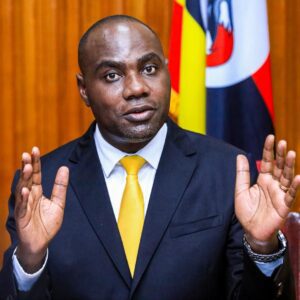
Born on February 25, 1981, in Rubanda district, Musasizi is an accountant by profession. He studied at Kigezi College Butobere before joining Makerere University, where he graduated with a Bachelor of Commerce degree in 2005. He later obtained professional accountancy qualifications from the Institute of Certified Public Accountants of Uganda and earned an MBA from Heriot-Watt University.
Before joining active politics, Musasizi worked with the Roman Catholic Diocese of Kabale and later with AMREF as an accountant. His political journey began in 2011 when he won the Rubanda East parliamentary seat on the NRM ticket.
Inside Parliament, Musasizi quickly built a reputation as one of the most technically grounded MPs on financial matters. He served on the Public Accounts Committee (PAC) before later becoming chairperson of Parliament’s influential Finance Committee, where he supervised scrutiny of national budgets, tax bills and loan requests. It was from that committee role that Museveni eventually picked him in 2021 to become State Minister for Finance in charge of General Duties.
Since then, Musasizi has played a central role in handling Uganda’s economic policy debates, including tax waivers, infrastructure financing, supplementary budget requests and negotiations around major government expenditures. He has frequently represented the Finance Ministry on the floor of Parliament and during media briefings concerning the national budget.
His elevation now places him at the center of Uganda’s economic management at a time when government faces rising public debt pressures, youth unemployment concerns, growing demands for infrastructure financing and increasing pressure to expand domestic revenue collection.
