


For fifteen years, Hanifah Nakiryowa has carried the brutal, agonizing reality of her trauma written directly onto her skin. Her face, surgically reconstructed after a horrific 2011 acid attack, is a permanent monument to a nightmare. But for fifteen years, the elite halls of Makerere University chose to look away, allowing the man she openly accuses of masterminding the attack—her ex-husband, Associate Professor Faisal Buyinza—to thrive in comfort, prestige, and power.
But Hanifah refused to be a hidden casualty.
When the justice system failed her between 2011 and 2014, and when institutional apathy threatened to bury her story forever, Hanifah weaponized her own survival. She didn’t wait for permission; she forced the world to look. Through a relentless, unyielding social media campaign and the raw vulnerability of her biography, Hanifah, she turned her private agony into a public reckoning.
“This gentleman is the reason I look like this today,” Hanifah declared to the digital court of public opinion, refusing to let Makerere pretend her alleged abuser was just another respected academic. “It has been 15 years and now it is my moment of truth.”

It was her voice—sharp, unapologetic, and echoing across the internet—that finally shattered Makerere’s decades of comfortable silence. On October 7, 2026, Acting Vice-Chancellor Professor Sarah N. Ssali finally ordered Buyinza to step down from his leadership positions pending an investigation.
The university is trying to frame this as an orderly, bureaucratic process, heavily stressing that Buyinza’s removal is a mere “administrative measure” and not a “finding of guilt.” They want the world to focus on their committees, their rules, and their procedural timelines. But no one is fooled. This isn’t a victory for institutional policy; it is a testament to Hanifah’s sheer refusal to be silenced.

For a decade and a half, Hanifah watched her alleged attacker maintain authority over a department, warning the public that he was “still manipulating young women” while she fought just to reclaim her life. Now, by stepping into the light and encouraging other silenced women to speak out, she has single-handedly forced one of Africa’s oldest universities to account for the company it keeps.
Makerere’s new investigative committee has until November 6, 2026, to deliver its findings. But whatever the ivory tower decides, Hanifah Nakiryowa has already won the most critical battle: she broke the silence, she claimed her truth, and she forced the institution to finally look her in the face.
The University Intervention
Makerere University has directed Dr Faisal Buyinza, a senior academic accused by his former wife of masterminding an acid attack that left her with severe facial injuries, to step aside from his leadership positions as the institution investigates allegations of sexual harassment, abuse of authority and gender-based violence.
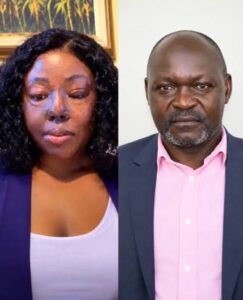
Buyinza, an Associate Professor and Head of the Department of Economic Theory and Analysis at Makerere University’s College of Business and Management Sciences (CoBAMS), has been ordered to relinquish the department headship and any other leadership or administrative position he holds for the duration of the investigation.
The decision follows renewed public allegations by his former wife, Hanifah Nakiryowa, who has in recent weeks spoken out on social media about the December 11, 2011 acid attack that she says was organised by Buyinza.
Nakiryowa, who continues to live with a surgically reconstructed face following the attack, has also documented her experience in a recently released biography titled Hanifah.
“This gentleman is the reason I look like this today. He is still a lecturer, still manipulating young women. Beware. It has been 15 years and now it is my moment of truth,” Nakiryowa said in one of the videos.
Her allegations have drawn renewed attention to a matter that Makerere says must be examined independently under its institutional policies, regardless of previous police investigations and criminal

In a statement dated October 7, 2026, Acting Vice-Chancellor Professor Sarah N. Ssali said the university had taken the allegations seriously and appointed a committee to establish the facts.
“Makerere University does not tolerate sexual harassment, abuse of authority or gender-based violence in any form,” Prof. Ssali said.
She said the university has its own responsibility, under its Policy and Regulations against Sexual Harassment, Safeguarding Policy and Human Resources Manual, to establish the facts and act on them.
The university has now constituted a committee chaired by Eng. Assoc. Prof. Dorothy K. Okello, Dean of the School of Engineering, CEDAT, to investigate the allegations.
The committee includes Prof. Engineer Bainomugisha, Principal of the College of Computing and Information Sciences; Dr Christine Mbabazi Mpyangu of the Department of Religion and Peace Studies; Ms Sumaiyah Nanyondo Sebuta, Legal Adviser; Dr Joelia Nasaka of the School of Veterinary Medicine and Animal Resources; and Mr Deust T. Mujuni, Chief Human Resource Officer, who is the secretary.
The committee will hear from complainants and witnesses and give Buyinza an opportunity to respond to the allegations in accordance with the principles of natural justice.
It is required to submit its report to the Vice-Chancellor by November 6, 2026.
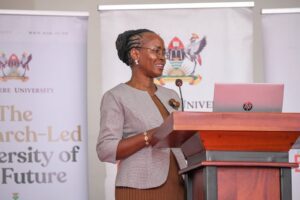
Prof. Ssali stressed that Buyinza’s removal from leadership should not be interpreted as proof that he committed the alleged offences.
“These are administrative measures to protect the integrity of the investigation and those who take part in it. They are not a disciplinary sanction and are not a finding of guilt,” she said.
She added that if the committee finds that there is a case to answer, the matter will proceed to the Appointments Board, where Buyinza will be accorded a fair hearing under university procedures.
During the investigation, the Dean of the School of Economics will oversee the Department of Economic Theory and Analysis.
Buyinza has also been directed not to contact, influence or interfere with any complainant or witness.
According to Makerere, some of the matters raised had previously been the subject of police investigations and criminal proceedings between 2011 and 2014. The university, however, says this does not remove its institutional responsibility to examine the allegations under its own policies.
The university has encouraged other complainants and people with relevant information to come forward, promising confidentiality and protection from intimidation, victimisation or retaliation.
“The University guarantees that anyone who takes part in, or provides information to, this process will be protected from intimidation, victimisation or retaliation,” Prof. Ssali said.
She also urged the university community to avoid social media comments that could expose complainants, intimidate witnesses or prejudice the investigation.
