

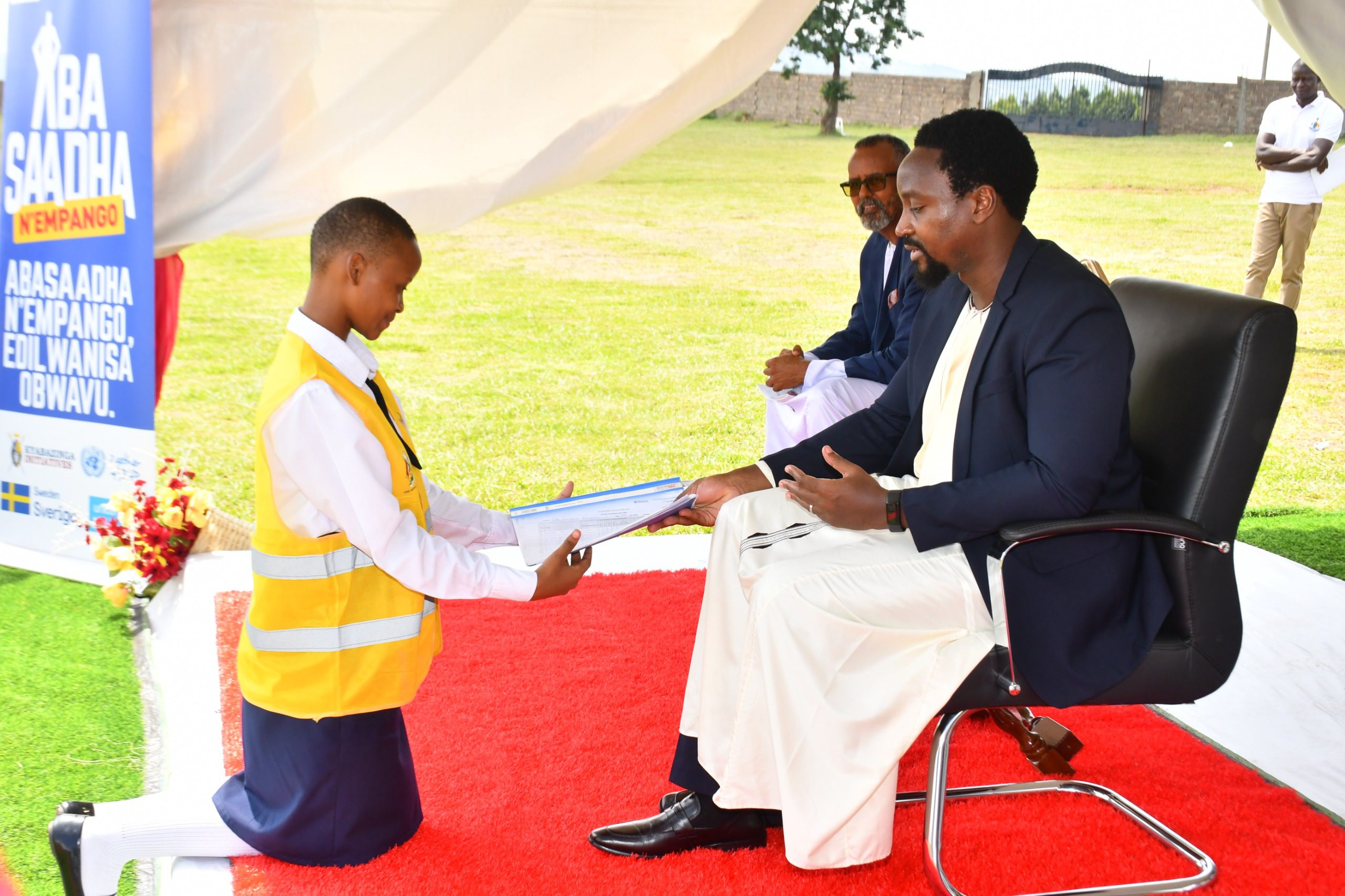
The devastating toll of teenage pregnancy in Busoga has found its primary battlegrounds in Jinja, Kamuli, and Buyende districts, where a unified UGX 50 billion resistance is taking root. At Igenge Palace in Jinja City, the Kyabazinga of Busoga, His Majesty William Gabula Nadiope IV, officially launched the Busoga Regional Multi-Sectoral Partnerships and Accountability Framework 2026–2030.
Backed by a massive baseline survey of 200,000 children, this monumental five-year strategy dismantles years of isolated interventions to confront the interlinked crises of extreme poverty, school dropouts, and rampant sexual violence against minors.
While the framework spans the entire sub-region, the data reveals that the frontlines of this crisis run directly through the urban corridors of Jinja, the agrarian heartlands of Kamuli, and the remote, lakeside communities of Buyende.
Behind the high-level palace launch and the multi-billion-shilling budget are raw, human stories of a childhood routinely cut short. Each district presents its own unique trap for young girls.

In urban Jinja, the allure of petty trade and commercial corridors often exposes young girls to exploitation. “I had to leave school at 14 because my family couldn’t afford secondary school fees, and a man operating a boda boda promised to help me,” says Naigaga, who grew up on the outskirts of Jinja City. “Now, I am struggling to feed my baby alone, and he disappeared. My dreams of becoming a nurse are gone.”
Moving inland to Kamuli District, the drivers are deeply tied to rural vulnerability. “We are burying the future of our daughters in premature marriages,” laments Sarah Namumbya, a community women’s advocate from Kamuli. “When agricultural input fraud destroyed our family’s sugarcane harvest, my parents couldn’t see any other choice but to marry off my younger sister. Poverty drives these girls into the arms of exploiters, but parental negligence is the real open door.”
Further north in Buyende District, geographical isolation exacerbates the danger. Local leaders note that the proximity to landing sites and fishing communities creates a transient population where child protection is incredibly difficult to enforce. “In Buyende, many parents have completely abandoned their roles, leaving young girls to fend for themselves selling fish or working in local markets, making them easy targets,” Namumbya adds.
About 25% (one in four) of adolescent girls aged 15–19 in Uganda have begun childbearing or are pregnant, translating to roughly 1,000 teenage pregnancies every single day.
The baseline survey, conducted by the Kyabazinga Initiatives alongside 2,000 regional planners, explicitly pointed to parental negligence, systemic poverty, and agricultural failure as the leading drivers of this societal decline.
As the UN National Goodwill Ambassador for engaging men to end teenage pregnancy, the Kyabazinga made it clear that cultural institutions will no longer tolerate harmful traditional practices that shield perpetrators, whether in bustling Jinja or remote Buyende.
“We are facing challenges of poor parenting and deteriorating family and community responsibility,” His Majesty William Gabula Nadiope IV declared. “On behalf of Obwa Kyabazinga bwa Busoga, I want to assure you of our commitment to use our cultural approaches to support government and other stakeholders to mobilize our people and shift mindsets for better development outcomes.”
Local clan leaders across the three districts are already echoing the royal decree, promising a cultural shift at the grassroots level.
“For a long time in Kamuli and Buyende, families would quietly negotiate ‘compromises’ with men who defiled our girls, exchanging a child’s future for a few goats or a small cash settlement,” admits a local cultural chief from the Bugabula chiefdom. “That ends now. Our culture must protect our children, not oppress them or cover up crimes.”
Supported by international diplomats, UN agencies, and the central government, the UGX 50 billion framework represents the largest coordinated social rescue mission in Busoga’s recent history. Representing the UNFPA Country Representative, Laura Lafuente Criado, noted that fragmented work has proven obsolete against two decades of unchanging numbers.
To bridge this gap, she announced four explicit UN commitments designed to turn policy into measurable grassroots protection:
- Strengthening healthcare access to sexual and reproductive health services for vulnerable adolescents across Jinja, Kamuli, and Buyende.
- Enhancing community-led protection systems by equipping local advocates to identify, report, and prevent gender-based violence (GBV).
- Supporting evidence-based planning through continuous data collection to adapt interventions to emerging hot spots.
- Empowering girls economically and educationally to ensure survivors can safely return to school or gain self-sustaining livelihood skills.
A critical pillar of the new 2026–2030 framework is absolute legal accountability. Law enforcement agencies across Jinja, Kamuli, and Buyende have fully integrated into the strategy, vowing an end to out-of-court settlements and police complacency.
“We commit to provide a secure and safe environment for this initiative,” stated Charles Nsaba, Regional Police Commander (RPC) for the Kiira Region, which oversees the Jinja corridor. “And to take action on our part in enforcement, I, on behalf of the Uganda Police Force in this region, commit, endorse, and adopt the Busoga Multi-Sectoral Framework 2026-2030.”
Local activists emphasize that police stations in Buyende and Kamuli must remain equally steadfast against community pressure. “We need to see these perpetrators in handcuffs, not roaming the villages,” says Namumbya. “When the community sees real legal consequences, the mindset will change.”
To safeguard the massive budget and ensure it does not disappear into administrative overhead, the Kingdom is establishing airtight transparency measures.
“We are building a clean, accountable system,” assured Owek. Osman Ahmed, the 2nd Deputy Prime Minister of Busoga. He revealed that the Kingdom will soon launch a dedicated development fund, actively engaging local transporters, civil society, and the business community.
To keep the momentum alive, a newly established District Steering Committee will execute a rigorous, localized monitoring plan by meeting every three months to thoroughly audit regional expenditures and match budget rollouts directly against community-level outcomes.
Progress will be monitored via strict local trackers, measuring the exact reduction in school dropout rates in Kamuli, GBV case response times in Jinja, and the tracking of child protection cases at landing sites in Buyende and Local leaders and civil society organizations will feed raw community feedback directly to the steering committee, creating an early-warning system for gaps in enforcement or resource distribution.
For the mothers, leaders, and children of Jinja, Kamuli, and Buyende, the framework is more than a policy document—it is an overdue lifeline. With the palace, the police, the UN, and local communities finally marching in lockstep, Busoga is drawing a firm line in the sand to reclaim the future of its youth.
