

The landscape of Uganda’s mining sector has shifted forever. In Busia, the newly commissioned Wagagai Gold Project marks the formal end of an era, turning an informal, artisanal mining hub into a high-yield industrial powerhouse.
Backed by a $150 million joint venture between the Wagagai Group of Companies and Roraima Mining Company, the project introduces commercial-scale value addition to East Africa, targeting an annual output of 1.2 metric tons of 99.9% pure gold. This aggressive shift away from raw material exports directly aligns with Uganda’s National Development Plan IV (NDPIV).
The Busia asset sits on the highly prospective Archaean greenstone belt of southeastern Uganda—a geological treasure trove that extends into Kenya and Tanzania, forming a critical segment of the gold-rich Tanzanian craton.
In 1915 Gold mineralization was first recorded by informal artisanal miners and 1932 Sir Edward James Wayland, Uganda’s first Commissioner of Geological Survey, formally catalogs the reserves.
In 1990 a joint framework between the Ugandan Government and France’s BRGM verifies massive reserves across Tira, Amonikakinei, Masaba Buinja, and Eseka and in 1994 & 2011: Independent United Nations (UNDP) and World Bank audits validate the deep commercial viability of the Busia gold field.
For over a century, the Busia gold fields operated as an unregulated, fragmented, and informal sector. While it provided a survival livelihood for thousands, the artisanal era carried heavy environmental, social, and governance (ESG) liabilities.
For decades, artisanal miners mixed liquid elemental mercury with raw sediment to form an amalgam. They burned this mixture with open blowtorches—often in residential areas—to vaporize the mercury and leave behind raw gold.
Vaporized mercury polluted the air, while runoff poisoned local water tables and crops. Communities faced devastating risks of neurological damage, respiratory failure, and kidney damage.
This primitive approach was highly inefficient, capturing a meager 30% to 50% of the available gold, leaving the rest trapped in discarded waste.
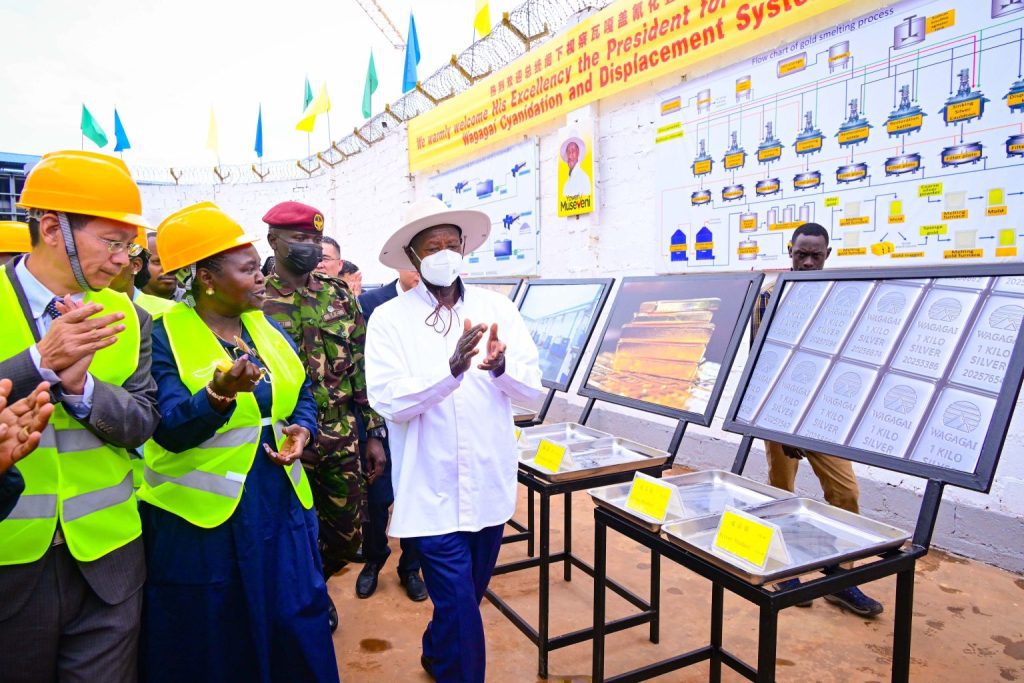
Wagagai’s industrial facility completely eliminates mercury from the equation, replacing it with an automated, international-standard Carbon-in-Leach (CIL) hydrometallurgical process.
Crushed ore is mixed into an aqueous slurry where a diluted sodium cyanide solution cleanly dissolves the gold. The dissolved gold is then caught by active carbon particles inside specialized tanks. Because it is a completely closed loop, all chemical solutions and gases are contained, neutralized, and recycled safely internally.

The gold undergoes electrowinning—passing through electrolytic cells where pure gold deposits onto cathodes—before being smelted to remove any remaining base metal impurities. The final result is investment-grade, 99.9% pure bullion bars.
The operationalization of the Busia refinery coincides with strict, structural reforms in Uganda’s sovereign mineral policy. The state has enacted a firm ban on the export of unrefined raw minerals, positioning local processing as a non-negotiable legal requirement.
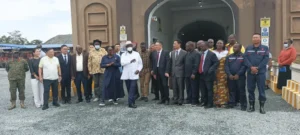
During the official commissioning ceremony, executive leadership presented a 1kg refined gold bullion bar to Ugandan President Yoweri Kaguta Museveni, proving the facility’s active refining capabilities.
To ensure long-term economic stability, the state is enforcing several key structural mandates.
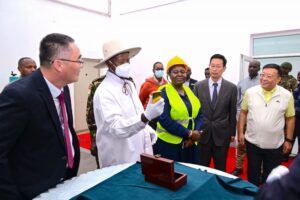
Former Minister of Energy and Mineral Development, Hon. Canon Dr. Ruth Nankabira, confirmed that the newly operationalized National Mining Company is legally mandated to equity-participate in domestic mineral exploitation alongside private capital.
This processing mandate stretches beyond gold. For example, Kilembe Mines Limited is now required to advance its domestic copper capabilities to produce 99.9% pure cathode copper.
The mega-project has injected millions into local socio-economic transformation. For the communities surrounding Alupe Village and Mawero Town Council, the investment is manifesting in real-time structural development.
John Charles Namayindi, Busia District LC 5 Chairperson: “We commend Wagagai for its immense contribution to our local economy. They have actively created thousands of jobs for our residents and are driving community transformation. Beyond the mining perimeter, their partnership in expanding infrastructure—like the newly constructed ward for patients at Masafu Hospital—is lifting healthcare services across the district.”
To foster long-term community benefits, Wagagai Mining Limited handed over a newly constructed Shs 4.4 billion primary school and church facility to the Busia community. The state-of-the-art facility includes an eight-classroom block, library, staff quarters, a secure perimeter wall, and integrated safe water systems to uplift regional education and mitigate prior school displacements
Joseph Emudu, LC1 Chairperson of Agoriata Village: “Our community highly welcomes these new water interventions. For a long time, local families had to rely on contaminated natural sources. Having access to clean, safe, and heavily subsidized tap water right in our villages protects our households from waterborne health crises.”
Because mineral reserves are finite, the state has directed that all resulting royalty and tax revenues must be aggressively recycled into permanent national infrastructure—like power plants and rail networks—rather than recurrent government spending.
The executive branch issued a clear warning to local landowners against attempting to claim exclusive rights over mineral deposits, reiterating that all subsurface mineral rights are explicitly vested in the state.
While the purification stages of the multi-phase project are successfully online, the mega-facility faces an immediate hurdle: energy infrastructure.
A recent technical inspection highlighted that the massive power consumption profile of the factory could strain localized electricity supply. To protect the project from costly processing downtime, the Ugandan government has acknowledged these grid limitations and is actively prioritizing the stabilization of dedicated, high-voltage power transmission lines feeding the mine.
By trading hazardous, primitive “bush” techniques for a $150 million closed-loop industrial facility, Uganda is protecting its communities, wiping out legacy environmental liabilities, and exponentially multiplying the economic recovery of its finite natural wealth.
