

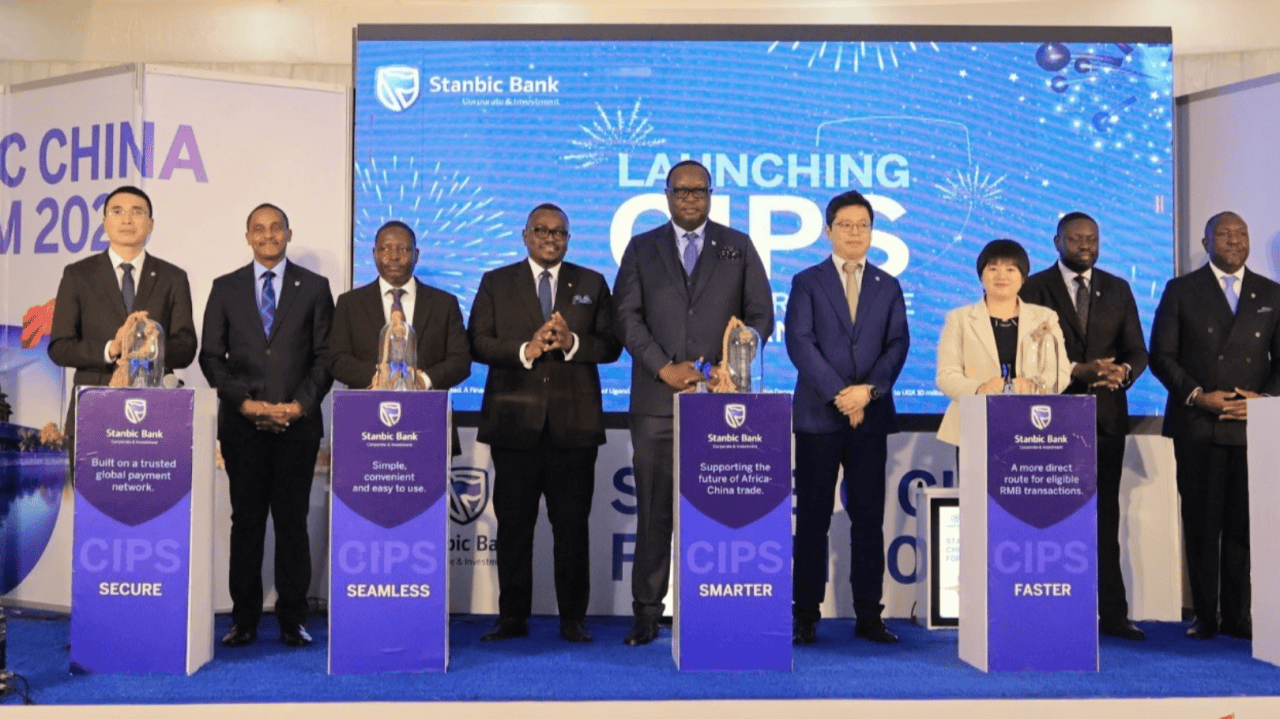
Stanbic Bank Uganda has become the first local lender to connect to China’s CIPS, allowing businesses to settle trade payments directly in yuan.
The move reduces the need for businesses to first convert payments through intermediary currencies when trading with China. Stanbic says this could cut foreign exchange costs, reduce exposure to currency swings and speed up transactions.
The People’s Bank of China launched CIPS in 2015 to support the clearing and settlement of cross-border payments made in renminbi, also known as the yuan.
Stanbic announced the development during the inaugural Stanbic-China Trade Forum.
State Minister for Industry David Bahati said China remains one of Uganda’s most important trading partners.
“China is one of Uganda’s most significant bilateral partners. This solution removes key bottlenecks and opens practical pathways for deeper industrial and commercial collaboration,” Bahati said.
Standard Bank Group Head of Business and Commercial Banking for Africa Regions and Offshore Andrew Mashanda said Africa-China relations should increasingly focus on investment, manufacturing and value addition.
“Africa–China trade has been a key driver of growth across the continent. The next chapter will be defined not just by trade volumes, but by what we build together: manufacturing capacity, value addition, and infrastructure. We must continue unlocking investment opportunities for Chinese partners and create an environment conducive to shared prosperity,” Mashanda said.

Stanbic Uganda Chief Executive Mumba Kalinfungwa said the payment system could give local companies an advantage when dealing with Chinese businesses.
“The system will give Ugandan businesses a competitive edge and significantly contribute to the government’s efforts to grow the economy ten times to reach USD 500 billion by 2040,” Kalinfungwa said.
Kalinfungwa said direct yuan settlement could also improve payment speeds and strengthen commercial ties between businesses in the two countries.
The development comes against a wide trade imbalance between Uganda and China.
Uganda imported goods worth $3.3 billion from China in 2025, while its exports to the Chinese market stood at $118 million.

This left Uganda with a trade deficit of more than $3.1 billion.
Stanbic hopes easier yuan payments will lower costs for Ugandan importers while also helping local exporters connect with Chinese buyers.
The bank has also partnered with Guomao, a platform that links businesses to one of Beijing’s major trading districts.
The partnership is expected to support Ugandan traders seeking suppliers and market access in China.
Chinese foreign direct investment in Uganda has surpassed $1 billion, with major projects spanning oil and gas, infrastructure, and industrial manufacturing. Key ventures include the CNOOC-backed commercial oil developments, industrial parks like the Sino-Uganda Mbale facility, and recent direct yuan settlement mechanisms to ease trade.
Stanbic Bank Uganda is the largest commercial bank in the country by assets and a member of the Standard Bank Group. Headquartered at Crested Towers in Kampala, it operates 83 branches nationwide, offering personal, business, and corporate financial services under its parent company,
Stanbic Uganda total assets expanded to UGX 11.5 trillion, driven by strong corporate lending, SME financing, and digital adoption.
