

Uganda has renewed its call for stronger trade and investment partnerships with the Kingdom of Saudi Arabia, highlighting opportunities in agro-processing, tourism, mining, science and technology, as well as digital infrastructure.
Uganda has a persistent trade deficit with Saudi Arabia, importing significantly more goods and services than she exports in bilateral commerce. Uganda exports to Saudi Arabia are currently valued at US$9.11 million, mainly consisting of coffee, agricultural products like tea and spices, chilled meat, alongside a major service export in migrant labor. Uganda’s total imports from Saudi Arabia are currently valued at approximately $149.15 million, consisting primarily of plastics, fertilizers, and sugar among others.

Uganda’s key exports to Saudi Arabia include coffee, agricultural products, and newly introduced shipments of chilled meat, alongside a major service export in migrant labor. Total recorded merchandise trade remains modest, with specific categories growing through recent bilateral value-addition partnerships.
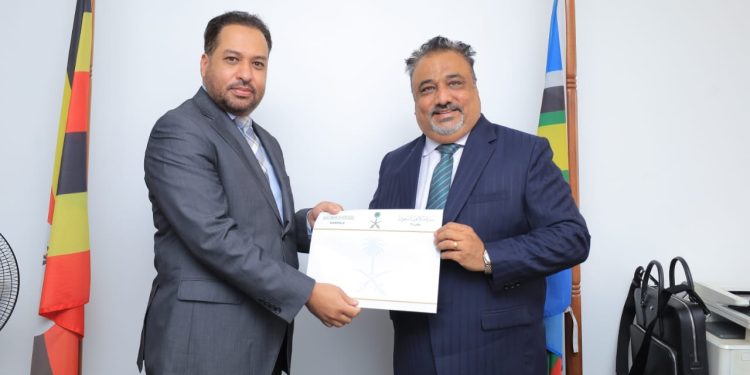
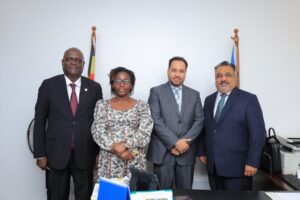
Speaking during a meeting with the Ambassador of the Kingdom of Saudi Arabia to Uganda, H.E. Mohammed Bin Khalil Faroudah, the Minister for Trade, Industry and Cooperatives Hon. Sanjay Tanna emphasized that Uganda is open for business and ready to work with Saudi investors to unlock the country’s vast economic potential.
“We are here to work. Uganda is ready for business. The opportunities are immense, and we need your collaboration and support,” the minister said.
He noted that the Government of Uganda is currently focusing on strengthening economic cooperation with the Gulf countries particularly Saudi Arabia, the United Arab Emirates, Qatar and others, with agro-processing identified as a key area for collaboration.Hon. Tanna said Uganda is adopting a demand-driven production model to ensure farmers produce according to market needs rather than speculative production, which often results in oversupply and low prices.
He further highlighted investment and export opportunities across several value chains, including maize, beans, milk, poultry, beef, fish, cassava, cocoa, honey and shea butter. He persuaded Saudi Arabia to buy Uganda’s sugar, saying that Uganda currently produces nearly 300,000 tonnes of surplus sugar annually, with capacity to increase production to 500,000 tonnes if additional export markets are secured.
“We need your support to find markets for our products. Uganda has enormous agricultural potential and is one of the most fertile countries in the region,” he said.
Beyond agriculture, the minister invited Saudi investors to explore Uganda’s tourism sector, citing attractions such as Murchison Falls National Park, Queen Elizabeth National Park, the source of the River Nile and the Rwenzori Mountains.
He also encouraged investment in mineral value addition, manufacturing and technology-driven industries, noting that Uganda seeks partnerships that will promote industrialization rather than the export of raw materials.
In the digital economy, the minister disclosed that discussions are underway with a Saudi company interested in establishing a data centre in Uganda in partnership with an Indian firm.
“I have already briefed the Minister of ICT, and we shall continue discussions before formally engaging you on the proposed data centre project,” he said, adding that Saudi Arabia’s growing investments in artificial intelligence and data infrastructure present opportunities for collaboration.

Responding to the proposals, H.E. Mohammed Bin Khalil Faroudah welcomed Uganda’s commitment to strengthening bilateral economic relations and emphasized the importance of continued engagement between government officials and technical teams to translate opportunities into concrete investments.The ambassador also emphasized the operationalization of the Saudi-Uganda Joint Technical Committee for Trade Development that was established in 2025 to provide a structured platform for bilateral dialogue between the two countries, address trade barriers, and boost economic cooperation.
“We need to fast-track the implementation of the Joint Technical Committee. The officials and technical groups from both countries should meet together to discuss how to move this forward. I am more than willing,” Ambassador Faroudah said.
The discussions reflect Uganda’s broader efforts to position itself as a preferred investment destination for Gulf countries by leveraging its agricultural potential, tourism attractions, mineral resources and growing digital economy while strengthening trade and economic cooperation with Saudi Arabia.
