

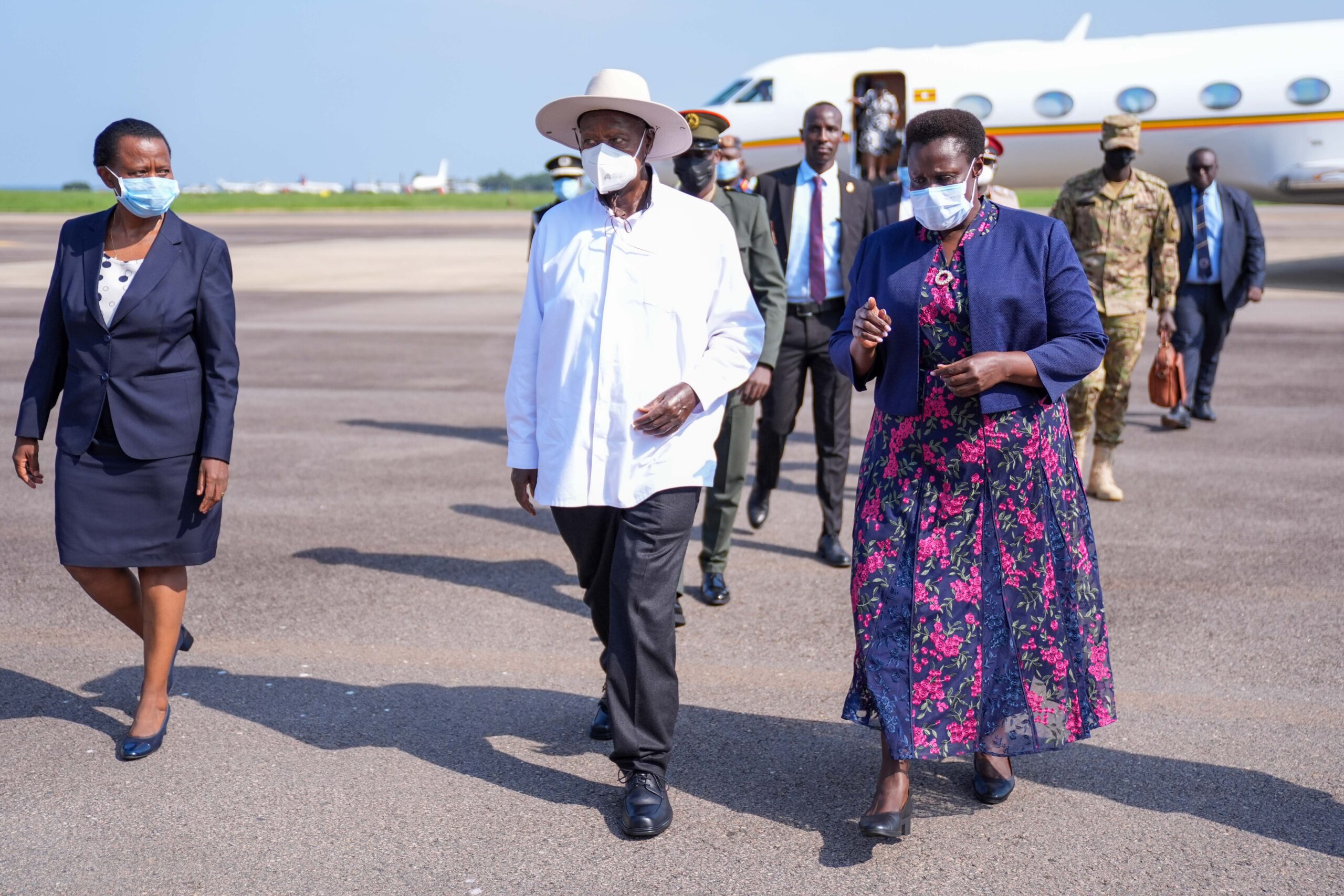
President Yoweri Kaguta Museveni has returned to Uganda following a two-day working visit to the United Republic of Tanzania, where he held bilateral engagements aimed at strengthening cooperation between the two neighbouring countries.
The President arrived at Entebbe International Airport this evening and was received by the Vice President, H.E. Jessica Alupo, the Head of Public Service and Secretary to the Cabinet, Ms. Lucy Nakyobe, and other senior government officials.
During the visit, President Museveni and his Tanzanian counterpart, H.E. Dr. Samia Suluhu Hassan, launched a new phase of Uganda-Tanzania energy cooperation. The two leaders also witnessed the signing of a landmark Memorandum of Understanding (MoU) expected to deepen collaboration in the energy sector and support sustainable economic development.
The visit reaffirmed the longstanding cordial relations between Uganda and Tanzania and underscored the two countries’ shared commitment to advancing regional cooperation through strategic partnerships.
Uganda and Tanzania share strong economic ties anchored by the $6 billion East African Crude Oil Pipeline (EACOP), regional integration via the East African Community (EAC), and a newly signed August 2026 agreement to develop Tanga into a major regional energy hub.
Trade between Uganda and Tanzania is very healthy and in 2013 Tanzania exported $62.2 million worth of goods to Uganda, mainly machinery, agriculture products and medicines. The Balance of trade is very even and in 2013 Uganda exported $62.6 million worth of goods to Tanzania, mainly corn and telecommunication equipment

Tanzania and Uganda anchor their bilateral relationship on the 1,443 km East African Crude Oil Pipeline (EACOP), a USD 3.55 billion cross-border project routing Ugandan crude to the Tanzanian port of Tanga.
Uganda is a strategic partner of Tanzania in trade, security, education, agriculture and energy, with cooperation formalised through their founding membership of the East African Community (EAC).
The two neighbours share Lake Victoria and a long land border, and their economic integration runs through EAC free movement rules, a broadly balanced bilateral trade profile, and joint investment in the EACOP energy corridor that positions Tanga as an export gateway for East African hydrocarbons.

Tanzania and Uganda are founding members of the East African Community, and cooperation spans trade, security, education, agriculture and energy.[1] Both countries are also members of the African Union, the Commonwealth of Nations, the Non-Aligned Movement and the Group of 77, providing multiple multilateral platforms for coordination alongside their EAC engagement.[1] Relations date back to the 1960s independence period from the British Empire, and despite the historical rupture of the 1978-1979 Uganda-Tanzania war, ties have since developed into one of the most integrated bilateral corridors in East Africa

Uganda’s total exports stood at USD 2,357 million and imports at USD 6,044 million, with Kenya ranking as its second largest export market (USD 254 million, 10.78% share) and third largest import source (USD 590 million, 9.76%), reflecting the depth of intra-EAC flows in which Tanzania participates on similar corridors.
Uganda’s leading export products at that time included coffee (USD 370.7 million), transmission apparatus (USD 143.8 million) and refined petroleum oils (USD 138.3 million), while its top imports were petroleum oils (USD 1,309.0 million), medicaments (USD 191.9 million) and automobiles (USD 165.3 million), all product categories relevant to Tanzania’s transit, port and re-export role
EACOP is the flagship Tanzania-Uganda cross-border infrastructure project, a 1,443 km pipeline transporting crude oil from Uganda’s oil fields to Tanga on the Tanzanian Indian Ocean coast, with a design capacity of 200,000 barrels per day and a total cost of USD 3.55 billion.[1] The pipeline anchors Tanga as a strategic export terminal for East African hydrocarbons and directly links Uganda’s upstream production to Tanzanian midstream and marine export infrastructure

Alongside EACOP, Uganda is developing an oil refinery worth USD 2.5 billion, with a private consortium holding 60% and the remaining 40% allocated to EAC member states including Tanzania, Burundi, Kenya, Rwanda and Uganda itself. Tanzania has committed USD 150.4 million for an 8% equity stake in the refinery, embedding bilateral energy cooperation within a formal regional shareholding structure
