


The Permanent Secretary and Secretary to the Treasury, Dr.Ramathan Ggoobi, has called on Ugandans to monitor public expenditure saying the success of the national budget depends not only on its formulation but also on oversight and citizen participation.
Ggoobi also reaffirmed government’s commitment to transparency, accountability and inclusive public engagement throughout the budget cycle while launching National Budget Month for Financial Year 2026/27 in Kampala,
He said the FY 2026/27 budget was developed through extensive consultations involving the President, Cabinet, Parliament, ministries, departments and agencies, local governments, civil society organizations, development partners, the private sector, academia, youth, women, persons with disabilities, and citizens across the country.
“The National Budget Month provides a platform for government to report on achievements, share opportunities contained in the new budget, and receive feedback from citizens to inform future planning and budgeting processes,” Ggoobi said.
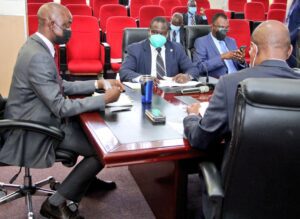
According to him this years FY 2026/27 budget is themed: “Full Monetization of Uganda’s Economy through Commercial Agriculture, Industrialization, Expanding Services, Digital Transformation and Market Access.”
Ggoobi noted that since its introduction in 2018, National Budget Month has significantly strengthened public engagement in the budget process, improved awareness of government programs, and enhanced Uganda’s standing in international budget transparency assessments.
According to the latest Open Budget Survey, Uganda’s budget transparency score improved from 58 percent in 2021 to 59 percent in 2023, surpassing the global average of 45 percent. Similarly, the country’s budget oversight score increased from 59 percent to 67 percent, well above the global average of 52 percent.

He urged citizens and stakeholders to actively participate in Budget Month activities, emphasizing the importance of monitoring government programs, ensuring resources are utilized as intended, and supporting national development priorities under the Ten-Fold Growth Strategy and the Fourth National Development Plan (NDP IV).
Hannington Ashaba, the Acting Director of Budget, also called upon government institutions, civil society organizations, and the media to continue promoting budget literacy, accountability, transparency, and citizen engagement.
The National Budget Month initiative is aimed at enhancing public understanding of the national budget, promoting citizen participation and feedback, strengthening monitoring and accountability in public resource utilization, and making the budget process more accessible and understandable to all Ugandans.
The total national budget for Uganda for the 2026/2027 financial year is shs 84.3trllion above the previous figure of 72trilion.
Parliament has passed a Shs84.3 trillion national budget for the 2026/2027 financial year in April following the adoption of the Appropriation Bill and the report of the Budget Committee that details how the funds will be raised and spent amid growing fiscal pressure from debt and statutory obligations.
The budget was approved during the sitting of the House chaired by Speaker Anita Among on Friday, 24 April 2026.
Finance State Minister, Hon. Henry Musasizi told Parliament that the budget will be financed through domestic revenue of Shs44.18 trillion, representing more than half of the total budget.
Other sources include domestic borrowing of Shs11.97 trillion, external project support of Shs11.27 trillion, domestic refinancing of Shs13.97 trillion, petroleum revenues of Shs1.44 trillion, budget support grants of Shs1.22 trillion and local government revenues of Shs339 billion.
Of the approved expenditure, Shs47.16 trillion has been allocated as discretionary spending while Shs37.23 trillion is classified as statutory expenditure covering debt servicing, wages, pensions and other legally mandated obligations.
