

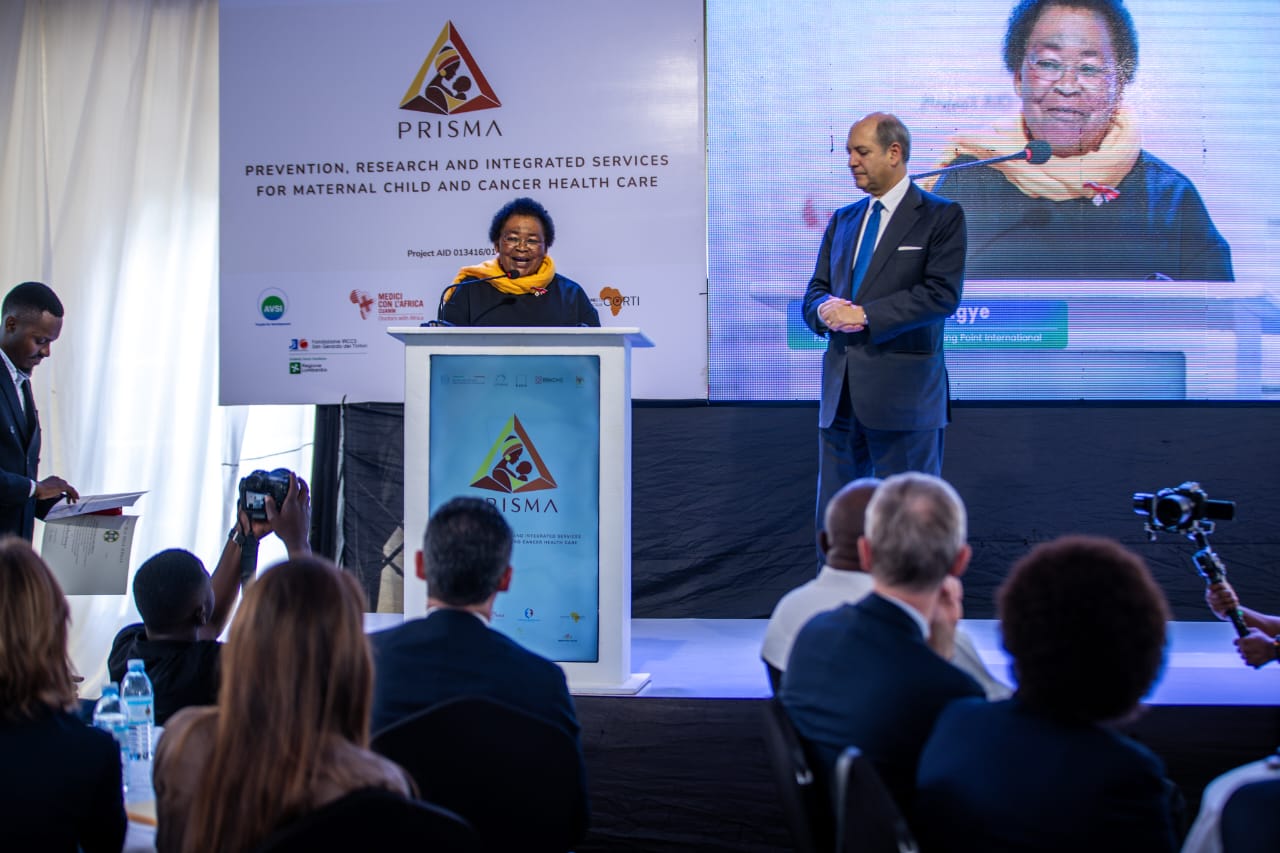
Uganda and Italy have launched a massive €12.75 million (approx. UGX 50 billion) healthcare initiative specifically targeting the deep structural deficits in maternal, neonatal, and oncology care across Northern Uganda. Dubbed the Prisma project (Prevention, Research and Integrated Services for Maternal, Child and Cancer Health), the 36-month intervention will aggressively fortify 32 public and private-not-for-profit (PNFP) health facilities across West Nile, Acholi, Lango, and Karamoja through June 2029.
The project is financed by the Italian Ministry of Foreign Affairs and International Cooperation through the Italian Agency for Development Cooperation (AICS). Led by the University of Milan-Bicocca, the comprehensive framework targets direct, life-saving clinical interventions for over 581,000 women and children.
Speaking at the launch at the AVSI Foundation headquarters in Nsambya, Health Minister Dr. Chris Baryomunsi highlighted the stark demographic and epidemiological pressures straining Uganda’s public health network:
Uganda’s population is expanding at a rapid 3.2% annually, with a high fertility rate of 5.2 children per woman—contrasting sharply with Italy’s shrinking population (-0.37% growth, 1.15 fertility rate).
Local infrastructure is buckling under a dual assault: rampant infectious diseases like malaria and tuberculosis alongside a steep rise in non-communicable diseases (NCDs) like cancer, diabetes, and cardiovascular illnesses.
While institutional maternal deaths dropped from 700 to roughly 200 per 100,000 live births over recent decades, Dr. Baryomunsi stressed that “even that 200 is bad news. Nobody should die while giving birth.”
The Ministry of Health will chair a joint project management committee to oversee Prisma’s field operations, which will be directed from a primary regional office in Gulu City across four core areas:
Scaling up diagnostics and screening for cervical and breast cancers in women, and tackling Burkitt lymphoma in children.

Establishing a robust sample-transport network. Remote facilities lacking advanced pathology labs will route patient biopsies directly to regional hubs including Lira Regional Referral Hospital, Gulu Regional Referral Hospital, and Lacor Hospital.
Adapting to rural constraints. Second Deputy Prime Minister Dr. Crispus Kiyonga noted that health delivery must adjust to pastoral regions like Karamoja, where nomadic families travel long distances during droughts, frequently disrupting immunization schedules.
Driving strict antibiotic stewardship and infection-control guidelines across the 32 designated hospitals to mitigate rising antimicrobial resistance.
To break long-term dependence on foreign medical expertise, Gulu University is leveraging the partnership to launch a Master of Science in Cancer Epidemiology—the first program of its kind on the African continent.
“Diagnosis of cancer should stop being a death sentence in the mind of anybody in Uganda,” stated Dr. Deogratius Mwaka, Dean of the Faculty of Medicine at Gulu University. Faculty and medical students will engage in bilateral academic exchanges with the University of Milan-Bicocca, leading research on early detection pathways for pediatric and female cancers.
Concurrently, the Uganda Cancer Institute (UCI) will deploy localized screening and treatment protocols through its Gulu Regional Cancer Centre and its upcoming West Nile facility in Arua. “Screening and early detection are useless if we cannot link these patients directly to care,” warned Dr. Nixon Niyonzima, Head of Research and Training at UCI, pointing out that existing HPV and PCR machines in the region often sit idle due to a lack of standardization guidelines.
