


Israel has passed a new law to impose the death penalty and conduct public trials for those involved in the unprecedented Hamas-led attacks and mass hostage-taking in Israel in October 2023.
The legislation was passed by 93 votes to 0 120-seat parliament, the Knesset, late on Monday. in Israel’s parliament – the Knesset – and was unusually jointly sponsored by government and opposition politicians.
“May everyone see how the victims and their families look into the whites of the eyes of those murderers, rapists and kidnappers,” Yulia Malinovsky, a co-sponsor of the bill, told a news conference ahead of the parliamentary votes.
“May everyone see how the State of Israel is a sovereign state which knows how to hold those who harmed it to account,” the opposition politician said.
“We have reached the finish line, which is actually the starting line: the beginning of historic trials, which the whole world will see.”
Israeli human rights groups have spoken out against the new law, opposing the principle of capital punishment but also warning against “show trials” based on confessions allegedly extracted under torture.
7 October 2023 was the deadliest day in the history of Israel. Hamas-led fighters killed over 1,200 people in southern Israel, mostly civilians. Another 251 were kidnapped and held in captivity in the Gaza Strip, including men, women, children, and foreign nationals.
The events triggered the deadliest ever war in Gaza, with 72,740 people killed to date – the majority children, women and the elderly, according to the Hamas-run Health Ministry.
Although Israel’s parliament passed the Death Penalty for Terrorists Law in March, aimed at Palestinians convicted of terrorism offences, it does not apply retroactively. This meant that separate legislation was required to deal with those alleged to have carried out the assault.
Israeli politicians supporting the law say it will allow for a trial of historic significance, comparing it to that of the Nazi war criminal Adolf Eichmann. Eichmann – an architect of the Jewish Holocaust – was hanged in 1962, becoming the only person previously sentenced to death by an Israeli civil court.
The new law creates a special legal framework for prosecuting those accused of direct involvement in the attacks, including members of the Nukhba special forces unit of the al-Qassam Brigades, the military wing of Hamas, who were captured in Israel.
They are expected to face charges ranging from terrorism and murder to sexual violence and also genocide – which will carry the death penalty. They will be tried before a special military court in Jerusalem with different rules from regular criminal trials.
Israel is a parliamentary democracy with a multi-party system, where the Prime Minister serves as the head of government, often leading a coalition in the 120-seat Knesset. As of 2026, politics are dominated by right-wing and religious Zionist parties, with a focus on security, the Iranian threat, and managing ongoing conflicts, while heavily influenced by coalition negotiations
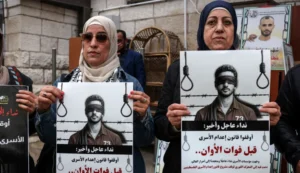
Statement by Israeli International Law Scholars Concerning Israel’s New “Death Penalty for Terrorists” Law
- The undersigned, scholars of international law in Israeli academic institutions, wish to express our outrage and clear condemnation of Israel’s new death penalty law. It is not only immoral and in violation of the most basic dictates of public conscience, but is also unlawful both in terms of domestic constitutional law and Israel’s obligations under international law.
- Israel is a party to the International Covenant on Civil and Political Rights from 1966. Under the Covenant it is prohibited to reintroduce the death penalty once abolished – a prohibition which includes, according to the Human Rights Committee’s General Comment 36 (2018), a ban on extending the list of crimes to which the death penalty applies or relaxing associated procedural safeguards, even for states that have not formally abolished the death penalty. As long as the death penalty is applicable, legal proceedings relating to its imposition must meet all due process safeguards, including the right to seek commutation of the death sentence. The right to commutation is also guaranteed in the Fourth Geneva Convention from 1949. Furthermore, under the Covenant, States must act towards abolition of the death penalty, and in no case may the death penalty be imposed in a discriminatory manner.
- The new law violates all of these standards: It creates a new capital crime (intentional killing with an intent to deny the existence of the State of Israel), and transforms the existing capital punishment under law applicable in the West Bank for the crime of terror killing from an optional sentence to a default sentence which can be deviated from only in special cases. It further relaxes the procedural guarantees associated with the imposition of the death penalty under the law, by authorizing the bench to impose the penalty even by a non-unanimous decision based on a majority of two low-ranking officers, and without the prosecution even asking to impose the death penalty. The law also removes the military commander’s power to commute the sentence. It only allows the Prime Minister to request the court to suspend execution for no more than 180 days. In addition, the law requires the carrying out of execution through hanging – a form of punishment regarded in General Comment 36 as cruel, inhuman and degrading.
- Crucially, the new death penalty law expands the legal circumstances in which the penalty would apply, in a manner that effectively applies to Palestinian convicts only. This is facilitated by the fact that, in civilian courts in Israel, the penalty would apply only to crimes undertaken with an intent to deny the existence of the State of Israel (a motivation unlikely to be attributed to Jewish terrorists), and by the fact that the relaxed procedures for the application of the death penalty in military courts in the West Bank would explicitly apply only to West Bank residents who are not Israeli citizens or residents. The law thus violates explicitly and implicitly both the right to life and the prohibition on discrimination.
- In our view, imposing the death penalty in such circumstances amounts to racial discrimination and, in certain circumstances, even to the crime of apartheid, which may give rise to international criminal liability to anyone involved.
- By having the Knesset legislating directly for the occupied territories, the law also exceeds Israel’s authority as the occupying power, and violates the international prohibition on annexation of territory. The Israeli parliament has no general legal power to pass legislation that governs the conduct of Palestinian residents inside the occupied territories, whether directly or indirectly by requiring the military commander to legislate in a certain manner. Therefore the law, insofar as concerns the occupied territories, is null and void from an international law standpoint.
- We call on the Supreme Court to issue a preliminary injunction against the implementation of the law, and thereafter to declare the law unconstitutional in its entirety, and to strike it down. We also call upon the Attorney General to refuse to defend this law in any proceeding against its constitutionality, as defending the law will associate its office with this reprehensible law. We also forewarn the military commander in the occupied territories that the new law is in clear violation of international law and that any step towards its implementation might expose him, and others under his command, to international criminal liability. We also call on civil society to unite in a struggle against this law and its racist underpinnings, and to all members of the political opposition to commit, in their political platforms, to annul this law after the next elections.
