

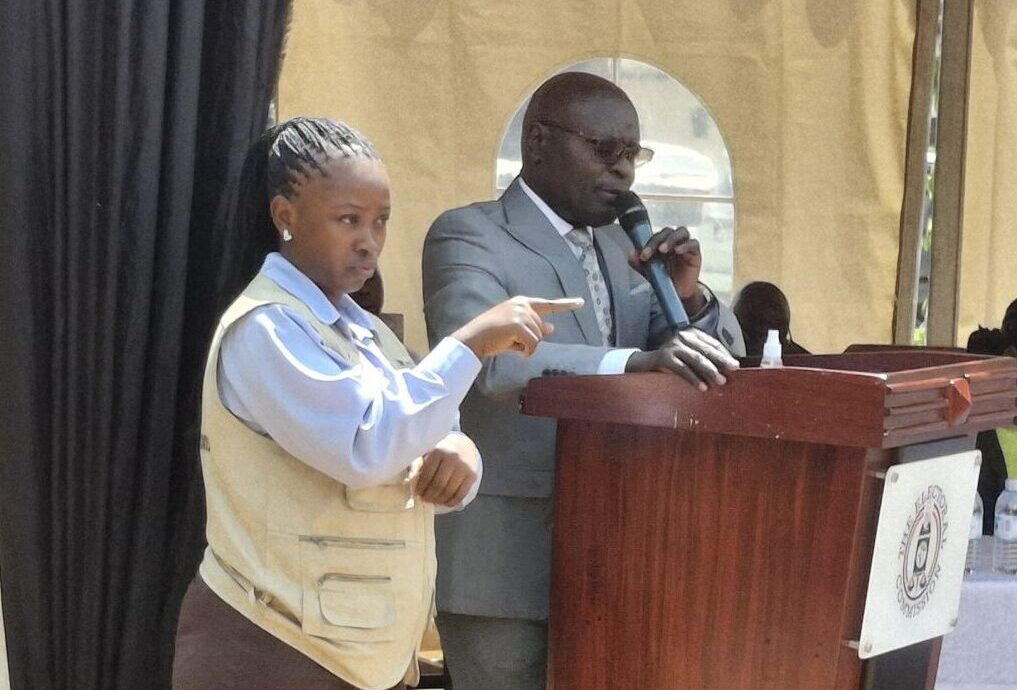
The Electoral Commission has set July 28, 2026, as the date for long-awaited elections of Village Local Council One (LC I) chairpersons across Uganda, ending years of extensions of grassroot leaders’ terms.
EC Chairperson Justice Simon Byabakama Mugenyi said the nationwide exercise will be conducted simultaneously in all 71,214 villages, marking a significant milestone in restoring elected leadership at the grassroots level.
Byabakama revealed that the government has released Shs56 billion to facilitate the elections, paving the way for the commencement of the electoral process.
“The process shall start on July 6 with the verification of residents and compilation of the village register where all residents wishing to participate in the elections, whether as voters or candidates, must be on that register,” he said.

The elections come after several years of delays caused largely by funding constraints. The last village and parish elections were held in 2018, ending a 17-year gap since the previous polls in 2001. When the five-year mandate of the elected leaders expired in July 2023, the Electoral Commission was unable to organize fresh elections due to a lack of funds.
To maintain continuity in local administration, the government, through the Ministry of Local Government, repeatedly extended the tenure of LC I and LC II leaders. The extensions, approved through statutory instruments under the Local Government Act, sparked criticism from legal experts, civil society organizations, and opposition politicians who questioned the legitimacy of leaders serving beyond their original
Under the roadmap, the compilation and verification of the Village General Voters Register will take place from July 6 to July 10, 2026. During the same period, the Electoral Commission will compile a separate register for Village Women’s Council elections.
The Commission emphasized that registration will be free of charge. Eligible voters must be Ugandan citizens aged 18 years and above, ordinary residents of the village in which they seek registration, and willing members of the Village Council. Applicants will be required to present a National Identification Card, National Identification Number (NIN), or proof of National ID registration
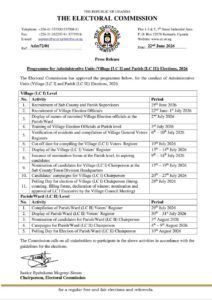
The voters’ registers will be displayed for public scrutiny on July 13 and 14, giving residents an opportunity to verify entries and report ineligible individuals, including deceased persons, minors, non-citizens, and non-residents
Candidates seeking election as LC I chairpersons will collect nomination forms between July 9 and July 14 from Parish Election Officials. Formal nominations will be conducted from July 15 to July 19 at Sub-county, Town Council, and Municipal Division headquarters.
The elections will be conducted under Uganda’s multi-party political system, allowing political parties to field candidates while also permitting independent contestants. No academic qualifications or nomination fees will be required.
Campaigns will run from July 20 to July 27. The Electoral Commission has directed that campaign meetings be held only between 7:00 a.m. and 6:00 p.m. and restricted to the candidate’s village. Cross-village campaigning will not be permitted.
On polling day, voting will be conducted through the traditional lining-up method as provided for under the Local Government Act. Voters will line up behind their preferred candidates, representatives, portraits, or party symbols.
The election exercise will begin with voter verification at 7:00 a.m., followed by voter education and the actual voting process. Results are expected to be declared before noon, after which the newly elected chairpersons will oversee the formation of the remaining members of the Village Executive Committees
The practice of leaders assuming office through elections in Uganda can be traced to pre-independence period, when the British colonial government made a statute that allowed Africans to participate in local elections starting with the Legislative Council (LEGCO) which was a precursor to Uganda’s independence in 1962.
Following the enactment of the Legislative Council (Elections) Ordinance, No. 20 of 1957 on October 16 1957, the Colonial Government organized the first direct elections in Uganda in 1958, which were characterized by Limited African/Ugandans franchise and representation to the Legislative Council (LEGCO).
In the same year, the government convened a Constitutional Conference that debated the preparations for independence. The Governor, Sir Andrew Cohen, appointed Hon. J.V. Wild, the Colonial Administrative Secretary, to chair a committee to recommend the form of elections and the functions of members of LEGCO which would be introduced in 1961. The Wild Committee was also to determine the number of seats in the LEGCO, their allocation among the Protectorate regions, and to set up structures to organise elections leading to independence
In March 1961, the Colonial Government organised direct elections, in which two political parties, namely, the Democratic Party (DP) and the Uganda People’s Congress (UPC) contested. Buganda Kingdom boycotted the elections, and insisted on its demand to have its representatives elected by the Lukiiko, its local legislative assembly. DP won the elections with 43 seats, while UPC got 37 seats; hence DP formed the first ever internal self-government, headed by the Chief Minister, Benedict Kiwanuka.
The 1961 elections were considered unrepresentative because of the boycott by Buganda; hence the Colonial Government organized fresh elections in 1962. Buganda Kingdom was granted its request to hold indirect elections and its Lukiiko [local assembly] nominated 21 representatives to the National Assembly, who represented the Kabaka Yekka (KY) Party.
On 25th April 1962, the Colonial Government organized the National Assembly Elections, in which DP won 24 seats, while UPC won 37 seats. UPC made an alliance with KY Party who had 21 representatives, and formed a UPC-KY government, headed by UPC’s Milton Obote as the first Prime Minister of Independent Uganda.
