







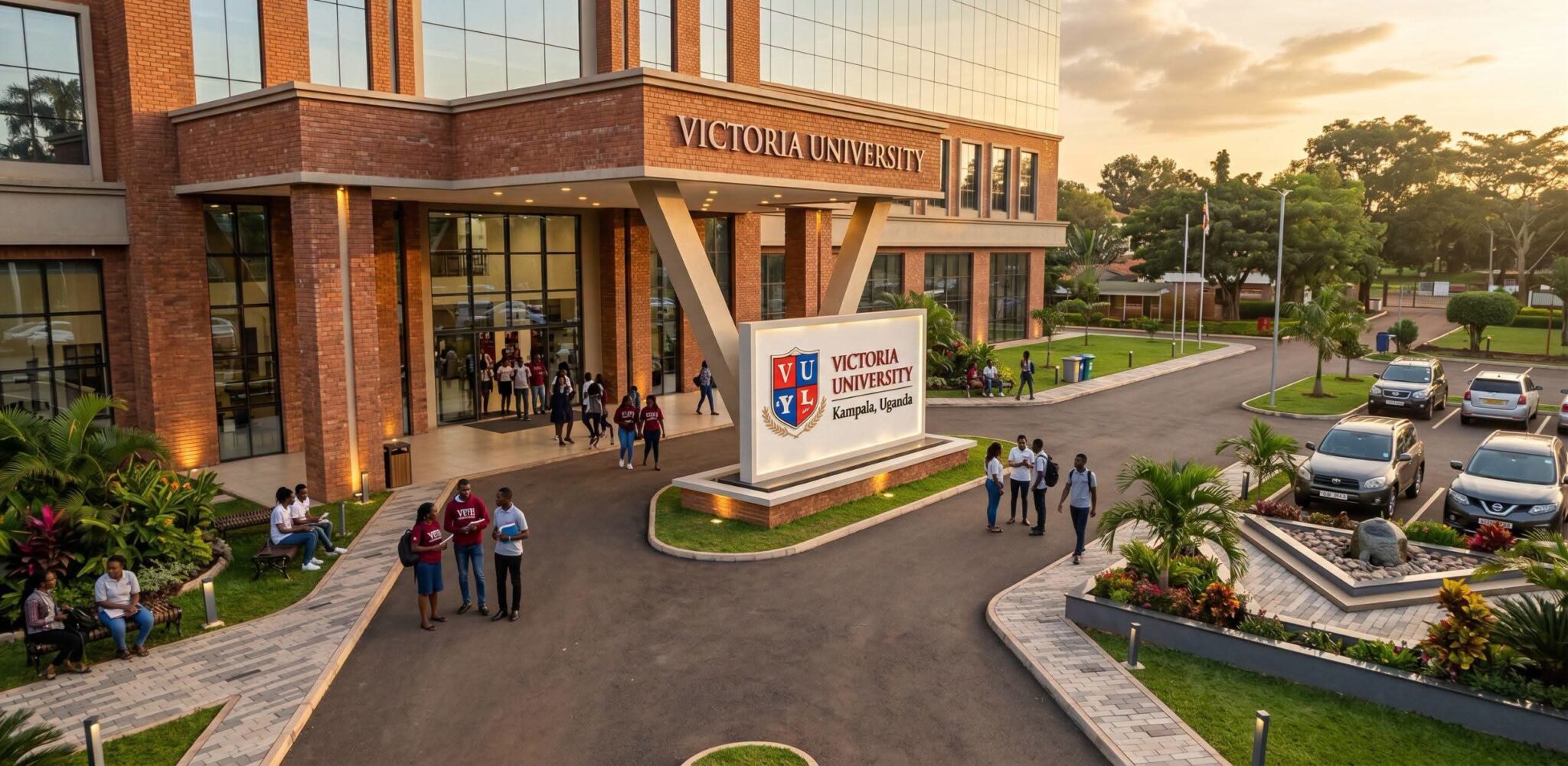
Victoria University is officially expanding its footprint in Kampala, launching construction on a ultra-modern campus in Naguru later this year.
The university’s Vice Chancellor, Dr. Lawrence Muganga, recently shared the architectural design impressions for the new facility. Acknowledging their futuristic look, Dr. Muganga joked that while the stunning designs might look like the work of artificial intelligence, they are the actual blueprints for the institution’s next chapter.
“At first glance, you might think someone got a little too creative with AI,” Dr. Muganga said. “But no, these are the actual design impressions of the upcoming Victoria University campus in the heart of Kampala—Naguru to be exact, close to Phaneroo.”


The strategically located campus will sit in one of Kampala’s fastest-growing hubs. Dr. Muganga confirmed that the university community is eager to break ground and watch the ambitious blueprints transition into a fully functional, state-of-the-art educational facility.
“Yes, this is happening, and I am excited to share that work begins this year,” Dr. Muganga added. “We cannot wait to see these images become something you can actually walk into, experience, and call home. This one is going to be beautiful.”
Known for its emphasis on innovation, practical learning, and digitally enabled education, Victoria University aims for this new campus to further its mission of transforming higher education across Uganda
Victoria University Kampala has set its sights on becoming a regional leader in technology-driven higher education with the launch of its Strategic Plan for 2025/26–2029/30. The plan was unveiled on Friday at Speke Resort Munyonyo, alongside the inauguration of the university’s first-ever Tribunal, a new body tasked with strengthening internal governance and resolving disputes.


Buganda Road Magistrate Ronald Kayizzi who presided over the swearing-in of the tribunal members stressed that the body will serve as the compulsory first avenue for handling academic and administrative complaints. “From today, all disputes must be brought before this tribunal. Skipping this step may lead to dismissal of the matter in court—with costs,” he cautioned.
The new strategic plan, titled “Empowering the Future: Collaboration, Innovation and Impact,” outlines the university’s push toward future-focused, technology-enhanced learning. Key priorities include integrating theory with practical experience, strengthening employability through the block-teaching model, expanding research and entrepreneurship, and deepening engagement with industry and communities.
Vice Chancellor Prof. Lawrence Muganga praised Dr. Ruparelia’s vision, noting the university’s rapid rise since its establishment in 2013. “We want to be the university that turns potential into productivity—where every course builds competence and every learner graduates with proof of workplace readiness,” he said.
A major highlight of the strategy is an upcoming infrastructure expansion. Ruparelia has provided prime land for a modern mega-campus designed to host thousands of students as demand continues to grow. Victoria University, which is chartered by the National Council for Higher Education, already serves over 5,000 learners across business, law, engineering, and health sciences, supported by its flexible trimester system and strong industry links.


The newly constituted tribunal is chaired by barrister and High Court-qualified judge Mr. Elisha Bafirawala. The panel includes representatives from across the university, such as Guild Speaker Rt. Hon. Gizamba Calvin and academic staff representative Dr. Bill Nkeeto. Chancellor Prof. Opuda-Asibo urged the team to uphold fairness, confidentiality, and constitutional standards, saying that strong internal justice is crucial to improving service delivery.
Bafirawala pledged to handle all matters with professionalism and impartiality, reinforcing the institution’s commitment to accountability and integrity.
University Secretary Mrs M. G. Katusabe-Ssemwezi described the five-year blueprint as “a roadmap to global excellence,” aligned with Uganda’s Fourth National Development Plan and the country’s wider agenda for quality higher education.
Positioning itself as East Africa’s leading provider of experiential learning, Victoria University aims to bridge the gap between academia and industry—especially important in a country where more than 70% of the population is under 30.
Backed by Ruparelia Group’s investment, the university says the initiative could reshape how private universities contribute to national development. “The future is never given; it is created by those bold enough to redesign it,” the university declared.


