
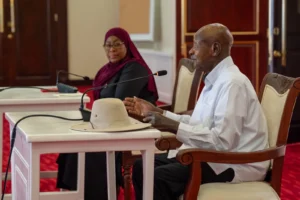





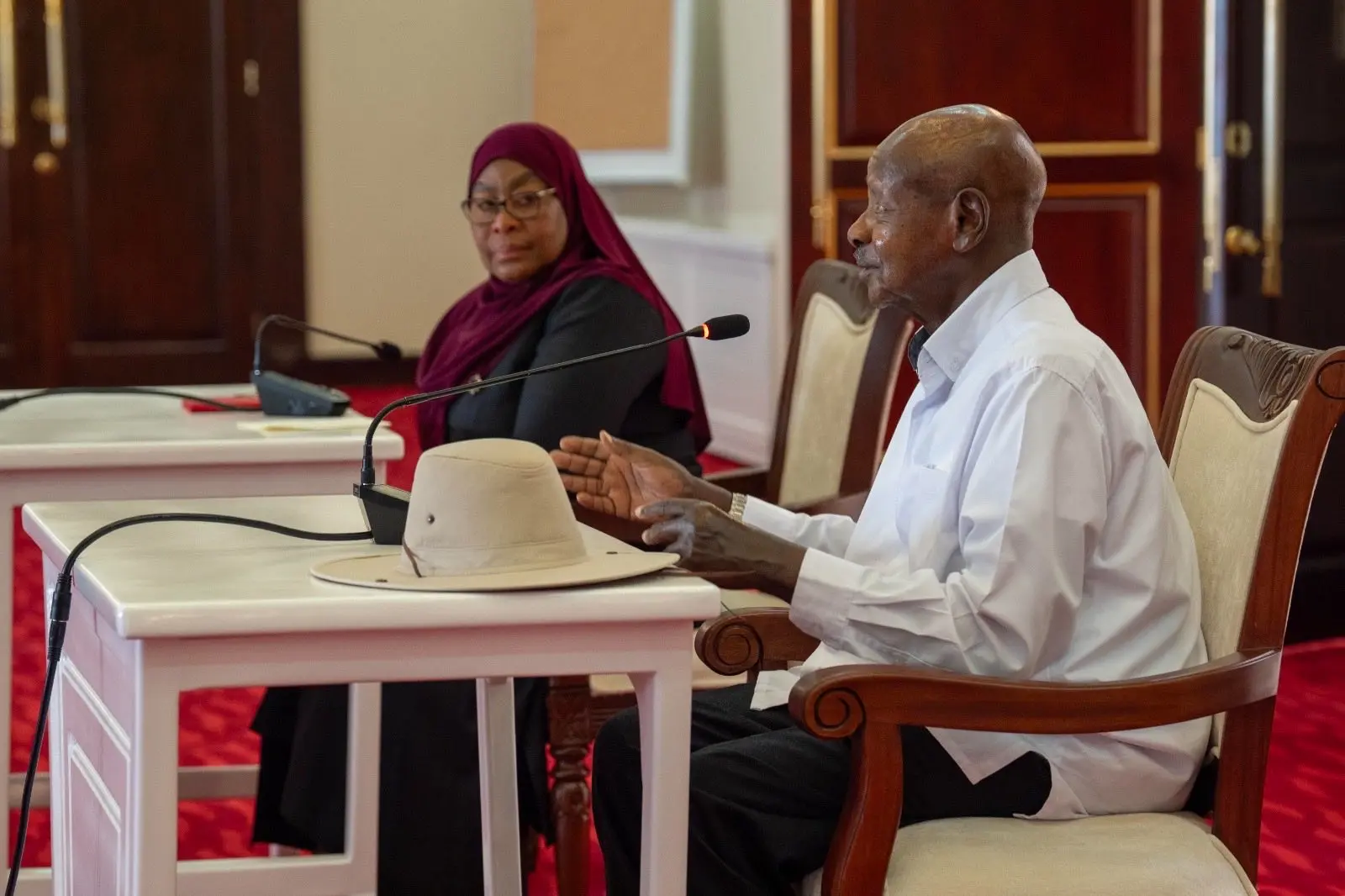
Ugandan President Yoweri kaguta Museveni and his Tanzanian counterpart, Samia Suluhu Hassan, have agreed to expedite work on the east african crude oil pipeline (eacop) and regional standard gauge railway (sgr) networks, with the pipeline now 93.9 per cent complete.
the two leaders met at state house entebbe on november 18, 2026. in a statement following the bilateral talks, museveni confirmed they agreed to accelerate the completion and commissioning of the pipeline alongside regional railway development, though he did not announce specific completion dates.
with construction in its final stages, both presidents directed officials to fast-track remaining testing, commissioning, and operational preparations.
valued at roughly $5 billion, the 1,443-kilometre heated, insulated, and buried pipeline will transport up to 230,000 barrels per day of uganda’s waxy “pearl sweet” crude oil from the tilenga and kingfisher projects in the lake albert basin. the route stretches 296 kilometres from kabaale in hoima district across uganda and 1,147 kilometres through tanzania to the chongoleani marine storage terminal near tanga port.
building on a memorandum of understanding signed in august 2026, the leaders also agreed to fast-track the transformation of tanga into a regional energy hub. the hub will anchor petroleum storage, refining, and joint ventures in manufacturing fertilisers, plastics, and industrial chemicals.
alongside the pipeline, both leaders committed to speeding up cross-border railway links to lower transport costs and ease the movement of goods and people. during the summit, the presidents welcomed the signing of a framework agreement for the isaka–lusahunga–murongo/kikagati–mpondwe sgr project, which will link tanzania’s central railway corridor directly to western uganda.
separately, uganda is advancing its 272-kilometre malaba–kampala sgr line to connect with kenya’s railway network and the port of mombasa. the entebbe talks came a day after state minister for works and transport fred byamukama told parliament that uganda has already paid shs373.07 billion to compensate 7,721 project-affected persons along the malaba–kampala route. with turkish contractor yapi merkezi signed on, the government is working with citibank to reach a financial close on the €2.70 billion ($2.97 billion) project by january 2027 before launching major construction.
Beyond oil and rail, the entebbe summit addressed broader bilateral trade and infrastructure goals:
The leaders called for faster implementation of the 400kv electricity interconnector linking wobulenzi and masaka in uganda to ibadakuli and shinyanga in tanzania.
Authorities were directed to speed up plans for parallel natural gas and refined petroleum product pipelines between the two nations.
Both governments committed to eliminating non-tariff trade barriers to expand market access and streamline cross-border commerce.
Eacop formally launched construction after its final investment decision in february 2022, while the regional standard gauge railway (sgr) network began in stages starting in april 2017 in tanzania and november 2024 (preliminary launch) in uganda.both megaprojects rely on distinct financing models: eacop uses a private-public equity and project-finance debt structure, whereas the sgr networks are sovereign government projects funded through multilateral development banks, export credit agencies, and commercial syndicates.
Planning began in 2013, and foundational stones were laid in 2017. major construction officially kicked off after shareholders signed the final investment decision (fid) on february 1, 2022, with major pipeline laying accelerating in 2023. by november 2026, overall construction reached 93.9 per cent and the project carries an estimated price tag of $5 billion


