

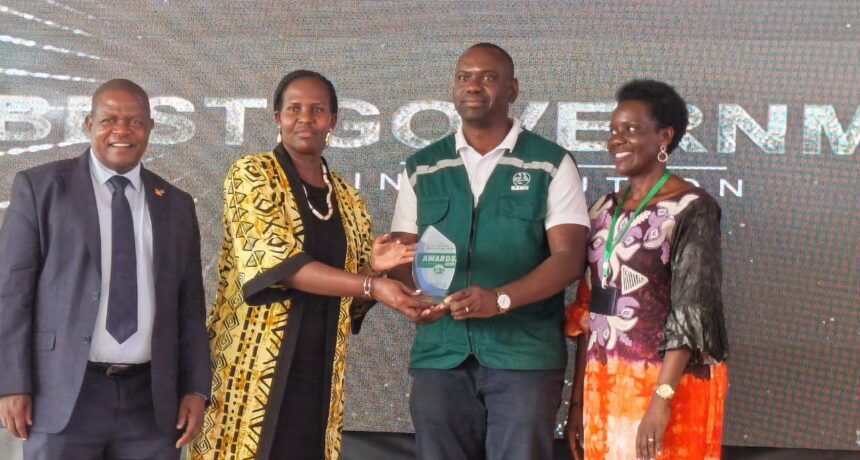
The National Agricultural Research Organisation (NARO) has been named the Best Government Institution at the just concluded 32nd National Agricultural Show in Jinja.
This year’s Education Show was held under the theme: “Youth-Driven Innovation: Growing the Future of the Agricultural Industry.”
The accolade was presented by the evaluation committee’s report, Chairperson Benjamin Isabirye who said NARO distinguished itself through excellence in agricultural research and the development of practical technologies that are transforming Uganda’s agriculture.
“NARO has demonstrated excellence in agricultural research and technology development. It is also the government agency that has excelled in innovation dissemination and the provision of scientific solutions that support Uganda’s agricultural transformation,” Isabirye said.

NARO showcased a wide range of innovations designed to improve agricultural productivity, resilience, and commercialization. Among the highlights were the newly developed anti-tick vaccine, value-added banana products, coffee value chain technologies, forestry innovations, solutions for semi-arid farming systems, climate-smart agricultural practices, improved crop varieties with higher yields and enhanced nutrition, pest- and disease-resistant technologies, mechanization innovations, and the newly introduced black rice variety known for its nutritional and health benefits.
The evaluation committee commended exhibitors for their creativity and commitment to advancing Uganda’s agricultural sector.
“The quality of exhibitions reflected the country’s growing capacity in agricultural production, research, mechanization, value addition, climate-smart agriculture, and agro-industrial development,” Isabirye noted.

Presiding over the closing ceremony, the Minister of State for Agriculture, Hon. Desire Muhooza, commended UNFFE for organizing the annual exhibition, saying it reinforces President Yoweri Kaguta Museveni’s vision of transitioning Uganda from subsistence farming to commercial agriculture by equipping smallholder farmers with knowledge, technologies, and market opportunities.
The Minister reaffirmed the Government’s commitment to strengthening agricultural extension services to ensure farmers receive timely technical support while providing reliable feedback from communities to guide policy and interventions.
“I want to deploy ‘battalions’ on the ground so that farmers receive the right messages while also establishing a dependable feedback mechanism that enables us to implement solutions tailored to the real challenges they face,” she said.

She added that the Ministry would engage stakeholders on establishing regional agricultural exhibition spaces to replicate the impact of the Jinja Agricultural Show across the country.
The Minister also directed NARO’s National Coffee Research Institute (NaCORI) to urgently develop mechanisms to address the growing national demand for coffee seedlings.
During the event, NARO launched the Next Wave: Seeds of Wealth initiative, a new campaign aimed at building resilient and economically secure coffee farming communities in the Busoga and Bukedi sub-regions through research, innovation, and improved access to quality planting materials.
Although the National Agricultural Show has concluded, activities at the Jinja Show Grounds continue with the Education Show, which runs from July 6 to 11, 2026. The event is expected to inspire young people to embrace agriculture through innovation, agribusiness, and practical learning.

The National Agrucltural Research Organisagtion is an agency of the Ministry of Agriculture with the mandate to coordinate and over see all aspects of public funded agricultural research in Uganda
Established as a body corporate by the National Agricultural Research Act of 2005, NARO comprises a Governing Council, a Secretariat and 16 Public Agricultural Research Institutes (PARIs) spread across the country.
NARO is mandated to undertake research in all aspects of agriculture including crops, livestock, fisheries, forestry, agro-machinery, natural resources and socio-economics.
