


Absa Bank Uganda and Amref Health Africa have extended a rainwater harvesting facility to Lwanika Primary School in Mayuge District to keep vulnerable girls in school.
The project addresses menstrual health, provides clean water, and aims to lower school dropout rate.
The Mayuge school commissioning is part of a broader Absa-Amref partnership funded by the KH3 7 Hills Run. Across 20 schools in Mayuge, Mbale City, and Bukwo District, the program has supported thousands of learners with menstrual health information and reusable sanitary pads.
Officials say clean running water provides the necessary sanitation required for girls to manage menstruation safely and with dignity.
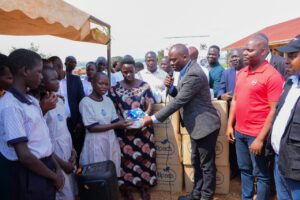
Also lack of adequate facilities often forces girls to miss school during their periods. This project removes that barrier to ensure uninterrupted learning.
The Absa–Amref partnership has so far channelled UGX 80 million into the effort, delivered in two phases and reaching 20 schools across Mayuge District, Mbale City and Bukwo District. The programme has supported 5,295 girls with reusable sanitary pads, reached 6,196 learners with menstrual health and sexual and reproductive health information, and trained 60 teachers as Menstrual Hygiene Management Champions.
At Lwanika Primary School specifically, 225 vulnerable learners have received school uniforms and socks, while the new water facility is expected to ease access to water needed for menstrual hygiene management — addressing one of the practical barriers that often causes girls to miss school during their periods.

Julius Busingye, Relationship Manager for Corporate and Investment Banking at Absa Bank Uganda, said the initiative was designed to ensure the marathon’s impact reaches beyond race day.
“At Absa, we believe every kilometre run in the KH3-7 Hills Run should translate into meaningful impact. For many girls, access to water, menstrual hygiene support and basic school essentials can make the difference between staying in school and falling behind,” he said. “Through this partnership with Amref, we are helping create safer, more supportive learning environments where girls can learn with dignity and confidence.”
Timothy Tirwomwe Basiimampora, Chair of the Amref Health Africa Advisory Council, said the project tackles a barrier to education that is often overlooked.
“This partnership is helping remove barriers that keep girls out of school by combining menstrual health education, reusable sanitary pads, school uniforms and improved access to water,” he said. “The commissioning of this facility is an important step in ensuring that girls have the support they need to manage menstruation safely, remain in class and continue learning.”
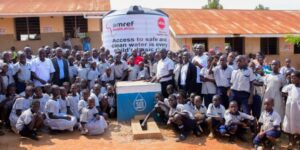
Absa said it plans to continue using proceeds from the KH3-7 Hills Run to fund similar community-led interventions in partnership with Amref, with the aim of improving school attendance and long-term opportunities for girls in the region.
Absa Bank Uganda is part of Absa Group Limited, one of Africa’s largest diversified financial services groups, listed on the Johannesburg Stock Exchange. It operates 39 branches, 91 ATMs and 26 cash deposit machines across the country, and is regulated by the Bank of Uganda
The Mayuge District Local Government and the Ministry of Water and Environment have expanded piped water access through the National Water and Sewerage Corporation (NWSC) for Mayuge Town Council, which currently serves over 25,000 residents,significant infrastructure gaps remain in the remaining sub-counties, historically causing reliance on broken boreholes and unprotected springs
Challenges and Interventions
While the district average is solid, access rates vary widely, dropping as low as 28% in certain areas like Malongo Sub-County.
Over 150 water points across the district have previously been classified as abandoned or broken. The district’s Water Sector relies on routine mechanical inspections and borehole maintenance supervisors to rehabilitate faulty points
