






By Our Correspondent
As prolonged droughts and unpredictable weather patterns continue to threaten traditional food production in the Karamoja sub-region, a humble root crop is being transformed into a powerful shield against climate change.
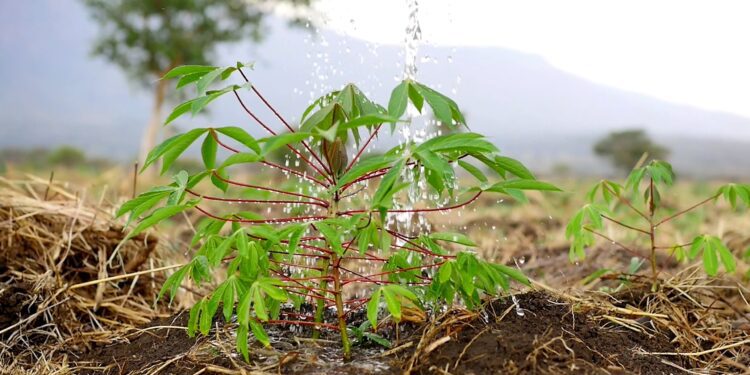
Agricultural researchers have launched a massive campaign to promote drought-resilient cassava varieties, aiming to provide local households with a dependable food reserve that can survive even the harshest dry spells. At the center of this effort is a new 200-acre cassava multiplication and demonstration facility at the Nabuin Zonal Agricultural Research and Development Institute (ZARDI) in Napak District.
Established by the National Agricultural Research Organisation (NARO) under the Uganda Climate-Smart Agricultural Transformation Project (UCSATP), the facility serves a dual purpose: drastically increasing local access to high-quality planting materials while teaching farmers modern, climate-smart agronomic practices.
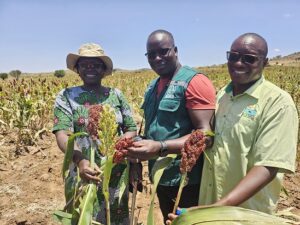

Dr. Walter Odongo, the Director of Research at Nabuin ZARDI, explains that cassava’s unique biology makes it uniquely suited for Karamoja’s shifting climate.
“Cassava has proven to be a very resilient crop for the farmers,” Dr. Odongo said. “The intention here is about two-fold: one, to increase access to quality planting material, but also to demonstrate cassava production technology to the farmers.”
Among the climate-smart varieties being distributed is NAROCAS 1, a variety that Dr. Odongo notes has already shown exceptional adaptation to Karamoja’s unforgiving soils and weather.


The impacts of the 200-acre “nuclear farm” are expected to ripple across the entire region. Dr. Damalie Akwango, the UCSATP Coordinator at NARO, revealed that Nabuin ZARDI is currently partnering with roughly 200 farmer groups. The massive multiplication block is projected to generate enough high-yield planting materials to supply at least 6,000 farmers across Karamoja.
“This is a good move towards the achievement of what is planned in the project,” Dr. Akwango said.
To ensure maximum survival and yield, NARO is focusing on three specific varieties: NASE 14, NASE 19, and NAROCAS 1. According to Dr. Ijara Anthony Raphael, a Senior Research Officer at NARO, these varieties were handpicked for their fast maturity rates and high yields. NASE 14 offers quick maturity and excellent soil compatibility, NASE 19 is prized for its high-yielding traits, and NAROCAS 1 brings proven stability from successful trials across Uganda.
However, researchers face a unique cultural hurdle: changing how locals view the crop.
“In Karamoja, cassava is perceived as a wild crop that grows on its own, so we are trying to stimulate uptake of cassava,” Dr. Ijara said.
By utilizing the demonstration farm as a practical training center, NARO hopes to transition communities from casual foragers to deliberate, skilled cassava cultivators.


The biggest selling point for the crop is its unparalleled harvesting flexibility. Unlike grains or legumes that rot if left unharvested, cassava acts as a natural underground storehouse. It can remain safely in the soil for more than two years, allowing families to harvest it “piecemeal”—only taking what they need, when they need it.
“Cassava can ensure food availability throughout the year because it can be harvested piecemeal and is always available when needed, as opposed to other crops which you harvest once and consume,” Dr. Ijara emphasized.
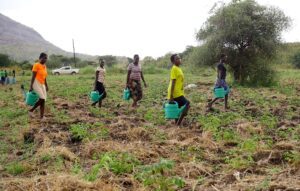
Beyond long-term food security, the Nabuin ZARDI facility is injecting immediate economic life into Napak District. The farm employs an average of 50 local workers daily—predominantly women and youth—who earn roughly Shs7,000 per day for vital tasks like weeding, planting, and manual watering during dry spells. It also serves as a living classroom for agricultural students pursuing certificates, diplomas, and postgraduate degrees.

On the ground, local farmers are already celebrating the shift. Lugel Patrick, a host farmer in Napak who underwent NARO’s training, says the community response has been overwhelmingly positive.
“These cassava varieties are very good. Farmers are very happy about them,” Lugel said. “My call to the farmers in Karamoja is that they should continue planting cassava to fight hunger. We want cassava as a staple food.”
Lugel noted that local families are integrating cassava into their traditional diets by drying and grinding the root to mix it with sorghum flour, creating a hearty, filling meal.
Furthermore, the crop is proving to be a viable cash cow. “The money got from selling the cassava can be used for taking children to school and you can also use it for buying animals that you rear at home,” Lugel added.
By rewriting the narrative of cassava from a wild backyard root to a commercial, climate-resilient staple, NARO and its partners are building a more food-secure and financially stable future for Karamoja, one acre at a time.


