







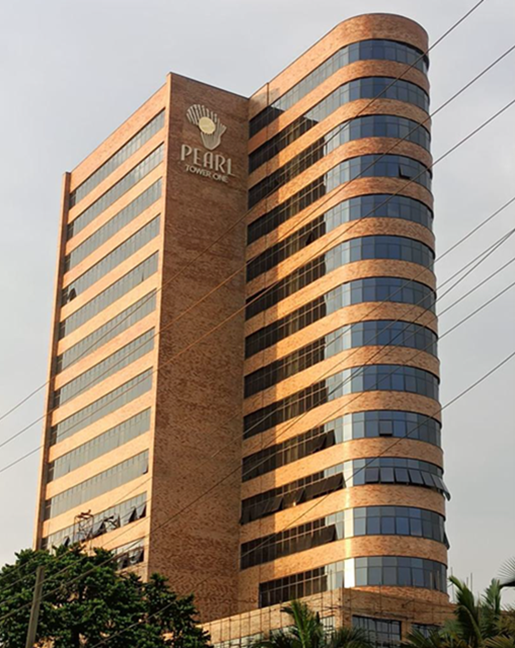
Uganda Revenue Authority (URA) has relocated its Real Estate Tax Office from its headquarters in Nakawa to RR Pearl Tower One, a property owned by Property Mogul Dr. Sudhir Ruparelia, in a move aimed at improving service delivery to taxpayers.
According to a public notice issued by URA, the Real Estate Tax Office officially moved to the new premises on September 7, 2026 to occupy 9th Floor of RR Pearl Tower One along Yusuf Lule Road, opposite the Ministry of Health headquarters.
URA said the relocation is intended to make it easier for taxpayers to access real estate tax services while improving the authority’s service delivery.


The relocation also puts one of URA’s specialised tax offices in a landmark building associated with the Ruparelia Group, one of Uganda’s prominent business empires and biggest real estate taxpayer in Uganda.
RR Pearl Tower forms part of the Ruparelia Group’s extensive property portfolio. The “RR” Pearl name is associated with the Ruparelia family and honours the late Rajiv Ruparelia, Dr. Sudhir Ruparelia’s son, whose death in 2026 shocked Uganda’s business community and beyond.
Rajiv was widely known for his involvement in the family’s business interests and philanthropic activities before his untimely death.
The choice of RR Pearl Tower as the new home for URA’s Real Estate Tax Office comes at a time when Uganda continues to place greater emphasis on improving compliance and revenue collection from the rapidly expanding real estate sector.

Real estate taxation remains an important area for URA, given the growth of commercial and residential property developments, particularly in Kampala and other urban centres.
URA has asked taxpayers seeking services from the Real Estate Tax Office to take note of the new location.
Stay updated with The Standard New Uganda – your trusted source for breaking news, politics, business, and analysis. Get the latest stories shaping Uganda and beyond.
Uganda’s real estate sector is an emerging market and one of the safest fields of investment in Uganda. The sector has grown tremendously over the past decade with many residential homes, business premises and office blocks being set up, especially in the Kampala Central Business District.
The sector is characterized by big residential estates put up by individuals mainly for rental purposes, office blocks, large and medium shopping malls.


Key drivers for the sector are growth in population, the steady economic growth, remittances from Ugandans living abroad and the investment opportunities in the sector.
The 1995 Constitution grants land ownership rights solely to citizens of Uganda. Foreigners cannot own land freehold. They may, however, obtain leases for 49 or 99 years. Foreigners can either rent/lease from citizens or from the government.


Current State of Uganda’s Real Estate
Uganda’s property market is thriving, with Kampala leading the charge. The capital city accounts for over 60% of all real estate transactions in the country.
Residential properties, especially apartments and townhouses, are in high demand. Areas like Kololo, Nakasero, and Ntinda are hotspots for luxury homes, while suburbs like Kira and Bweyogerere cater to middle-income buyers.
Commercial real estate is also growing. Office spaces in central Kampala fetch high rents, and retail spaces in malls like Acacia Mall and Garden City are fully occupied.
Outside Kampala, towns like Entebbe, Jinja, and Mbarara are seeing increased activity. Entebbe, for instance, is becoming a hub for tourism-related properties, while Jinja is attracting industrial investors.
The rural property market is not left behind. Improved infrastructure, such as new roads and electricity connections, is making remote areas more accessible. This has led to a rise in land prices and development projects in regions like Masaka, Fort Portal, and Gulu.


