





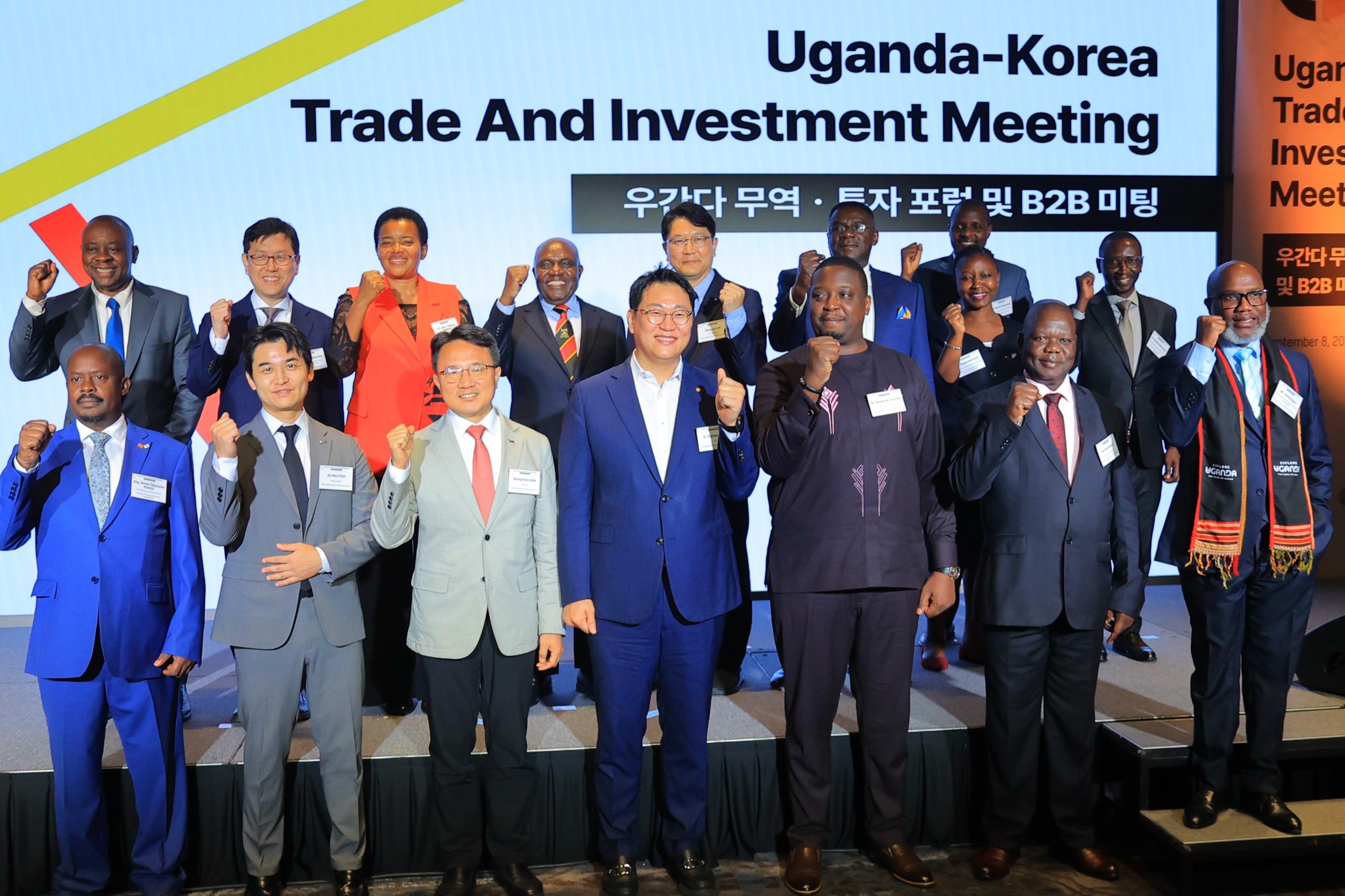
Uganda has opened a trade and investment meeting in Seoul with a pitch to Korean capital and technology, presenting itself as a low-cost manufacturing base for the wider African market and as part of a plan to grow its economy to $500bn by 2040.
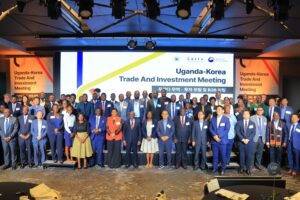
The Uganda–South Korea Trade and Investment Meeting, held at The Westin Seoul Parnas under the theme “Boosting Trade and Investment Between Uganda and South Korea”, is co-hosted with the South Korea International Trade Association (KITA). Tuesday’s opening session brought together Ugandan ministry officials, the Uganda Investment Authority (UIA) and Korean government and business representatives.
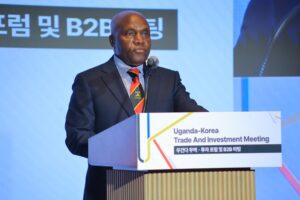

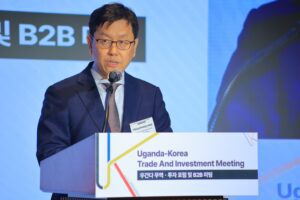
Delivering the keynote, Dr Crispus Kiyonga, Uganda’s Second Deputy Prime Minister and head of the delegation, said the economy had grown to about $70bn, with real GDP expanding by an average of more than 6% a year over the past decade. He said the government expected growth of more than 10% once commercial oil production begins later this year.
Dr Kiyonga said Uganda offered investors business registration in as little as 45 minutes, a 10-year tax holiday, exemptions on imported machinery and access to land for strategic projects. Those setting up in industrial parks, he added, would also get a 10-year income tax exemption on rental income and full depreciation on mining exploration equipment.
He said Uganda’s location “at the heart of Africa”, and its membership of the East African Community (EAC), the Common Market for Eastern and Southern Africa (COMESA) and the African Continental Free Trade Area (AfCFTA), opened access to a market he valued at more than $3.1 trillion. He said Uganda had a youthful, largely English-speaking population, with more than 73% aged under 30.
The meeting’s first concrete result came a day before the main session. On Monday 7 September, Uganda signed a memorandum of understanding with GVCC Co. Ltd, a coffee firm in the southern Korean port of Busan.
Under the deal, Besmark Coffee Company Ltd will act as Uganda’s exclusive supplier and GVCC as the exclusive distributor in South Korea. A first consignment of two containers is already being shipped, the Ugandan delegation said.
The partners said they planned to use Busan as a hub to process and re-export Ugandan coffee across Asia, including to Japan and South East Asia, with volumes and prices set under separate commercial agreements.
GVCC’s chief executive, Soo-jung Lim, said the firm was ready to trade with Uganda, having taken an interest in its coffee after meeting the delegation at an exhibition in Busan. Tophace Kaahwa, Uganda’s ambassador in Tokyo, whose mission is accredited to South Korea, said Ms Lim was aiming for one 20-tonne container a day — about 3,500 tonnes a year — and urged Ugandan farmers to grow more to meet the demand.
Richard Nuweyesiga, director of the investment division at the UIA, said the government was focusing on four sectors: agro-industrialisation, tourism, science and technology, and mineral development, and urged Korean firms to “use Korean capital, use Korean technology, tap into Ugandan resources”.
He said Uganda held 49% of East Africa’s arable land and produced more than 5 billion litres of milk a year, and invited investment in adding value to coffee, fish and dairy.
A panel of ministry and agency officials was asked why a Korean manufacturer weighing several African locations should choose Uganda, and which imports could be made locally through joint ventures.
Richard Okot, an assistant commissioner at the Ministry of Trade, Industry and Cooperatives, said Uganda’s central location cut transport and logistics costs for reaching Kenya, Tanzania, the Democratic Republic of Congo, South Sudan and Rwanda.
Mr Okot said vehicle parts and filters, medical devices, diagnostic equipment and pharmaceuticals could be made in Uganda instead of imported. Coffee and cocoa, he added, offered scope for a shared value chain, with some processing done in Uganda and finished in South Korea.
Eng. Simon Tebasulwa Kelanzi, commissioner for nuclear energy at the Ministry of Energy and Mineral Development, invited investment in iron and steel processing, wind and solar power, and nuclear applications.
Amos Mpungu, commissioner for information technology at the Ministry of ICT and National Guidance, was asked whether Uganda could host Korean firms in software development, business process outsourcing, artificial intelligence and digital services. He pointed to South Korea’s own shift from an agrarian to a technology economy and the scope for developing solutions together.
Kwang-yong Chung, director general for African and Middle East affairs at South Korea’s foreign ministry, said Africa was becoming an important engine of global growth, and that South Korea wanted to turn a strong government-to-government relationship into more trade and investment.


Building on the 2024 South Korea–Africa Summit, South Korea planned to host the next one in 2029, he said, and was considering making it a regular event. He noted Korean support for distance learning at Makerere University and for vocational training in Uganda.
Uganda and South Korea established diplomatic relations in 1963. Dr Kiyonga said South Korea’s development assistance to Uganda had exceeded $500m across health, education and infrastructure.
Before Tuesday’s session, a matchmaking programme paired six Ugandan companies with Korean firms in electronics, bio and financial technology over six timed sessions.


The meeting follows a diaspora outreach in Seoul at the weekend, where officials urged Ugandans in South Korea to invest capital and skills at home. Community members again raised the lack of a resident Ugandan embassy in Seoul; consular services are run from Tokyo, and Uganda’s ambassador is non-resident.
The meeting continues, with sector-specific engagements and further business talks scheduled through 10 September.


