

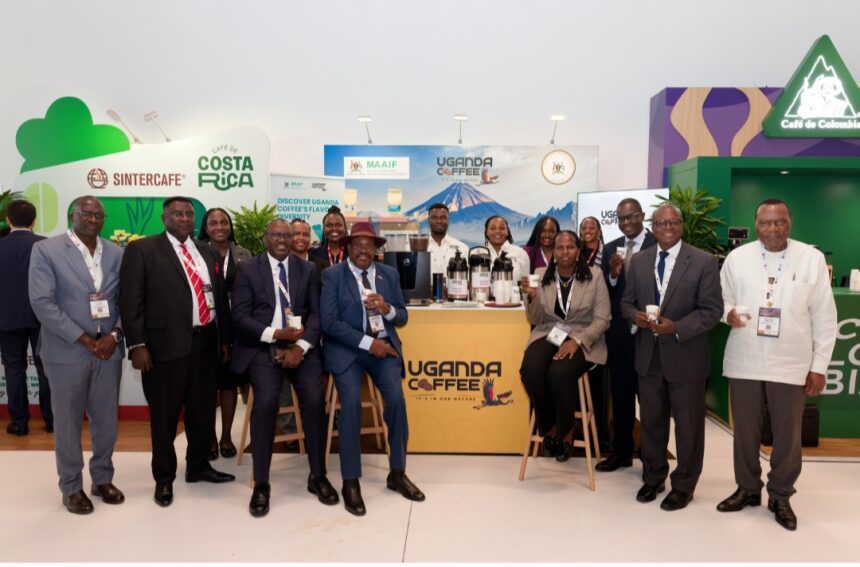



Uganda has majorly strengthened its position in the global coffee market during its historic debut at the 17th Swiss Coffee Trade Association (SCTA) Forum and Dinner in Montreux.
Leading a high-level delegation, government officials and private sector leaders declared Uganda’s commitment to building a competitive, sustainable, and fully traceable coffee sector capable of meeting strict international standards.
The SCTA is a powerhouse in the global industry, representing over 40 companies that manage more than 50 percent of global green coffee exports.


Uganda’s entry into this space marks a massive milestone for its economic diplomacy and trade relations.
Opening the engagement, Hon. Desire Muhooza, Minister of State for Agriculture, revealed Uganda’s explosive sector growth. National coffee exports have surged from 3.6 million bags in 2017 to more than 8.3 million bags in 2025.
Growth is powered by intentional government investments, including free seedlings, farmer training, and subsidized fertilizers.
Economic Lifeline: Coffee remains central to rural livelihoods, supporting millions of Ugandan households.

With international regulations tightening, Uganda is aggressively implementing systems to comply with global standards like the European Union Deforestation Regulation (EUDR).
Rtd. Maj. Gen. David Kasura-Kyomukama, Permanent Secretary for the Ministry of Agriculture, Animal Industry and Fisheries (MAAIF), emphasized that the country is fast-tracking farmer mapping and registration.
“We are not pursuing traceability solely because international markets require it. We are doing so because transparency, sustainability, and accountability are fundamental to the future competitiveness of Uganda’s coffee sector,” Kasura-Kyomukama stated.
Uganda is transitioning from exporting raw commodities to capturing premium market value. At the forum, the Ugandan booth stood alongside coffee giants Costa Rica and Colombia, showcasing its unique Fine Robustas (known for chocolate, caramel, and spicy profiles) and specialty Arabicas from Bugisu, Mount Elgon, and the Rwenzori Highlands.


Mr. Joseph Enyimu, Commissioner at the Ministry of Finance, Planning and Economic Development, noted that this shift opens up lucrative private sector opportunities in processing, manufacturing, branding, and export development.
By aligning ministries and private actors, Uganda’s commercial diplomacy aims to protect the smallholder farmers at the backbone of the industry while securing a dominant, trusted spot on global retail shelves.