


The number of Female Headed families has increased in Uganda,New Uganda Harmonized Integrated Survey (UHIS) report conducted by Uganda Bureau of Statistics has revealed
The report further shows notable shifts in Uganda’s population characteristics, including a rise in female-headed households, growing literacy levels, and an increase in school attendance among children.
The Uganda Harmonized Integrated Survey (UHIS) is a flagship, nationally representative survey program conducted by the Uganda Bureau of Statistics (UBOS). It provides comprehensive and high-quality data on household living conditions, agricultural production, food security, and socio-economic trends to guide evidence-based policy and national development planning.
UBOS officially launched the consolidated UHIS reports covering Waves I, II, and III (collecting data across 2021/22, 2023/24, and 2024/25). Key highlights from the survey

According to the report, the proportion of male-headed households declined from 66.3 percent in 2021/22 to 64.3 percent in 2024/25, while female-headed households increased from 33.7 percent to 35.7 percent over the same period.
The survey further noted that one-member households increased from 7.8 percent in 2021/22 to 10.2 percent in 2024/25, suggesting a gradual rise in smaller family units however households with more than five members declined from 44.6 percent to 42.1 percent.
On education the report indicated arise in the proportion of children aged between six and 12 years attending school rising from 85.5 percent in 2021/22 to 94.6 percent in 2024/25.
According to the report girls slightly outperformed boys in school attendance in the latest survey year, with attendance rates standing at 94.9 percent for females compared to 94.3 percent for males.
In terms of literacy levels among persons aged 10 years and above improved substantially. National literacy rates increased from 73.6 percent in 2021/22 to 85.3 percent in 2024/25.
Male literacy remained higher at 92 percent in 2024/25 compared to 80.2 percent among females. However, the gap narrowed as female literacy improved steadily over the survey period.
Rural areas recorded the biggest gains in literacy. The literacy rate in rural communities rose from 67.8 percent in 2021/22 to 83.2 percent in 2024/25, while urban literacy increased from 84.5 percent to 91.1 percent.
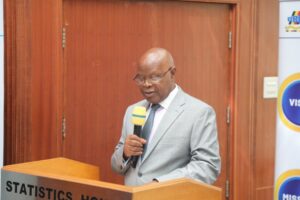
Dr. Chris N. Mukiza UBOS Executive Direcror in his remarks noted that the Uganda Harmonised Integrated Survey (UHIS) Report covering Waves I, II and III (2021/22, 2023/24 and 2024/25) provides integrated socio-economic and agricultural statistics to support planning, policy formulation, monitoring, and reporting on national, regional and international commitments. The report presents up-to-date data on housing conditions, labour force characteristics, unemployment, access to grid electricity, financial services, and other key development indicators.
Dr. Albert Byamugisha, Chairperson of the UBOS Board of Directors urged ministries ,Departsment,Agencies and civil society organisations to use the avaliable report for planning and education purposes strrssing that report provides an important evidence base for understanding household welfare, agricultural production, and socio-economic trends, while supporting evidence based planning, policy formulation.
