





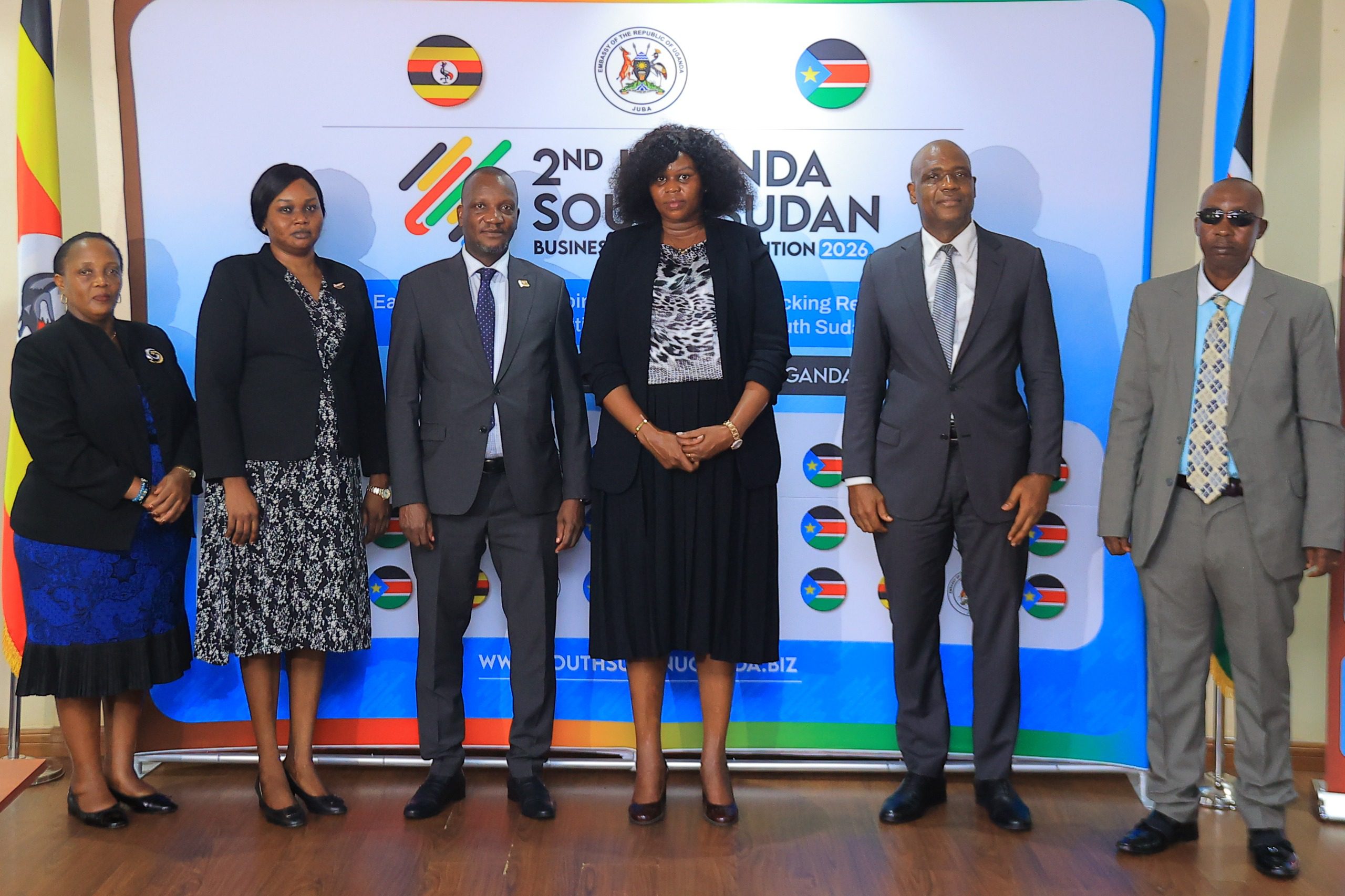
Government officials and diplomatic representatives from Uganda and South Sudan have announced plans cut cross border costs at the second Uganda-South Sudan Business Forum and Expo in Kampala.
The high-level event taking place from October 13 to 15 at the Mestil Hotel in Kampala, focuses on slashing trade barriers, driving economic resilience, and unlocking fresh commercial opportunities across the region.
Under the theme “Easing the cost of doing business and unlocking regional market opportunities,” the three-day forum will address critical infrastructure bottlenecks, simplify regulatory procedures, and promote foreign direct investment (FDI) within the framework of the East African Community (EAC).
Ambassador Charles Ssentongo, Chief of Protocol at Uganda’s Ministry of Foreign Affairs (representing the Permanent Secretary), emphasized the necessity of modernizing the trade relationship between the two neighbors.
“Our two countries have been trading with each other for a very long time,” said Amb. Ssentongo. “What has changed is the framework in terms of the East African Community and the sovereignty of the Republic of South Sudan. So what we are trying to do here is find ways of enhancing and promoting business between our two countries.”
Ambassador Ssentongo noted that annual bilateral trade has averaged between $700 million and $800 million in recent years, driven heavily by private sector resilience. Ugandan exports to South Sudan have seen a major upward trajectory, surging from $341 million in 2019 to $490 million in 2024, with current estimates placing trade volumes at approximately $600 million.
The partnership heavily positions South Sudan as one of Uganda’s most vital export hubs. Providing a breakdown of current trade operations, Anthony Kabugudho, the Political Attaché at the Ugandan Embassy in Juba, highlighted Uganda’s dominance in key sectors:
- Agriculture: Uganda stands as South Sudan’s largest food supplier. Approximately 58 trucks loaded with agricultural products cross the Elegu border daily, supplying five major markets in Juba.
- Construction: The vast majority of building materials powering South Sudan’s ongoing infrastructure development are sourced directly from Uganda.
- Services (Education & Health): Uganda now commands the largest percentage of South Sudan’s private health and education sectors. This includes two to three Ugandan-founded universities and multiple medical training facilities, including a nursing school, operating in Juba.
Diplomats from both nations stressed that sustained economic growth requires immediate, synchronized policy updates from both governments to support private sector innovation.
The Chargé d’Affaires at the South Sudan Embassy in Kampala, Akuol Abujok Deng, stated that the heavy daily volume of cross-border traffic demonstrates what is possible when neighboring countries embrace partnership.
“Our two governments must keep performing in the interest of our two sisterly countries, with high consideration for easy access to markets, simple procedures, transparent regulations, and efficient cross-border systems,” Deng said. “Addressing them is not only an economic task; it is how we build resilience, create jobs, and strengthen our regional integration.”
The upcoming forum will serve as a primary platform for policymakers, corporate leaders, and entrepreneurs to network, negotiate partnerships, and draft actionable solutions to eliminate trade impediments.


