
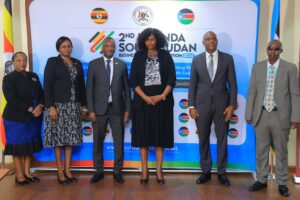






The Ministry of Foreign Affairs has officially launched the second Uganda-South Sudan Business Forum and Exhibition, aimed at eliminating regulatory bottlenecks and reducing the cost of cross-border commerce. The bilateral summit is scheduled to take place on Wednesday, 14 October 2026, at the Mestil Hotel in Kampala under the theme: “Easing the Cost of Doing Business and Unlocking Regional Market Opportunities for Uganda and South Sudan.”
Bilateral trade between the two neighboring nations has sustained an annual average of $700 million to $800 million, heavily driven by private sector small and medium enterprises (SMEs) rather than multinational corporations.
Speaking on behalf of the Permanent Secretary of the Ministry of Foreign Affairs, Amb. Charles Ssentongo emphasized that the upcoming forum will build upon the strategic commitments previously established by President Yoweri Museveni and President Salva Kiir.


“We need to find pathways to enhance business between our nations and unlock the much-needed opportunities to attract investment,” Amb. Ssentongo stated. “The conversation must also focus on the regional context beyond our individual countries.”
According to data from the Bank of Uganda, South Sudan has solidified its position as one of Uganda’s primary trading partners:Ugandan exports to South Sudan rose from $341 million in 2019 to $490 million in 2024.Monthly export revenue surged to $73.6 million in June 2026, up from $49.6 million in May 2026 and South Sudan first overtook Kenya as Uganda’s leading export destination in January 2025 and currently ranks second only to the Democratic Republic of Congo (DRC).
Uganda remains the primary supplier of food and infrastructure materials to South Sudan, operating five major food markets in Juba with an average of 58 supply trucks crossing the Elegu border post daily. Uganda also supplies all construction materials currently utilized in Juba, alongside a robust institutional presence in South Sudan’s health and education sectors. In return, Uganda imports approximately $21 million annually in scrap metals and dried fish.


The upcoming forum will bring together government officials, regulatory bodies, and private sector players to directly address persistent border delays, lengthy clearance processes, product-testing duplications, and infrastructure deficits. Key focus areas include the simplification of customs procedures and the optimization of one-stop border posts.
Furthermore, delegations will review major cross-border infrastructure initiatives designed to integrate the two economies: the $122M Power Interconnector: Backed by an African Development Fund loan, construction is underway for a 300km, high-voltage power transmission line from Uganda’s Olwiyo substation (supplied by the Karuma Hydropower Plant) to Gumbo on the outskirts of Juba. Uganda projects an export of 624GWh of surplus electricity during its first year of operation.
The High-level discussions will advance plans for critical cross-border road rehabilitation and the development of a railway line connecting Uganda to Juba.


Addressing recent concerns regarding an isolated statement by a South Sudanese caretaker county commissioner ordering Ugandan nationals to vacate, Akuol Abujok Deng, the Chargé d’Affaires at the South Sudan Embassy in Kampala, issued a firm reassignment of security and partnership.
“I can assure our Ugandan sisters and brothers who are in South Sudan: do not panic,” Deng stated, clarifying that the remarks did not reflect official government policy. “Our relationship as two countries is paramount, and we value it at the highest order.”
The forum will additionally explore inclusive trade opportunities for youth and women, trade corridor security, and the strategic implementation of the African Continental Free Trade Area (AfCFTA) framework.


