







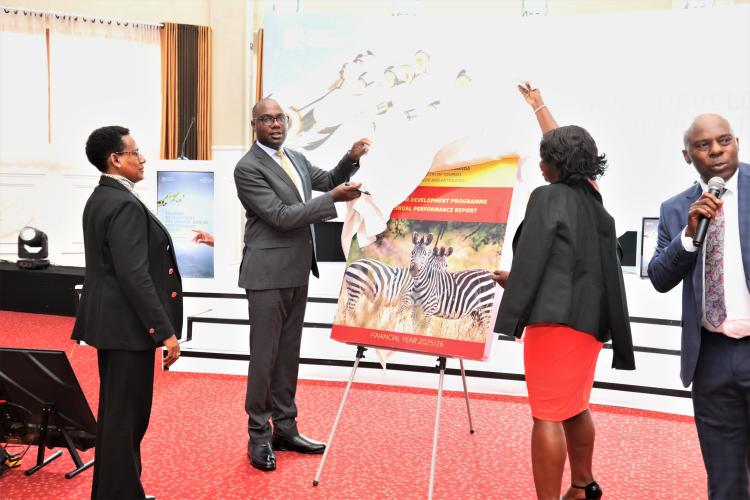
Uganda is targeting a massive $5 billion in annual tourism receipts by 2030. To hit this milestone, Finance Minister Henry Musasizi announced that the country will focus heavily on attracting high-value visitors and encouraging longer guest stays.
Speaking at the 4th Annual Tourism Development Programme Review Conference in Kampala, Musasizi emphasized that tourism remains a top priority for national economic growth.
Musasizi has called for deliberate action to unlock Uganda’s tourism potential and increase the sector’s contribution to the economy, saying Government is targeting $5 billion in annual tourism receipts by 2030.


Musasizi said achieving the target will require not only increasing visitor numbers but also longer stays and attracting high-value visitors, adding that tourism remains a high-priority sector.
The latest Tourism Development Programme Annual Performance Report for FY2025/26 shows Uganda received 1.64 million international tourists in 2025, up from 1.37 million in 2024. Tourism receipts increased by 21.3% to Shs5.83 trillion ($1.62 billion), driven by higher visitor spending and longer stays.
The average length of stay rose from 8.7 nights in 2024 to 8.8 nights in 2025, while average tourist expenditure per trip increased to $986, up from $933 in 2024.
“Tourism is a source of high economic growth, earns the country significant foreign exchange, creates jobs for Ugandans, redistributes income to rural areas, and gives us a compelling reason to protect our nature,” Musasizi stated.

According to the Tourism satellite account, the sector is a massive engine for livelihoods, directly generating 876,512 jobs—representing 7.5% of Uganda’s total employment.
To maintain this momentum, Musasizi called for aggressive public-private partnerships. The government aims to clear path for private investors by offering affordable financing, fiscal incentives, and using Economic and Commercial Diplomacy to market Uganda globally. Key focus areas for investment include:
Eco-tourism, cultural, and faith-based tourism,Hotels, conference facilities, and entertainment and Agro-tourism, sports, wellness, and adventure travel.
He called for stronger public-private partnerships to turn tourism opportunities into viable and bankable investments across hotels and conference facilities, eco-tourism, cultural and heritage tourism, faith-based tourism, agro-tourism, sports, wellness, adventure, creative and entertainment tourism.
The sector directly generates 876,512 jobs, equivalent to 7.5% of Uganda’s total employment, according to the Tourism Satellite Account.

State Minister for Tourism Susan Nakawuki highlighted that state-led marketing and infrastructure investments are already paying off.
Major milestones include the construction of over 280km of dedicated tourism roads, the expansion of Entebbe International Airport, the development of Kabalega International Airport, and the initial work on Kidepo International Airport.


Moving forward, Nakawuki urged stakeholders to continue pushing for deeper infrastructure funding, faster product diversification, and specialized skills training for hospitality workers to ensure Uganda remains a premier global destination.
“Tourism is a source of high economic growth, earns the country significant foreign exchange, creates jobs for Ugandans, redistributes income to rural areas, and gives us a compelling reason to protect our nature,” Nakawuki said.
She, however, called for more investment in tourism infrastructure, stronger marketing, faster product development and improved skills for sector workers.


