






The morning sun rises over the sugarcane fields of Kamuli, but inside a dim, mud-walled room, 14-year-old Naigaga struggles to lift herself from a woven papyrus mat. Her peers are walking to school, but Naigaga’s childhood ended months ago. At just thirteen, a victim of defilement, she became pregnant.
During labor, her underdeveloped pelvis fractured under the strain of an obstructed birth, leaving her with an obstetric fistula—a devastating condition causing chronic incontinence.Naigaga’s story is not an isolated tragedy; it is the lived reality of a two-decade public health crisis.
Across the Busoga sub-region, teenage pregnancy rates have stalled at an alarming 28% to 30%, trapping nearly one in every three adolescent girls in a cycle of physical trauma and extreme poverty. Behind these stubborn statistics are thousands of young girls whose futures are derailed by an interconnected web of poverty, broken family structures, and systemic vulnerability.


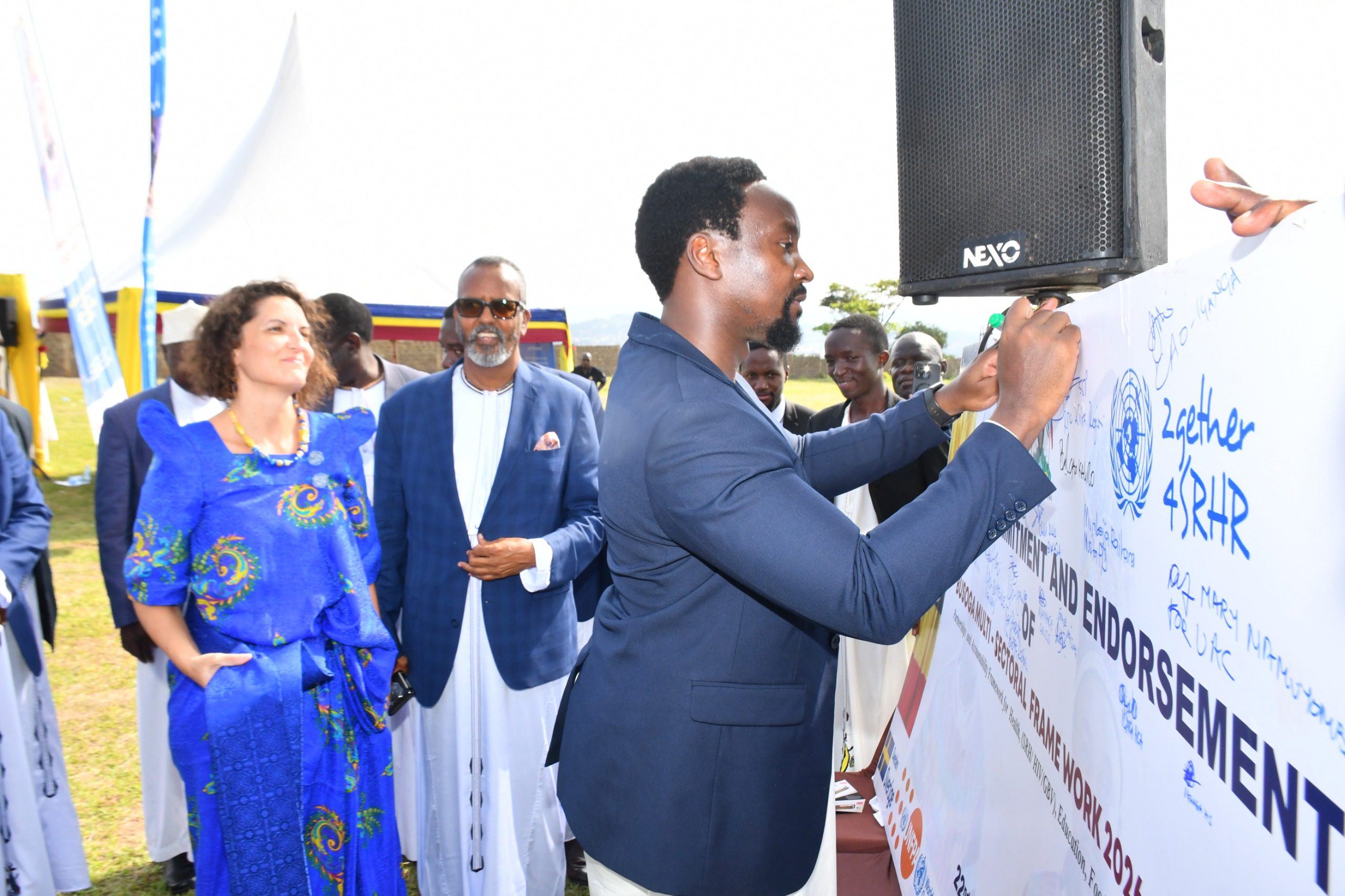
But at Igenge Palace in Jinja City, a historic counter-offensive has been launched. The Kyabazinga of Busoga, His Majesty William Gabula Nadiope IV, officially unveiled the Busoga Regional Multi-Sectoral Partnerships and Accountability Framework 2026–2030. Backed by an ambitious UGX 50 billion budget, this five-year development strategy serves as a unified battle assembly to dismantle the fragmented, isolated silos of past interventions and directly rescue the region’s daughters.
Speaking at the launch, Laura Lafuente Criado, representing the UNFPA Country Representative, delivered a sobering truth: historical, fragmented response programs have failed because they operated in isolation. For two decades, regional teenage pregnancy numbers have remained virtually frozen.
The scale of this new intervention matches the staggering depth of the problem. Built upon a comprehensive baseline survey conducted by the Kyabazinga Initiatives, the framework draws from the raw realities of over 200,000 children and 2,000 regional planners across all 11 districts, municipalities, and traditional chiefdoms.

What makes this five-year framework unique is its dual-engine approach, blending the moral weight of traditional cultural leadership with the unyielding hand of the law. The Kyabazinga, who serves as the UN National Goodwill Ambassador for engaging men to end teenage pregnancy, made it clear that cultural traditions must evolve into a shield for the vulnerable.
“We are facing challenges of poor parenting and deteriorating family and community responsibility,” His Majesty emphasized. “On behalf of Obwa Kyabazinga bwa Busoga, I want to assure you of our commitment to use our cultural approaches to support government and other stakeholders to mobilize our people and shift mindsets for better development outcomes.”
Historically, perpetrators of defilement in Busoga have evaded justice through illicit out-of-court settlements, where families accept minimal livestock or cash compensation to bury crimes. The 2026–2030 framework officially criminalizes this silence. Because cultural re-education alone cannot solve a crisis deeply tied to criminal exploitation, the Uganda Police Force has integrated completely into the strategic framework to guarantee immediate prosecution of offenders.
“We commit to provide a secure and safe environment for this initiative,” declared Charles Nsaba, Regional Police Commander (RPC) for the Kiira Region. “And to take action on our part in enforcement, I, on behalf of the Uganda Police Force in this region, commit, endorse, and adopt the Busoga Multi-Sectoral Framework 2026-2030.”
The framework has drawn immediate commitment from top national leaders. Hon. Rebecca Kadaga endorsed the initiative and pledged that the Busoga Consortium for Development (BCD) will monitor the framework directly to protect girls from abuse and high-risk relationships.
Concurrently, Hon. Rukia Nakadama vowed that the central government will aggressively back cultural structures to end the economic desperation that drives these vulnerabilities.
With four explicit UN commitments attached to scale up reproductive health care, gender-based violence (GBV) response systems, and educational retention, the framework is architected for longevity.
Furthermore, to prevent the financial mismanagement that frequently cripples large-scale humanitarian initiatives, the Kingdom will rely on continuous internal scrutiny to keep the focus strictly on resource delivery.
By targeting the financial decay of agricultural fraud, restoring parental accountability, and prosecuting those who exploit minors, Busoga is finally confronting its deepest social crisis out in the open. The UGX 50 billion framework is more than a financial investment; it is a coordinated, uncompromising rescue mission for the next generation of girls.


