

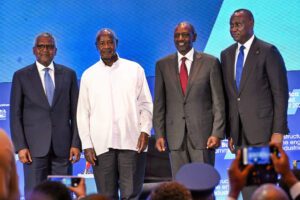





MOKOWE, LAMU— Africa is officially tired of being the world’s cheap supermarket. In a monumental move set to send shockwaves through global commodity markets, President Yoweri Museveni joined Kenyan counterpart William Ruto and Nigerian billionaire Aliko Dangote to break ground on a massive, $16 billion petroleum refinery in Lamu County.
The mega-project represents a aggressive structural shift away from raw material dependency, with leaders declaring that Africa will no longer bleed jobs and billions of dollars by exporting raw resources only to buy them back as finished goods.
Taking the stage at the groundbreaking ceremony for the Dangote East Africa Petroleum Refinery and Petrochemicals Special Economic Zone, a fired-up President Museveni exposed the brutal reality of resource exploitation. Using a stark coffee analogy, Museveni left no room for ambiguity about how much wealth the continent throws away annually.
“When we sell a bean of coffee, after the husking, removing the skin, you get $2 a kilo,” Museveni pointed out. “When it is roasted, ground, and packed, the one who did it gets $40!”
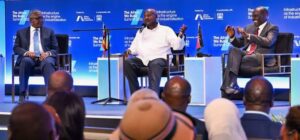

The President made it clear that the era of submissive trade deals is over. He revealed that early on, critics tried to discourage Uganda from developing domestic refining capacity by claiming it wasn’t “economically viable.” However, his consultations with major oil-producing nations proved the skeptics wrong, reinforcing his stance that East Africa must possess its own industrial muscle.
While welcoming the new 700,000-barrel-per-day Kenyan facility, Museveni issued a firm reality check regarding Uganda’s sovereign energy plans. He made it plain that Kenya’s mega-project will not alter Uganda’s domestic ambitions.
“We are going to build a small refinery in Uganda. We had planned this long ago. We can’t change that. The refinery will produce for Uganda and for the interior parts of Africa,” Museveni stated defiantly.
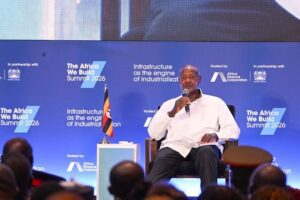

Rather than viewing multiple facilities as competition, Museveni called for a highly coordinated, multi-refinery regional network to unlock true regional dominance. He publicly questioned why a previously proposed refinery project in Tanga, Tanzania had stalled, promising to confront Tanzanian President Samia Suluhu Hassan and Ruto to demand answers.
“I want to discuss with Samia and His Excellency Ruto to find out what happened to that refinery in Tanga. What was the problem? The refinery here in Lamu can be there. The one in Tanga can be there. The one in Uganda will be there,” he asserted.


Billionaire Aliko Dangote offered East African states the opportunity to buy a 30% equity stake in the Lamu refinery. While Museveni acknowledged the economic benefit, he subtly pushed back, noting that passive ownership does not solve Africa’s youth unemployment crisis.
“Although the refinery is here, they will also get profit. But it does not answer the issue of jobs,” Museveni noted, doubling down on his ultimate vision of full political and economic integration across East Africa. He questioned why raw materials like Ugandan iron ore should be processed in Mombasa if local Ugandans face immigration and national barriers when trying to access those processing jobs.
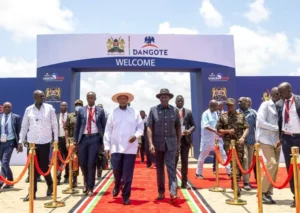

Kenyan President William Ruto lauded the project as a total game-changer for regional energy security, praising Museveni for being a visionary leader who is “well ahead of all of us” on East African integration. Ruto urged universities and technical institutions to immediately train an army of local welders, engineers, and managers to service the massive infrastructure.
Aliko Dangote, the mastermind behind the project, confirmed that the facility will sit along the LAPSSET Corridor and process crude from Kenya’s Lokichar fields alongside other regional sources. It will directly supply Kenya, Uganda, Tanzania, Ethiopia, South Sudan, and the DRC.
The $16 billion plant is just the tip of the spear; Dangote Industries has earmarked a staggering $50 billion for aggressive investments across African infrastructure, ports, power, and chemicals leading up to 2030. The Lamu refinery is scheduled to be commissioned in just 40 months, backed by a training school designed to equip 1,000 local residents immediately and sustain 60,000 jobs during its peak construction phase.


