







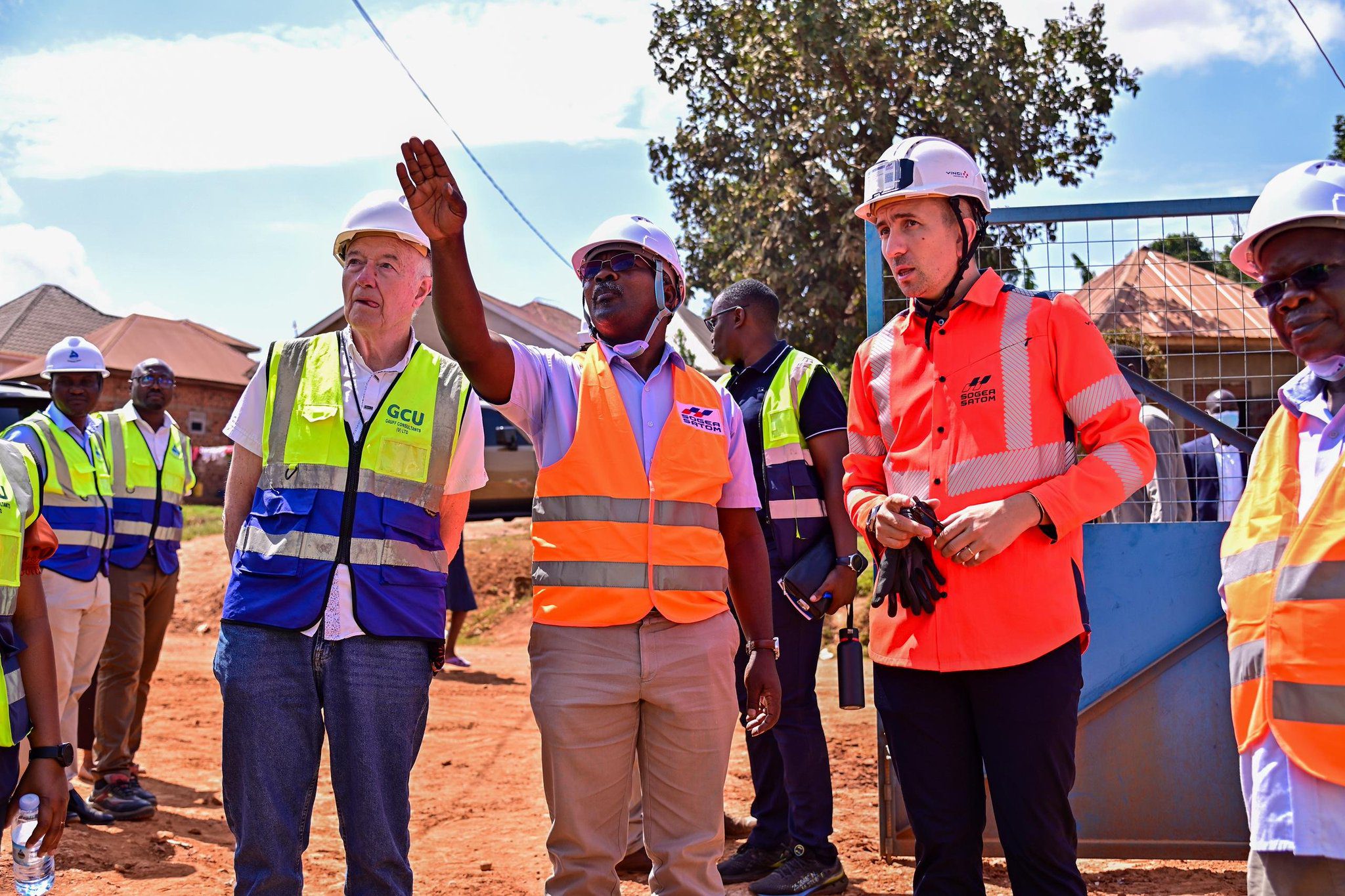
Dr Silver Mugisha Managing Director of National Water and Sewerage Corporation says its Package 2B network expansion, rehabilitation and network re-zoning project will end the recurrent water shortages across the Greater Kampala Metropolitan Area and keep pace with the region’s rapidly rising demand, as the utility works to deliver the full output of the Katosi drinking water treatment plant.
Dr Silver Mugisha said this during a tour of the Package 2B works, which include laying new transmission mains, construction of reservoirs, and booster stations across north and west Kampala.

Dr Mugisha said the project would resolve the immediate scarcity affecting fast-growing neighbourhoods while building enough network capacity to meet demand projected through 2040.
He said NWSC was deliberately shifting its focus from adding production to expanding distribution so that treated water already sitting in the system reaches households currently going without.
Touring the sites, Dr Mugisha pressed the contractor to fast-track pipe-laying and warned that the works must stay on schedule and on budget.
“The demand for water in the Greater Kampala Metropolitan Service Area is growing every day, and customers need answers,” he said. “The project must be completed within time and budget.”
He said the Government of Uganda, through NWSC, was implementing Package 2B to address water-supply challenges across the metropolitan area and to stabilise supply for a rapidly expanding population.
The corporation says the Katosi Water Treatment Plant, which added 160 million litres a day when it came online, is running at only about 52% of capacity because the distribution network cannot yet carry all of its treated water to consumers.
Mugisha said Package 2B was the missing link designed to close that gap and allow NWSC to draw on Katosi’s full potential. Dr Mugisha also directed NWSC engineers to begin work on an additional water-evacuation line from Katosi, which is designed to produce up to 240 million litres a day.
He said Package 2B would allow the utility to evacuate the plant’s full current output of 160 million litres a day, while the new line would let NWSC abstract still more water as the plant scales up. “We have a lot of water at Katosi, and plans are under way to evacuate more and serve Kampala,” he said.
Drawing more water from Katosi, he added, would relieve the supply stress currently carried by the older Ggaba water works. The contractor told the managing director that while the full project would be completed in 2027, it was pursuing sectional handovers — commissioning finished components as it goes so that residents get water sooner.
The Namugongo–Kasangati line is due to be commissioned by the end of this year. Dr Mugisha welcomed the phased commissioning approach, saying NWSC would switch on parts of the network as works progress rather than wait for full completion. He said he was pleased with the pace of pipe-laying in Nansana, Katooke, Kawempe and other areas, and noted that all sites had been well mobilised.
Dr Mugisha pledged to inspect the project quarterly and directed the contractor and supervising consultant to submit an acceleration plan and quarterly progress reports backed by tangible work on the ground. He urged the supervising consultant and the contractor to work in tandem to deliver a quality project.
Eng Paddy Twesigye, NWSC’s senior director for projects and capital development, reiterated the corporation’s commitment to improving water-supply reliability across all its areas of operation nationwide. NWSC deputy managing director for technical services Eng Johnson Amayo urged the contractor to carry out adequate pressure testing of the new pipeline to guard against leaks and bursts


