







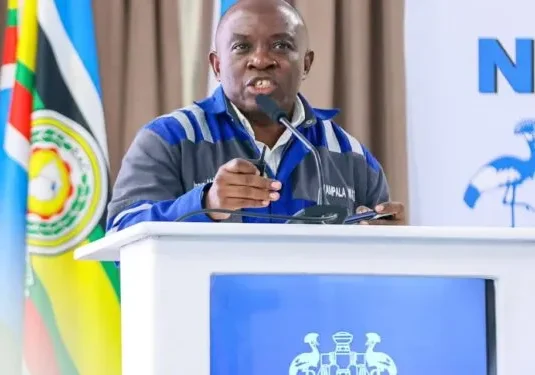
National Water and Sewerage Corporation (NWSC) is expanding infrastructure projects aimed at improving water and sanitation services in Kampala Kampala Water General Manager Eng. Mahmood Lutaaya has said.
According to him, the utility has invested in major projects over the past two decades to improve water production, transmission, storage capacity, metering systems and sanitation services.
Speaking during a stakeholder engagement, Eng. Lutaaya said the interventions are aimed at addressing challenges caused by the city’s expanding population and increasing economic activity.


“Over the years, we have continued to improve our water treatment and transmission infrastructure, increase reservoir capacity, expand prepaid metering and strengthen sanitation facilities to meet the needs of a growing city,” he said.
He further told the gathering that NWSC has introduced short-term measures such as mini water systems and boreholes in areas experiencing supply challenges.
Among the ongoing investments is Package 2B of the Greater Kampala Metropolitan Area Water Supply Network Project, which involves laying nearly 70 kilometres of pipelines, construction of reservoirs and installation of booster stations.
The project, which started last year, is expected to be completed in August 2027. However, Eng. Lutaaya said some sections will be completed earlier, including a section designed to convey water from Bombo towards Kassanda, which is expected to be commissioned by December.


He said most of the pipes required for the first phase of the project have already been delivered, with construction works progressing as planned.
Eng. Lutaaya, says the project will improve water reliability in areas currently experiencing supply pressure once completed.
“Some areas, especially within the Central Business District and other fast-growing suburbs, require upgrades because the existing smaller distribution pipes can no longer adequately support the rising demand,” he explained.
The utility is also planning interventions in southern Kampala and other areas that continue to experience intermittent water supply.


Eng. Lutaaya further revealed plans to expand production capacity at Katosi Water Treatment Plant, with the proposed expansion expected to add about 80,000 cubic metres of water per day to the existing supply capacity.
The additional production capacity is expected to support Kampala’s long-term water needs and cater for continued growth across the metropolitan area.
On sanitation, he said NWSC is implementing projects to improve sewerage infrastructure through upgrades of sewer networks and treatment facilities in different catchment areas.
Eng. Lutaaya said the combination of large-scale infrastructure projects, short-term interventions and system upgrades will help create a more reliable and sustainable water and sanitation network for Kampala.
He emphasised that continued investment in water infrastructure is critical to keeping pace with the city’s population growth and supporting economic development.


The National Water and Sewerage Corporation in May unveiled its Strategic Plan for 2025 to 2030, setting ambitious targets to expand access to safe water, improve service delivery and strengthen operational efficiency across the country.
The plan, anchored on the theme “Water for All for Health and Prosperity,” aligns with Uganda’s Vision 2040 and the Fourth National Development Plan, and comes on the back of steady growth recorded over the past five years.
Between 2020 and 2025, NWSC expanded its service coverage from 258 to 287 towns, while its customer base grew from 724,000 to over one million. The population served rose from 15 million to 20 million people, with annual turnover increasing from UGX 385 billion to UGX 649 billion. Customer satisfaction has remained stable at about 80 percent.
Building on this growth, the corporation now targets to increase the population served to 26 million people by 2030. The plan also includes expansion of pipeline networks by at least 500 kilometres and delivery of about 60,000 new connections annually.
NWSC is also seeking to reduce non-revenue water from about 34 percent to 28 percent, while growing annual turnover to UGX 768 billion.


To deliver on these targets, the corporation estimates an investment requirement of UGX 8.2 trillion. About 60 percent of this is expected to come from internal resources, 27 percent from development partners, 6 percent from government, and 4 percent through market-based financing.
Management says the strategy will focus on infrastructure expansion, environmental protection, digital transformation, improved customer experience and financial sustainability.
Even with the gains made so far, NWSC acknowledges mounting pressure from rapid urbanisation, population growth, climate change and ageing infrastructure.
Non-revenue water remains one of the key operational challenges. Technical assessments show that losses in parts of the system range between 10 and 15 percent, driven by illegal connections, leakages, metering inaccuracies and network inefficiencies.


The corporation also flagged challenges in water measurement, especially in systems affected by pressure variations, overhead storage and complex distribution layouts, which can affect billing accuracy.
To address these gaps, NWSC is rolling out targeted reforms, including infrastructure rehabilitation, improved monitoring systems, and pilot studies to enhance metering accuracy and better understand system performance.
Illegal connections and vandalism of infrastructure were also cited as persistent threats to service reliability. The corporation says it is strengthening enforcement and working more closely with security agencies and communities to protect water assets.
Several water supply stabilisation projects are already delivering results, improving reliability and extending services to previously underserved areas.
NWSC says it will also scale up digital management tools to support real-time decision-making and improve operational control across its network.
Management is now calling for stronger partnerships, innovation and sustained financing to deliver on the plan, stressing that expanding access to clean and safe water will require collective effort from government, development partners and the public.
The corporation maintains that the new strategy positions it to close existing service gaps while sustaining growth in access, efficiency and financial performance.


