







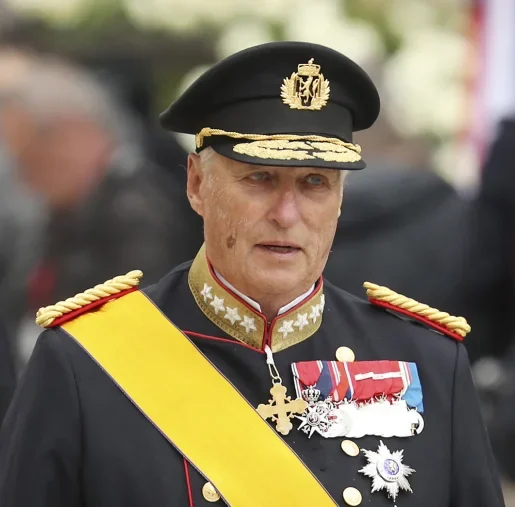
Norway’s King Harald V, who fled Adolf Hitler’s invasion with his family to take refuge in the United States White House as a boy, died Friday at a hospital in Oslo at 89.
Harald was Europe’s oldest monarch who modernized the royal house but refused to follow in the footsteps of other aging monarchs who have abdicated in recent times. His son automatically became King Haakon VIII.
Harald was crowned after his British-born father, King Olav V, died in January 1991, and reigned during an oil-and-gas-driven economic boom in his country.

“A whole nation is in mourning and the people of Norway are left with a deep sense of gratitude for a long life in the service of Norway,” Prime Minister Jonas Gahr Støre said in a statement. “For more than three decades as monarch, Harald V demonstrated an unwavering faith in the Norwegian people. He helped us to see the best in ourselves — and in one another.”
Harald was born in 1937 in Asker, near Oslo, becoming the first Norwegian prince to be born in the country since King Olav IV in 1370. In the following centuries, Norway didn’t have a king of its own until Harald’s grandfather, Haakon VII, was elected king following the 1905 dissolution of the union between Sweden and Norway.

Harald was 3 years old when the Nazis occupied Norway at the start of World War II. To avoid capture, his mother fled with him and his sisters, Ragnhild and Astrid, first to Sweden and then by boat to the U.S., while Harald’s father and grandfather went into exile in Britain with Norway’s government.
During their time in the U.S., the Norwegian royals were often guests at the White House. Harald was 6 when he carried out his first official duty, christening new warplanes at a Norwegian air base in Canada.
The family was reunited in Norway in June 1945, shortly after the end of the war in Europe. Harald attended public schools, the Norwegian military college and Oxford University.


Like his father — an Olympic champion sailor in 1928 — Harald loved the sea and sailboats. He represented Norway at several Olympics, and in 1987 he skippered his yacht to gold in the World Championships.
As a young man, Harald was urged to find a bride among Europe’s noblewomen and princesses. For nine years he shunned a series of prospects, holding out until he finally won his father’s permission to marry his longtime sweetheart, Sonja Haraldsen, the daughter of a successful businessman.
King Olav had feared the marriage would weaken Norway’s still-young monarchy. Instead, Norwegians greeted the Aug. 29, 1968, wedding with jubilation, and later embraced Sonja as their queen. The couple had two children, Haakon and his older sister, Märtha Louise.

The Norwegian Constitution was altered in 1990 to allow the first born, regardless of gender, to take precedence in the line of succession. However, it was not applied retroactively, meaning that Haakon continued to take precedence over his sister.
When Harald assumed the throne on Jan. 21, 1991, he adopted the same motto his father and grandfather had used: “All for Norway.” He spent the next years trying to modernize the monarchy.
“It has been my experience that the monarchy stands strong,” he once said. “This is not least because my father and grandfather did most things right. That puts me under pressure, but I take it as a challenge.”


