







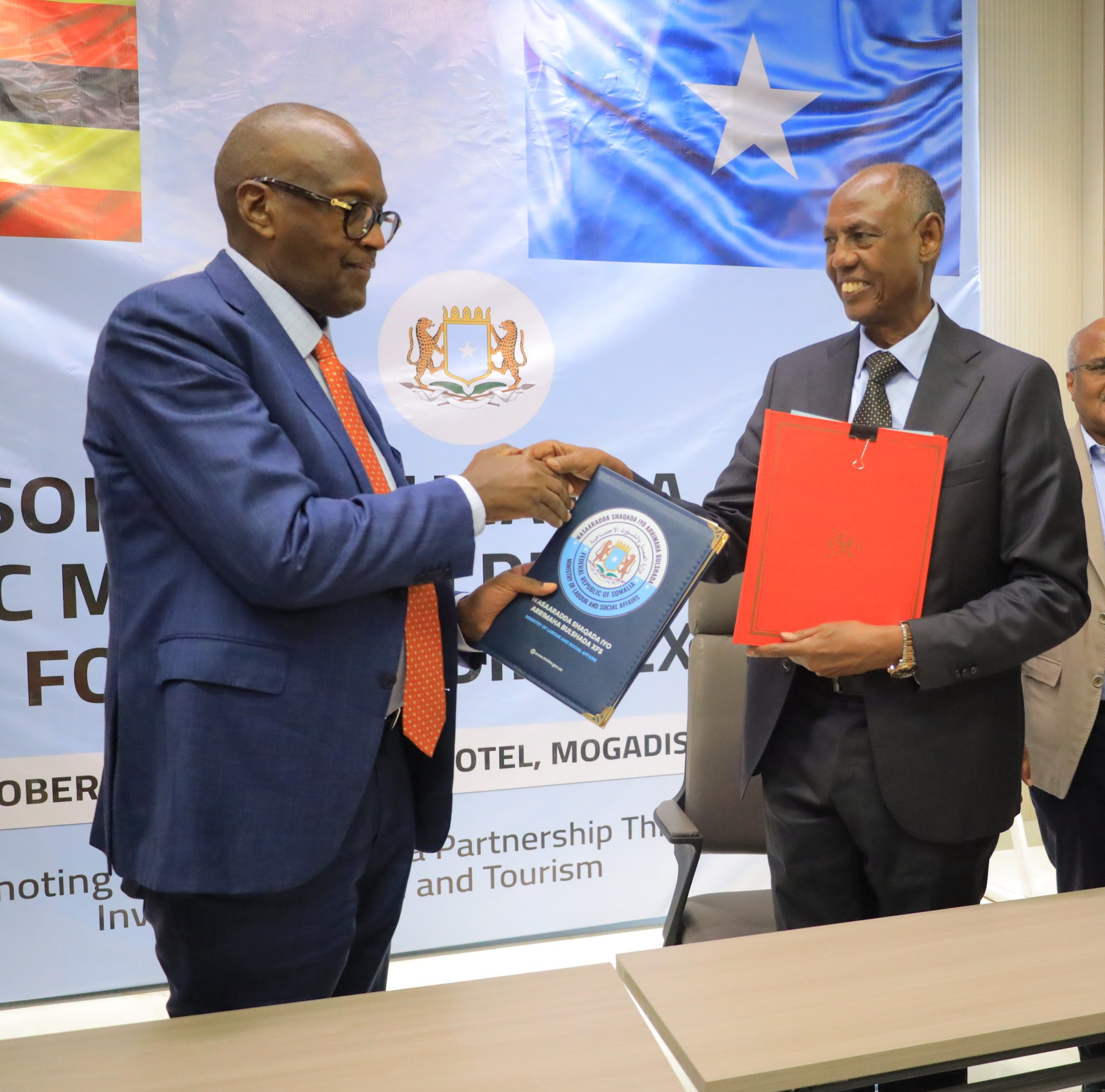
Uganda and Somalia have signed a bilateral labour agreement establishing formal legal protections for an estimated 20,000 Ugandan citizens employed in Somalia. Signed by Uganda’s Minister of Gender, Labour and Social Development, Gen. Henry Tumukunde, and Somalia’s Minister of Labour and Social Affairs, Prof. Salim Alio Ibro, the three-year accord aims to regulate employment and curb standard workplace abuses across the education, health, logistics, and private security sectors.
The deal concludes a mid-term review of the Uganda–Somalia Joint Permanent Commission (JPC), following Somalia’s entry into the East African Community (EAC) as its eighth member in March 2024. According to Uganda’s Ministry of Foreign Affairs, the pact addresses persistent operational challenges, including contract disputes, unpaid wages, work permit issues, and the unlawful confiscation of travel documents.
The agreement builds upon existing bilateral frameworks covering security, education, and immigration management signed during the JPC’s second session in Kampala in October 2025. Alongside the labour framework, delegates established definitive deadlines to expand private-sector investment, finance, and banking integrations.
Uganda remains a primary security partner for Somalia, having deployed the initial contingent of troops to Mogadishu under the African Union mission in 2007. Current timelines dictate a phased transition of the Ugandan People’s Defence Forces (UPDF) under the newly structured African Union Support and Stabilization Mission in Somalia (AUSSOM) ahead of the August 2027 complete withdrawal deadline
Despite the introduction of these legal benchmarks, regional analysts note that the operational efficacy of the treaty remains dependent on institutional enforcement capabilities that are currently strained.
Somalia’s domestic employment regulatory framework remains underdeveloped, with notable deficits in labour inspection capacity and limited consular services abroad. Concurrently, Uganda faces ongoing regulatory hurdles in monitoring external recruitment agencies and supervising compliance metrics for its migrant workforce overseas.
Furthermore, comprehensive public data tracking the exact volume of cross-border workers between the two nations remains unavailable, complicating independent assessments of whether the framework scales appropriately to meet current field demands. Bilateral committees are scheduled to review compliance progress annually, serving as the primary metric for whether the treaty achieves systemic enforcement or functions strictly as a diplomatic instrument.


