

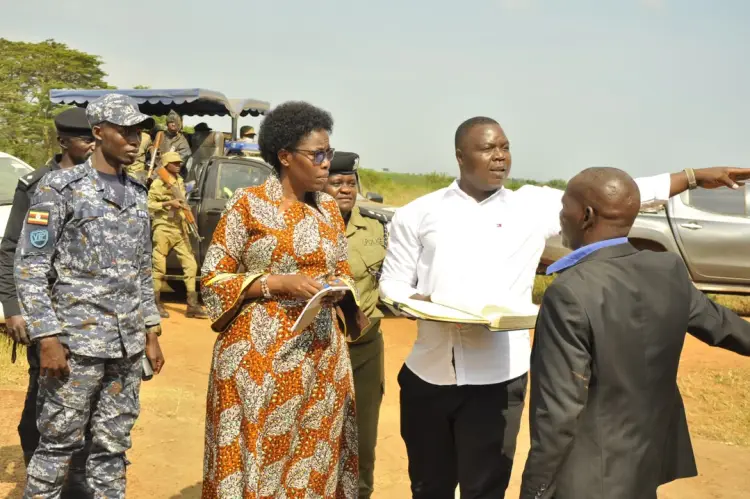
Lands,Housing and Urban Development minister, Judith Nabakooba has has stepped into a 40-year land dispute in Bugiri District, protecting over 900 families in six villages from eviction by an alleged landlord, David Ochieng. The dispute spans 3,000 hectares across Wakawaka, Namulesa, Igotero, Kiluna, Isinda, and Kinawampiti
Following a presidential directive, Nabakooba formed a joint verification team featuring the State House AntiCorruption and police to investigate boundary boundaries and historical land injustices. The ministry is using ground surveys and satellite mapping to determine true ownership and halt further threats to local homesteads
The minister’s intervention follows a presidential directive for the lands ministry to have this issue solved, following several complaints that flooded the President’s office over the same land.
The land in question measuring approximately 3000 hectares stretches on six villages including Wakawaka, Namulesa, Igotero, Kiluna, Isinda, and Kinawampiti in Bulidha Sub County.

According to Hamza Kinatama, the dispute started way back in the 1980s after Mr Ochieng acquired land in the area, started expanding boundaries by allegedly grabbing land from locals.
Kinatama explained that the land belonged to his late father Ezekiel Lukomera and it was intact not until 1980 when a man only identified as Luka, a squatter on this land then sold his Kibanja to Mr Ochieng.
“This was the genesis of the disputes. Mr Ochieng had land in Maziriga village but after Luka sold him his Kibanja at Kinawampiti, under unclear circumstances, he claimed ownership of all the villages,” he said, during the meeting held at Bugiri District headquarters on Thursday, where the minister went on ground to solve the impasse.
He claims Mr Ochieng used his influence of being a rich man to win court cases and in turn used court rulings to brutally evict locals from their land, demolished their houses and destroyed gardens in a two-time eviction saga in 1987 and 1996.
“During that time, Mr Bonifance Girimani was one of the few lucky survivors of the forceful evictions who provided shelter to many residents who were left stranded,” Mr Kinatama said.

After the eviction, Mr Ochieng, proprietor of Kirinya Sugar Estate remained in full control of the land until 2006 when he leased the land to New Forests Company that has since planted forests of eucalyptus and pine trees.
On behalf of their bedridden father Mr Ochieng who is reportedly hospitalized in Kampala, the director of Kirinya sugar estate Mr David Ochieng Junior, said they bought this land with the intent of establishing a sugar factory.
“Our chairman Mr David Ochieng, in 1978, acquired 3000 hectares of land from Hajj Salim Wandera and sons and other persons and it was later registered,” he said.
He added that in 1983, the late Lukomera sued Ochieng under civil suit 69 of 1983 at Bugiri, claiming for land which was measuring 500 by 1000 yards at Wakawaka village in Mankoma and lost the case.
He added that being dissatisfied with the decision of the court, he appealed under civil suit no.45 of 1984 at Jinja and also lost that appeal. Lukomera further appealed in 1987 and still lost.
“Even after losing the case, Lukomera continued settling people on the disputed land. The first court issued an eviction order in 1987 and 1996, giving possession to the defendant (Ochieng),” Mr Ochieng junior said.
“We have been having issues of encroachment each political season during election periods where people want to draw the attention of the President,” he said.

He cried out to the minister that this land issue has frustrated the investor- New Trees Company who invested over 50 million dollars on this land and is worried the forests may be set on fire by the angry locals.
Another victim of the said eviction saga, Mr Saad Nsango said his two homes were all demolished and he now lacks a permanent residence. He added that his children also dropped out of school.
“We request to be assisted to go back to the land. That was our ancestral land but now old as I look, I don’t have any home,” he said.
He said whatever is said by the family of Mr Ochieng are lies, arguing that even the local leaders at the time can testify.
Mr Abraham Tibiita, Bulidha Sub County chairperson, said it’s true Ochieng had land but it was only on 600 hectares. He said those who handled the court cases issued rulings without visiting the locals.
In her response, Nabakooba said she received a letter from the President on June 15 instructing her to intervene into the matter and rectify the problem and also to confirm if there was fraud.
The letter said the Uganda People’s Defence Forces (UPDF) lawyers from the Special Forces Command-SFC having deployed in Bugiri brought to the President the attention of possible injustice being inflicted on 900 people

The President also requested the Inspector General of Government to be involved in the matter to find out if it’s true all these injustices happened and find out where the responsible leaders were.
She said she would write to all relevant agencies who will form a committee that will go on the ground and establish facts about this disputed land.
The minister said they will use satellite to find out if this land had squatters as the locals claim and establish when the said eviction took place.
The committee involving officials from State House Anti-corruption unit, lands ministry, and directorate of criminal investigations among others will be expected to present a report to the minister after investigations.
Nabakooba asked all the district officials relevant to this matter to take part in the investigations and encouraged locals to work with the technical teams expected to commence on this duty soon.
“Our purpose here is a fact-finding mission to ascertain when all the recurring events happened,” she said, noting that they will need all the relevant documents about this land to support their investigations.
She additionally said the commissioner of survey and mapping will go to the ground to do fresh boundary opening.
“We want to establish the exact size of the land and delve into how it transitioned from the original owners up to the current said landlords.”
