




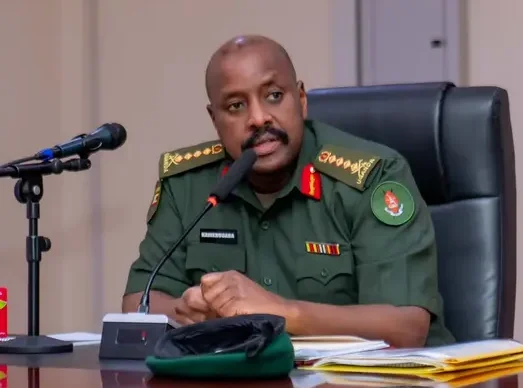
The Chief of Defence Forces (CDF) Gen Muhoozi Kainerugaba has declared that he will run for president in 2031, reviving his long-standing ambition to succeed his father, President Yoweri Museveni.
Gen Muhoozi, who is also the senior presidential advisor on Special Operations, announced his plans on Tuesday, August 25, 2026, in a brief post on X.
“I will stand for the highest office in the land in 2031. And we will win by the grace of Almighty God,” Gen Muhoozi said.


The declaration puts a date on an ambition that has shaped political debate around the army chief for several years.
PLU has resumed grassroots mobilisation, starting with a post-election baraza in Kyegegwa
Gen Kainerugaba had been widely expected to contest for president in the 2026 election. His supporters had built a nationwide mobilisation network around his potential candidature, first through the MK Movement and later the Patriotic League of Uganda (PLU).
However, he later ruled himself out of the 2026 race. He said God had instructed him to concentrate on the army and endorsed President Museveni for another term.


Gen Muhoozi’s latest announcement comes as PLU, which he chairs, returns to grassroots mobilisation following the 2026 general elections.
Last weekend, the organisation held its first post-election baraza at Humura Playground in Kyegegwa district. The meeting attracted PLU leaders and supporters from Tooro, Bunyoro, Greater Mubende and other areas.
PLU leaders described the gathering as the start of a fresh grassroots mobilisation campaign. The organisation has also been rebuilding its structures following leadership changes announced by Muhoozi in June.
His 2031 declaration is his clearest indication yet that his decision to stay out of the 2026 race was a postponement rather than an abandonment of his presidential ambitions.


Muhoozi was born and socialized within the inner architecture of state power itself. He understands its language, rituals, insecurities, and networks almost instinctively.
Muhoozi’s ascent within the military hierarchy cannot be reduced to proximity to power. Commissioned into the Uganda People’s Defence Forces (UPDF), his career reflects deliberate cultivation within both national and international frameworks. His training at the Royal Military Academy Sandhurst in the United Kingdom an institution synonymous with elite officer formation and further development at the Egyptian Military Academy positioned him within a global tradition of military professionalism. These experiences are not ornamental; they are foundational, shaping a command philosophy grounded in discipline, strategy, and adaptability.


His tenure as Commander of the Special Forces Command (SFC) place him at the nerve center of Uganda’s security architecture. The SFC is entrusted with the protection of critical national assets, including emerging oil infrastructure in the Albertine Graben, as well as presidential security. Under his stewardship, the unit maintained operational efficiency and strategic relevance in a region characterized by volatility.
Beyond command, his appointment as Senior Presidential Advisor on Special Operations further embedded him within Uganda’s strategic decision-making ecosystem. His promotion to full General in 2022 formalized a trajectory that had long been evident: he is not merely a participant in Uganda’s security architecture; he is one of its defining figure


